“So here is us, on the raggedy edge.”

74210_388516161231304_138690876_n

Via Firefly Fans on Facebook

Come a day there won’t be room for naughty men like us to slip about at all. This job goes south, there well may not be another. So here is us, on the raggedy edge. Don’t push me, and I won’t push you. Dong le ma? -Malcolm Reynolds, Serenity (2005)

The final episode of Firefly to air on network television aired ten years ago today. Although it was the eleventh episode Fox showed, “Serenity” was actually the two-hour pilot. Among the many flaws in Fox’s treatment of Firefly, it showed those eleven episodes completely out of order.

I remember watching that day, December 20, 2002. The episode had an odd feeling of completion, as if they were ending the story of Serenity’s crew by showing us the beginning. Not everyone’s beginning, of course, just Simon, River, and Shepherd Book. We got to see a bit of the origin of Serenity’s crew in the episode “Out of Gas.”

Reams of virtual paper have been dedicated to pondering Firefly‘s demise. I doubt I can add much of substance to the discussion that hasn’t been screamed into the abyss a thousand times before. Fox gave Joss Whedon and the brilliant cast and crew the opportunity to create fourteen episodes, plus a feature film, that stands out as one of the truly great iconic science fiction stories (I’m trying to avoid hyperbole, but this show is just plain fucking good, okay?)

If there is any sort of silver lining to Firefly’s short, yet brilliant, burst through our culture, it is this: unlike so many other great shows, it never had a chance to get bad.

Share

Cue the Invisible Hand of Capitalism!

1315987_3b3f47e7

What would Adam Smith do???

Downtown Austin has a parking problem. Anyone who has every tried to go there at any time other than 3:00 a.m. on a Wednesday knows that parking is a challenge. (Also, I am only assuming that parking is easier in the wee hours of mid-week, but I could be wrong.) To hear some city officials and business leaders describe it, though, you would think that we have too much parking downtown, thanks to antiquated government regulations. The city is prepared to respond, too:

Austin might soon ditch a three-decade-old policy of requiring downtown buildings and tenant businesses to have a minimum number of parking spaces tied either to square footage or the number of condos and apartments in a building.

Supporters of the move say the minimum requirement has caused a parking surplus downtown, encouraging people to use their cars rather than bikes, buses and rail. Take away that requirement, they say, and eventually garage parking will become a more scarce (and expensive) resource, encouraging people to use alternative transportation. [Emphasis added]

I must have missed this glut of downtown parking somehow. Admittedly, I do not spend as much of the evening hours downtown as I used to, say, ten years ago. In fact, I’m not certain of the last time I went downtown at night with the intention of doing anything other than improv or a movie.

The real question is about this “alternative transportation.” What “alternative transportation”??? Yes, we have buses, and yes, we have a nascent commuter rail system, but Austin is part of the grand western American tradition of drive-your-damn-self-everywhere.

Perhaps this is the Invisible Hand at work. If we remove the ability of consumers to park downtown, then the Invisible Hand will create a shiny, efficient transportation system to get people to and fro. I hope the mayor has an Adam Smith Signal, because we need to light that thing up!

Photo credit: © Copyright kim traynor and licensed for reuse under this Creative Commons Licence.

Share

Monday Morning Cute: Bonobo Sanctuary

This is perhaps better classified as “touching” or “heartwarming” rather than “cute,” but close enough. Lola ya Bonobo, “the world’s only sanctuary for orphaned bonobos” is located near Kinshasa, capital of the Democratic Republic of Congo.

800px-Lr_new_best_bonobo_pics20

This picture is described as “mwanda and lomela at Lola ya Bonobo sanctuary.” The caption on the sanctuary’s Wikipedia page says: “A new orphan called Lomela at Lola ya Bonobo is comforted by another bonobo.”

Photo credit: “Lr new best bonobo pics20” by Vanessawoods (Own work) [Public domain], via Wikimedia Commons.

Share

GIF of the [Insert Arbitrary Time Period]: Mini-Mini-Cooper

Seriously, y’all, I committed myself to too many “of the day/week/month”-type things already, so I’m just going to post stuff whenever I feel like it, and you’re going to like it.

This is a mini-Mini-Cooper.

ovH5X

Via guyism.com

You’re welcome.

Share

Monday Morning Cute: I sense much fear in you…….

His kittychlorian count must be off the scales!

(h/t Coco Puffin, in whom the Force is strong.)

Share

Instagram and Sturgeon’s Law

Fingerstache

“If you see the finger-mustache guy on the road, kill him!” -Zen Master Linji [citation needed]

To me, Tumblr, Pinterest, Instagram, and various other social media sites that mostly involve photos just look like a giant collage maintained by a crazy person with expensive tastes.

When I first discovered Tumblr, it appeared to be largely devoted to pictures of empty Starbucks cups framing a slightly out-of-focus Williamsburg, Brooklyn in the background. When I joined Pinterest, the boards automatically assigned to me, which the system seemed to think I would like, consisted mainly of pictures of tiaras. I am not kidding. Instagram was closed off to me for most of its still-short life, on account of my not having an iPhone. I remedied that last summer, but I wouldn’t say I entirely understand what Instagram is all about. Thankfully, the comical folks at College Humor have let me know that I am not alone:

Here’s the thing, though. Several wise friends have pointed out that hating on hipsters and hipster-y things has reached a point of becoming pretty hipster-y in and of itself. I’m not going to stop ripping on the most annoying of the hipster tropes, but I am going to try to be a bit more thoughtful about it.

Instagram and its ilk brings to mind Sturgeon’s Law: “Ninety percent of everything is crap.”

This applies to any and all forms and genres of media, be it visual arts, television, or cleverly-filtered smart phone pictures of half-eaten gnocchi from a deli on the Lower East Side. (Do they have delis on the Lower East Side? I haven’t been to Manhattan in eleven years, and even then I was not required to navigate.) (Also, do they serve gnocchi in delis?) (What exactly is gnocchi?)

Somewhere amid all the detritus (and by detritus, I mean “pictures of finger mustaches”) are a few bits of awesome. Yes, there is more detritus out there, in part because there are more people in the world, but mostly because more of the people have access to the internet, and the means to take and post pictures. Some people genuinely believe their pictures are meaningful, while others believe posting bad pictures is a good idea. I’m sure we have all fit in both categories at times. If you can get past the coffee foam and blurry sunsets, every so often something good will pop up.

And while you’re waiting to find it, you can join me in derisive laughter at finger mustache guy.

Photo credit: ‘Fingerstache’ by Vorhese [GFDL or CC BY-SA 3.0], via Wikipedia.

Share

Big, Mysterious Things in the Desert

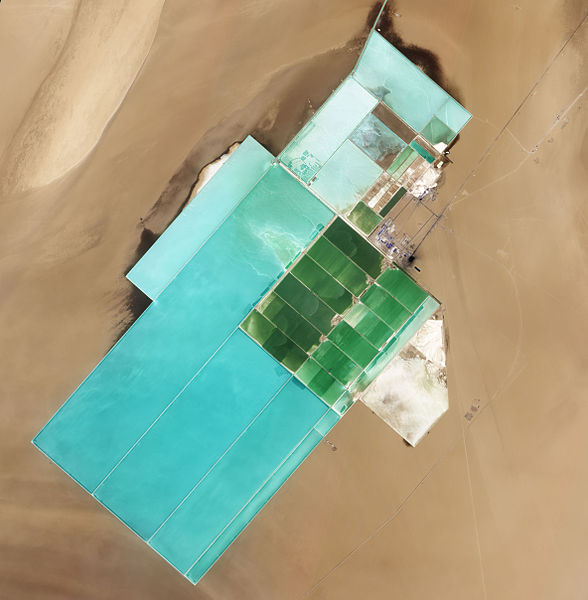
588px-Lop_Nur,_Xinjiang,_China

An ironman triathlon swim would not make it halfway across the *width* of this thing.

About a year ago, Gizmodo had an article entitled “Why Is China Building These Gigantic Structures In the Middle of the Desert?” I only noticed the article a few weeks ago, but it piqued my curiosity and provided a much-needed distraction from inarguably-more-important work. In addition to a variety of giant complexes of lines on the ground in the desert of western China (sort of like non-artistic Nazca lines, but not really), there is what appears to be a giant pool next to a complex of industrial buildings. By giant, I really do mean ginormous. This thing is probably 8 miles long by 5 miles wide.

The imaginative possibilities are nearly endless. The thing is located in the Lop Nur basin, a dried-up salt lake and nuclear test site in the Xinjiang Uygur Autonomous Region of western China. It doesn’t seem to be near much of anything, except for one road. Several straight lines, which appear to be canals, extend north out of the pools for miles. In the industrial complex, which is probably huge but seems tiny compared to the gigantic pools, are two large cooling towers, often seen in nuclear power plants.


View Larger Map
What could it be? I admit, I was kind of hoping for an underwater ghost city.

Somewhat disappointingly, the actual answer was not that hard to find. Even more disappointing was that I partly found it on Wikipedia.

Well, I found the publicly available answer, anyway. If the history of government subterfuge has taught us anything, it’s that the truth usually isn’t any more interesting than the cover story. I can’t say that this is a “cover story,” but let’s cling to what little intrigue we can.

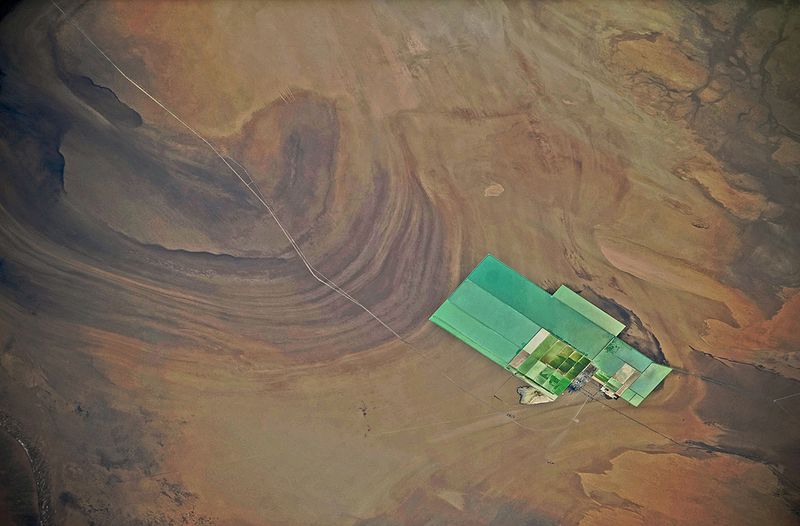
I’ll spare you any further dramatic tension: it’s a fertilizer plant. Yes, this giant complex of pools in the middle of a vast desert is there to exploit sylvite resources in the area to extract potassium chloride to make potash fertilizers. I had hoped that it was a training ground for human-fish hybrids, in preparation for colonization of the Pacific floor, but really, a fertilizer plant covering around forty square miles of desert is pretty impressive, too. NASA describes the site as follows:

Located in China’s resource-rich but moisture-poor Xinjiang autonomous region, Lop Nur is an uninviting location for any kind of agriculture. It sits at the eastern end of the Taklimakan Desert, where marching sand dunes can reach heights of 200 meters (650 feet), and dust storms rage across the landscape.

Yet for all it lacks in agricultural appeal, Lop Nur offers something valuable to farmers the world over: potash. This potassium salt provides a major nutrient required for plant growth, making it a key ingredient in fertilizer.

The discovery of potash at Lop Nur in the mid-1990s turned the area into a large-scale mining operation. The Advanced Land Imager (ALI) on NASA’s Earth Observing-1 (EO-1) satellite captured this natural-color image of Lop Nur on May 17, 2011. The rectangular shapes in this image show the bright colors characteristic of solar evaporation ponds. Around the evaporation ponds are the earth tones typical of sandy desert.
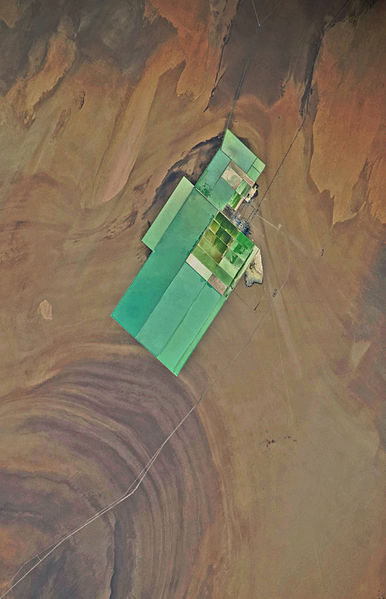
386px-Kaliumchlorid-Feld_in_der_Wüste_Lop_NorAn earlier picture of the site appears on the German-language Wikipedia page, with this somewhat-broken-English description:

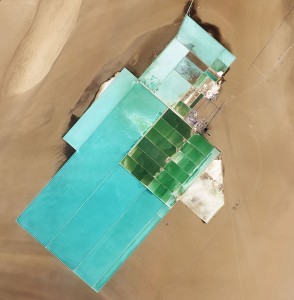
The world’s largest potash fertilizer production base in the size 10 to 21 km is built in the former Lake Lop Nur, Xinjiang, China. The first phase of the project which has an annual capacity of 1.2 million tons was put into operation on Dec.18, 2008. The second phase with an annual capacity of 1.7 million tons has been launched 2009 and will be operational in 2014. The 3 million program will make Lop Nor the largest potash fertilizer production base in the world. The Project of Development and Utilization of Sylvite Resources in Lop Nur region employs the technique of producing potassium sulphate through magnesium sulfate subtype brine, which filled a technological gas of this kind and made China among the fewer countries that could produce potassium sulphate from brine directly taken from salt lake. The satellite picture is taken 2009-10-12.
800px-Lop_Nur_and_the_potash_fertilizer_production_plant_2009

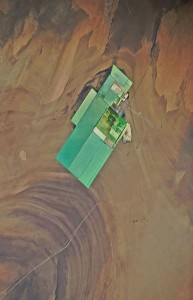
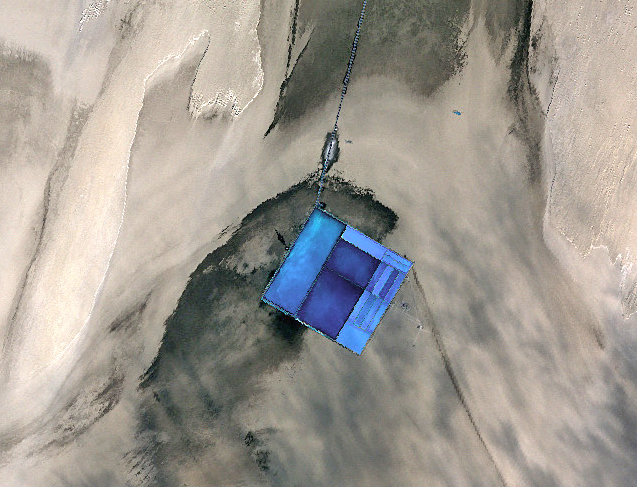
I guess it’s hard to keep big things secret anymore, although I’m still not sure if this was ever meant to be secret. I found another picture of what appears to be a separate site in the area, described as a “salt field”:
Salt_field_in_the_Lop_Nur_Desert

China, Xinjiang, desert Lop Nur. Satellite picture of the Lop Desert with the Basin of the formerly sea Lop Nur. You see the Salt field by the Lop Nur Sylvite Science and Technology Development Co. Ltd.

Based on some archived articles, China began the process of extracting sylvite from the region in 2001, expecting to find reserves of up to 250 million tons. The country made a “major breakthrough” in techniques to extract at use the mineral in 2004, and it began setting up the facility around the same time. The first phase of the facility became operational on December 18, 2008, with a capacity of producing 1.2 million tons of fertilizer per year. The second phase, which will produce 1.7 million tons annually, is supposed to go online this year.

On the other hand, it could be a prototype for China’s first ringworld, to test out ocean structures…

Photo credits: “Lop Nur, Xinjiang, China” by Jesse Allen and Robert Simmon (NASA Earth Observatory) [Public domain], via Wikimedia Commons; “Kaliumchlorid-Feld in der Wüste Lop Nor” by NASA. [Public domain], via Wikimedia Commons; “Lop Nur and the potash fertilizer production plant 2009” by NASA [Public domain], via Wikimedia Commons; “Salt field in the Lop Nur Desert” by NASA [Public domain], via Wikimedia Commons

Share