When a TV Show Gives Characters More Depth than the Original Books: Game of Thrones’ Margaery Tyrell and Jaime Lannister

I vowed last year that I would stop comparing the HBO series Game of Thrones to George R.R. Martin’s A Song of Ice and Fire series, in part because it becomes more and more difficult to hold a story told in the television format to the story found in a (so-far) five-volume, 3,000+ page series of novels. Also, the TV series deserves to be judged on its own merits, not just for its fealty to its source material. That said, the first few episodes gave depth to two characters that, to the best of my recollection, was missing in the books.

SPOILER ALERT: I’m going to talk about things that have happened so far on season 3 of Game of Thrones, some of which also happened in the book A Storm of Swords (book 3 in the ongoing series). This will, of course, draw on things in the first two seasons and first two books. I am still only halfway through book 5, A Dance With Dragons, so if something I say here contradicts something I haven’t read yet, shut up. I’ll finish the book, really.

-Margaery-Tyrell-margaery-tyrell-32848038-500-600

Via fanpop.com

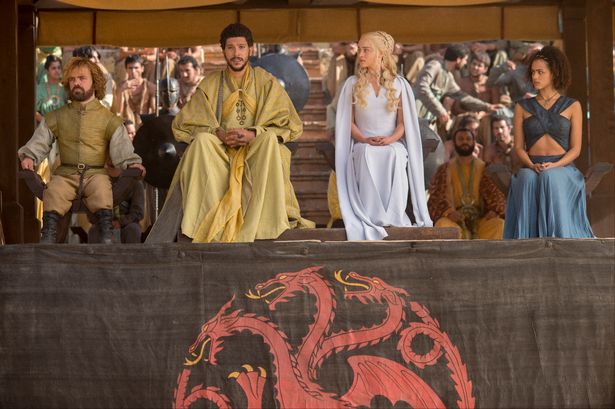
Margaery Tyrell: The books are told in third-person, but each chapter is from the point of view of a specific character. You therefore see certain events from a specific character’s perspective. The death of Ned Stark, for example, was seen through Arya Stark’s eyes in the book, and we learn about Sansa Stark’s experience later. At no point so far have we seen anything from the point of view of any of the Tyrells. Most of what we have seen of Margaery Tyrell is through the eyes of Sansa and Cersei. Cersei is obviously a less-than-reliable judge of Margaery’s character, but the fact that Cersei hates her is a mark in Margaery’s favor. It is therefore fascinating to see how the show develops her.

We know from an exchange with Littlefinger in season 2 that Margaery is ambitious (“You want to be a queen.” “No, I want to be the Queen.”) Now we get to see her schemes firsthand. Natalie Dormer plays the role with both hypnotic beauty and a very subtle cunning (which might be redundant.) She is genuinely kind to the orphan children, even if we know she has an agenda. That scene was a brilliant foil to Joffrey’s character, who refused to get out of his litter lest the common people try to hurt him. Joffrey expects the people to follow and obey him because they have to, because he is their king, end of story. Margaery knows that she must earn their trust and their love, and that this will bring their obedience. The books only show this through Cersei’s horrified eyes. Continue reading


Share

“So here is us, on the raggedy edge.”

74210_388516161231304_138690876_n

Via Firefly Fans on Facebook

Come a day there won’t be room for naughty men like us to slip about at all. This job goes south, there well may not be another. So here is us, on the raggedy edge. Don’t push me, and I won’t push you. Dong le ma? -Malcolm Reynolds, Serenity (2005)

The final episode of Firefly to air on network television aired ten years ago today. Although it was the eleventh episode Fox showed, “Serenity” was actually the two-hour pilot. Among the many flaws in Fox’s treatment of Firefly, it showed those eleven episodes completely out of order.

I remember watching that day, December 20, 2002. The episode had an odd feeling of completion, as if they were ending the story of Serenity’s crew by showing us the beginning. Not everyone’s beginning, of course, just Simon, River, and Shepherd Book. We got to see a bit of the origin of Serenity’s crew in the episode “Out of Gas.”

Reams of virtual paper have been dedicated to pondering Firefly‘s demise. I doubt I can add much of substance to the discussion that hasn’t been screamed into the abyss a thousand times before. Fox gave Joss Whedon and the brilliant cast and crew the opportunity to create fourteen episodes, plus a feature film, that stands out as one of the truly great iconic science fiction stories (I’m trying to avoid hyperbole, but this show is just plain fucking good, okay?)

If there is any sort of silver lining to Firefly’s short, yet brilliant, burst through our culture, it is this: unlike so many other great shows, it never had a chance to get bad.


Share

GIF of the [Insert Arbitrary Time Period]: Mini-Mini-Cooper

Seriously, y’all, I committed myself to too many “of the day/week/month”-type things already, so I’m just going to post stuff whenever I feel like it, and you’re going to like it.

This is a mini-Mini-Cooper.

ovH5X

Via guyism.com

You’re welcome.


Share

Monday Morning Cute: I sense much fear in you…….

His kittychlorian count must be off the scales!

(h/t Coco Puffin, in whom the Force is strong.)


Share

My Ultimate Geek Fail, Dead Milkmen Edition

You might find this surprising, but I’m kind of a geek.

I mean this on several levels. On certain issues of pop culture or history, I have a peculiarly encyclopedic knowledge, while finding myself cripplingly hamstrung in other arenas. I also have a tendency towards pompous certainty when it comes to my particular areas of knowledge, although I have tried to reign it in during the past few years. History will decide if I succeeded or not.

It therefore came as an embarrassing shock to me to learn, via Justin Griffith at FreeThought Blogs, that a beloved ’80s anthem contained a glaring error. Specifically, the Dead Milkmen’s “Punk Rock Girl” name-checked the wrong band:

We went to the Phillie Pizza Company
And ordered some hot tea
The waitress said “Well no
We only have it iced”
So we jumped up on the table
And shouted “anarchy”
And someone played a Beach Boys song
On the jukebox
It was “California Dreamin’”
So we started screamin’
“On such a winter’s day”

(Emphasis added)

See the problem? “California Dreamin’” is not a Beach Boys song. It was the Mamas and the Papas (although to be fair, the Beach Boys did record a cover in 1986. It just wasn’t nearly as good.) The Dead Milkmen released “Punk Rock Girl” in 1988, i.e. twenty-four years ago, and I never noticed the discrepancy until just now.

I have failed you, Gods of Geekdom. I offer myself in atonement.

BONUS FEATURE: I also want to acknowledge two of my favorite rhymes in all of songwriting history, courtesy of “Punk Rock Girl”:

She took me to her parents
For a Sunday meal
Her father took one look at me
And he began to squeal

And

We got into a car
Away we started rollin’
I said “How much you pay for this?”
She said “Nothing man, it’s stolen”

Honorable mention goes to “If you don’t got Mojo Nixon then your store could use some fixin.’”


Share

10-11-12

It occurred to me that this is the third-to-last sequential-numbers date we’ll have for nearly a century. Next year we’ll have 11-12-13, and after that 12-13-14 (assuming we don’t all vaporize on 12-21-12, of course.) That’s it until the next 1-2-03, though (assuming civilization survives Y2.1K, of course.)

Also, of course, there was that whole viral thing in Prometheus:

I had an elaborate blog post in mind after I saw Prometheus in the theater, but I never wrote it. I think I am still processing my feelings about the film. At least one of those feelings, I’ll admit, is disappointment. (It took me years to admit, even to myself, that Star Wars Episode I: The Phantom Menace was a lousy, lousy movie. Prometheus was better than Phantom Menace.)

Anyway, today’s date appeared in this image from the end credits of Prometheus, and it leads you to some other viral stuff that may or may not be significant to something. To be honest, I only intended to write a brief post pondering the ethereal nature of numbers, and how a date like 10-11-12 can take on imaginary meaning. When I started to type “10/11/12″ into Google, though, it auto-filled “10/11/12 at the end of prometheus,” and that sort of sucked me in.

Since I don’t really have anything else meaningful to say this morning, here are a couple of GIFs of Jessica Simpson at a car wash: Continue reading


Share

Fun SciFi Trivia: 2001 Originally Had Nukes in Space

MatchCutRemember the early scene in 2001: A Space Odyssey when the newly-smartened proto-hominid beats the leader of the competing pack to death with a bone, throws the bone up in the air, and the bone turns into a spaceship? Did you know that spaceship was originally supposed to be an orbiting nuclear weapons platform?

I just though that was an interesting bit of trivia. The film originally set up a continued nuclear stalemate between the U.S. and the Soviet Union, and the first spaceship we see was meant to be a missile launcher. At the end, when Dave Bowman appears above Earth as the Starchild, he was going to detonate all the nukes in orbit, which I guess was meant to bring Peace on Earth. Or a massive EMP returning Earth to the Stone Age. One of those, probably.

Anyway, Stanley Kubrick’s most recent film at the time was 1964′s Dr. Strangelove, so he was kind of over telling Cold War nuke stories. As Wikipedia says:

Another holdover of discarded plot ideas is with regard to the famous match-cut from prehistoric bone-weapon to orbiting satellite, followed sequentially by views of three more satellites. At first, Kubrick planned to have a narrator state explicitly that these were armed nuclear weapon platforms while speaking of a nuclear stalemate between the superpowers.[60]

This would have foreshadowed the now-discarded conclusion of the film showing the Star Child’s detonating all of them.[61] Piers Bizony, in his book 2001 Filming The Future, stated that after ordering designs for orbiting nuclear weapon platforms, Kubrick became convinced to avoid too many associations with Dr. Strangelove, and he decided not to make it so obvious that they were “war machines”.[62]

Alexander Walker, in a book he wrote with Kubrick’s assistance and authorization, described the bone as “transformed into a spacecraft of the year A.D. 2001 as it orbits in the blackness around Earth”, and he stated that Kubrick eliminated from his film the theme of a nuclear stalemate between the United States and the Soviet Union, each with a globe-orbiting nuclear weapons. Kubrick now thought this had “no place at all in the film’s thematic development”, with the bombs now becoming an “orbiting red herring”. Walker further noted that some filmgoers in 1968-69 would know that an agreement had been reached in 1967 between the powers not to put any nuclear weapons into outer space, and that if the film suggested otherwise, it would “merely have raised irrelevant questions to suggest this as a reality of the twenty-first century”.[63]

In the Canadian TV documentary 2001 and Beyond, Dr. Clarke stated that not only was the military purpose of the satellites “not spelled out in the film, there is no need for it to be”, repeating later in this documentary that “Stanley didn’t want to have anything to do with bombs after Dr. Strangelove”.[64] Continue reading


Share

A beloved ’80s cartoon turns out to be racist. Who knew?

Carbombya_Marker

Do you hear that? It’s the sound of the dead, desiccated husk of my childhood idealism blowing away on a warm desert wind…

Not too long ago, I tried to watch the pilot episode of the original Transformers cartoon on Netflix Instant. You know how some children’s cartoons actually operate on multiple levels, so that adults can find something entertaining in them, too? This was not one of those cartoons. This was an unrepentant 1980′s toy commercial stretched out over about 22 minutes without the actual commercials.

In an unrelated incident, my random wanderings through Wikipedia in the cause of avoiding anything productive or income-generating led me to some recaps of the old series, now known as Transformers: Generation 1 to distinguish it from all the subsequent canon-destroying cartoons and live-action sludge that followed. I stopped watching the Transformers cartoon after the second season in 1986, not coincidentally the same year I started junior high school. Therefore, I missed a rather, ahem, colorful character they added in season 3. I Googled this extensively because I refused to believe the description of a new human character, “the dictator Abdul Fakkadi of the desert nation of Carbombya.”

I dare say I need to repeat that for incredulity: “the dictator Abdul Fakkadi of the desert nation of Carbombya.”

TFWiki.net describes this fictional nation as follows:

The Socialist Democratic Federated Republic of Carbombya is a kingdom located in the Sahara Desert region of the continent of Africa on the planet Earth. It has a coastline, with foreign ships that venture too close to it often being fired upon. This intensely xenophobic state is ruled by Abdul Fakkadi, and apparently derives most of its wealth from particularly fine oil. The people are often heard swearing on the lives of their mother’s camels and so forth. This is of course hilarious offensively stereotypical.

Its city of Carbombya City, population 4,000 (and 10,000 camels), is presumably the capital.

(See also Transformers Wiki at wikia.com.)

It’s a kingdom with a socialist, federal republic system? With a dictator? Um, got it…..

The symbolism is pretty obvious. Clumsy, even. This was 1986, of course, when American esteem for Arab nations was certainly even lower than it is now. I can totally picture the writer who conceived of this character and country, who I am certain has never even seen a book on political science. I’m sure he laughed at his own cleverness as he spilled Cheeto dust onto his anti-Gaddafi t-shirt.

daffy

Yeah, something like this.

Photo credit: ’Carbombya Marker’ © 1986 Sunbow Productions, Marvel Productions, and Hasbro, via tfwiki.net; ’Khadaffy Duck’ by vintageretrowear, via defunkd.com. You had best believe I’m claiming fair use on this bullshit.


Share

We have quite a bit of post-apocalyptic or dystopian SF about the U.S., but what about everyone else?

1153288_52572910I came across this brief post as I was scrolling through Tumblr entitled “I still wonder what happened to the rest of the world in The Hunger Games”:

Do they still have meetings and stuff?
France: Anyone heard from America lately?
Mexico: Same old, same old. They’re still sending out children to fight to the death in a reality show.
UK: Shouldn’t we do something about that?
China: Just leave them, at least they’re not annoying us.

We have a rather extensive set of post-apocalyptic or dystopian speculative fiction set within the boundaries of the United States or North America, but not much looking at such an America from the outside. Speculative fiction, by offering a view of a possible future, is often the best vehicle for commenting on or criticizing today’s political, economic, or social realities. Think of how much social commentary the original Star Trek was able to accomplish by setting its stories in a quasi-utopian future humanity. I too wonder what a post-disaster U.S. would look like from a non-U.S. perspective, particularly one from the “developing world.”

In terms of post-apocalyptic or dystopian future Americas, aside from The Hunger Games, Cormac McCarthy’s The Road comes to mind, along with alternate history works like Harry Turtledove’s “Timeline-191″ series and about half the episodes of the TV show Sliders. Then there are TV shows like Jericho, which portrayed a modern-day nuclear attack, and Terra Nova, which was set 85 million years ago but centered around a dangerously polluted 22nd-century America. The new ABC show Last Resort, about which I will probably write more later, depicts a potentially dystopian contemporary or near-future United States. These all focus on America itself, though.

Robert Silverberg’s Time of the Great Freeze takes place during a future Ice Age, where ice sheets have covered much of North America. The protagonists leave their underground city in North America after picking up a radio signal from the London area, intending to cross the ice sheet over the Atlantic. The book mentions that, with much of Europe, North America, and East Asia covered in ice, the equatorial nations of South America, Africa, and Asia have become dominant world powers. It still doesn’t tell us anything about life in those places.

The Brits Seem to Have No Problem Blowing Us Up in Fiction

The best examples I can think of, that deal with the rest of the world, should the United States go all post-apocalyptic or dystopian, come from Great Britain or other English-speaking countries. The films V for Vendetta and Children of Men both came out around the same time in 2005 or 2006. Both are set in the relatively-near future: V for Vendatta mentions the year 2015 as the not-too-distant past, and Clive Owen’s character in Children of Men wears an extremely ratty London 2012 Olympics sweatshirt for much of the film. Both films reference events in “the former United States,” and both depict a UK turned to dictatorship in one form or another. Nevil Shute’s On the Beach, set in Australia, shows a U.S. devastated by nuclear war. Continue reading


Share