Our ungrateful rich

'Singapore Merlion BCT' by Bjørn Christian Tørrissen [CC-BY-SA-3.0 (www.creativecommons.org/licenses/by-sa/3.0) or GFDL (www.gnu.org/copyleft/fdl.html)], via Wikimedia CommonsAmerica has quite a few brilliant but lucky entrepreneurs who work within the American system to make a lot of money, then whine about having to pay to help sustain that system.

Eduardo Saverin came to the U.S. from Brazil because his parents didn’t want him to be kidnapped:

Saverin, who stands to make billions from his 4 percent share in Facebook, hastily moved here at the age of 13 when his name turned up on a list of potential kidnap victims targeted by criminal gangs in Brazil. His father was a wealthy businessman, with a high profile in their home country, and so his family relocated to Miami to protect the youngster. Eduardo thrived in his new country, eventually attending Harvard University, where he had a stroke of life-changing luck when he was assigned future Facebook CEO Mark Zuckerberg as a roommate.

After years of reaping the benefits of a society that does reasonably well at preventing kidnapping, he became a billionaire. Then he moved to Singapore. Then, standing to make billions on Facebook’s IPO, he renounced his U.S. citizenship. Continue reading


Share

This will blow your mind

I’m a big fan of optical illusions and such. This one is fascinating. Give it a second to load, or click the image to open a bigger version in a new window:

Optical illusion GIF

(Source)

Share

The worst conceivable reason to get a pet

PhotobucketThe Harry Potter series, as far as we know, is at its end, with the last book published in 2007 and the last film released in 2011. Also at an end, apparently, are the hopes and dreams of the owls that idiots across the UK adopted as pets, based on the popularity of the books and movies. Via The Guardian (h/t io9):

Hundreds of owls are being abandoned across the country after being bought as pets by Harry Potter fans.

Sanctuaries are full of the birds now the craze has faded after the release of the final Harry Potter film last year.

And it’s feared many more have been illegally released into the wild and will have starved to death or taken over territory inhabited by smaller wild owls.

There was a surge in demand for pet owls from fans who fell in love with Harry’s cute companion ­Hedwig.

But the birds, which can live for 20 years, take a lot of looking after – and many owners have become fed-up of repeatedly having to clean up garages and sheds of their ­droppings and feathers.

One rescue worker says she is now having to care for 100 owls at her sanctuary.

Harry Potter had a snowy owl named Hedwig, who went on adventures with him and sometimes delivered his mail. In reality, of course, owls spend much more time killing mice and pooping than adventuring, and they almost never deliver envelopes to the location you intend. Most Harry Potter fans are not going to have ready access to a twenty-foot aviary, a captive owl’s preferred digs, and the owls may not like living in a small flat. Continue reading

Share

Thoughts on Game of Thrones: “I hope it’s a very beautiful bridge”

This episode was really nothing but battle prep. The theme seemed to be “doing what must be done.”

Qhorin Halfhand, captive of the wildlings along with Jon Snow, told Jon explicitly that he must do what needs to be done. We don’t know exactly what that is yet (well, I think I do, but I’m not telling.)

Daenerys must go to the House of the Undying to save her dragons. This scene in the book was a twenty-page acid trip. I can’t wait.

Tyrion must mount a defense of King’s Landing, basically by himself. Everyone else is caught up in their own petty crap. Tyrion enjoys the “Game,” as does Tywin. Cersei and Jaime hate it. All three of Tywin’s children have relied on their family’s wealth all their lives, but Tyrion has had to develop the most skills in order to survive. Both Cersei and Jaime showed remarkable clumsiness–Jaime by haphazardly killing Stark men, and Cersei by threatening and hurting the wrong woman while trying to get at Tyrion. Tyrion’s only weakness is Shae. Continue reading

Share

“Survival is a team sport:” Remembering Ernest Callenbach

Just over a month ago, a sad event was overlooked amid the general nonsense distracting the country. Part of the tragedy is how petty most of today’s squabbles may seem compared to the vision of Ernest Callenbach, who passed away on April 16:

Ernest Callenbach, the author of the 1975 novel “Ecotopia,” the tale of an awakening paradise in the Pacific Northwest that developed a cult following as a harbinger of the environmental movement, died on April 16 at his home in Berkeley, Calif. He was 83.

I read Ecotopia in 1997, when I was around 23 years old and ridiculously idealistic. The book’s concept of a utopian society built around sustainability was irresistible to me.

Written in the throes of the Vietnam War, “Ecotopia” tells of a secessionist nation — carved from what was once Oregon, Washington and Northern California — that by 1999 has evolved toward a “stable state” of bioregionalism, in which each territory cultivates its distinct ecological character.

***

The novel is told through the accounts of a newspaper reporter who is sent to Ecotopia two decades after it seceded from an economically collapsing United States. Ecotopians realized just in time, the reporter writes, that “financial panic could be turned to advantage if the new nation could be organized to devote its real resources of energy, knowledge, skills and materials to the basic necessities of survival.”

The book describes a society in which recycling is a way of life, gas-powered cars are replaced by electric cars (although most people walk or commute on high-speed magnetic-levitation trains) and bicycles are placed in public spaces to be borrowed at will. In Ecotopia, solar energy is commonplace, organic food is locally grown and, instead of petrochemical fertilizers, processed sewage is used to cultivate crops.

Continue reading

Share

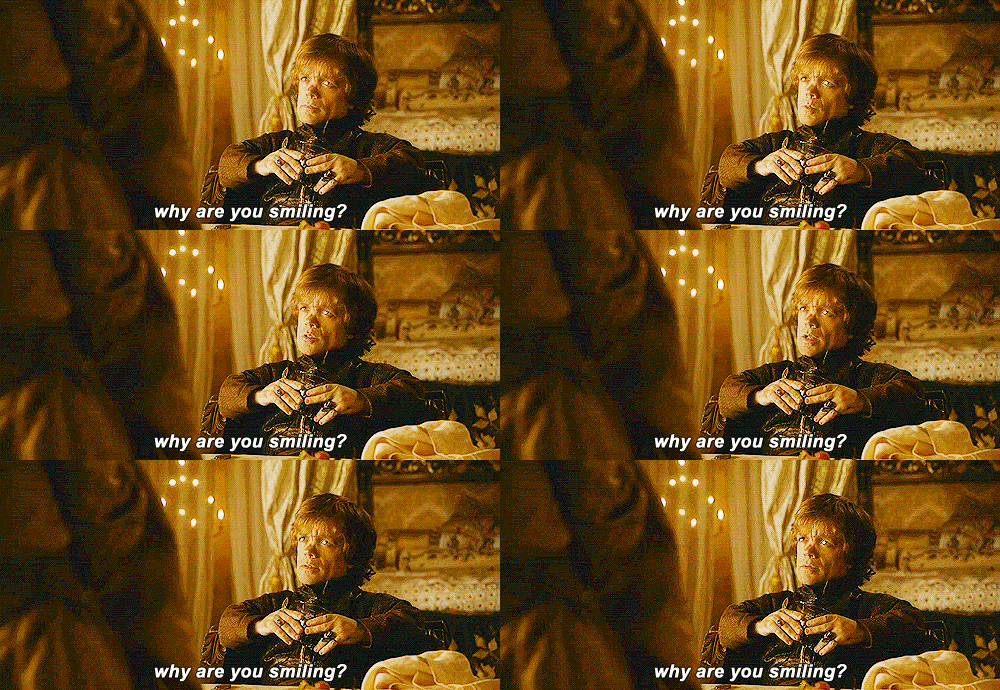
Thoughts on Game of Thrones: You Know Nothing, Jon Snow

NOTE: This is about the episode “A Man Without Honor,” which aired May 13. I’m just behind on my blogging.

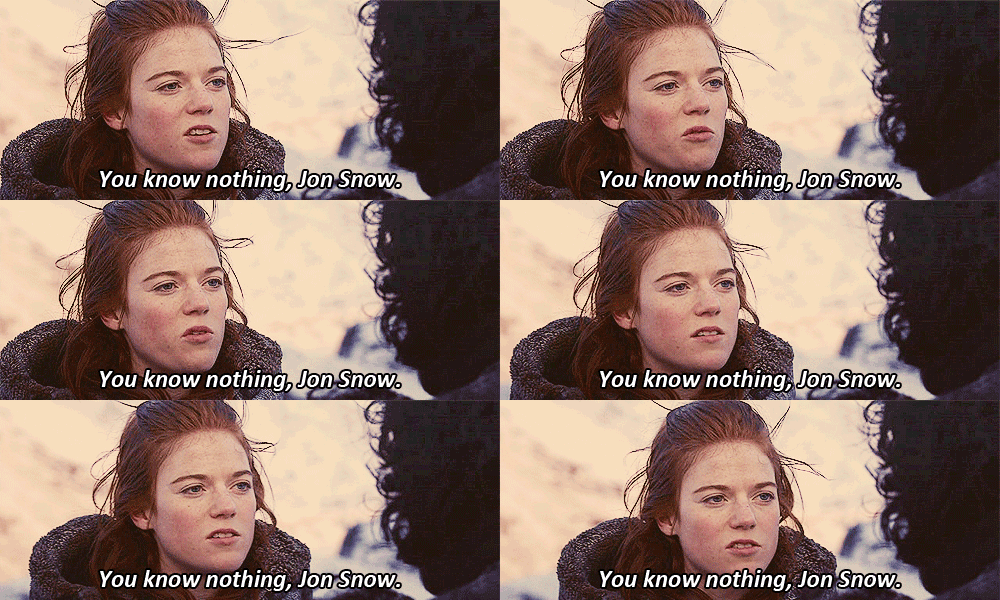
I’m happy because Ygritte said her catchphrase.

As for spoilers, yes, there probably will be some.

I took my own advice from last week and put the books as far out of my mind as posible during this week’s episode. As I was watching the episode, I realized that, for the first time since the shpw premiered last year, I felt real dramatic tension. Previously, I felt tension from knowing what was going to happen but not knowing exactly how the producers would show it, or how the actors would convey it. Now, all bets are off, and it is awesome.

In that vein, I’m going to look at last night’s events in light of how they relate to other aspects of the show.

Arya/Tywin –> Arya/Ned

I am fascinated by the quasi father-daughter relationship building between Arya Stark and Tywin Lannister. Tywin is, in his own way, showing her a remarkable amount of warmth and kindness. I suspect he is playing his own game, as he clearly knows she is not who she claims to be. Perhaps he is keeping his enemies closer, but then again he is allowing her access to quite a bit of intel. Arya, of course, has no means to do anything with this intel (that she knows of.) Tywin, I think it is fair to say, values strength above all else. His own children, Cersei, Jaime, and Tyrion, have their own kinds of strength. Tyrion is by far the most like his father, but neither of them would ever admit that. Arya is very much like Tyrion, a person born with traits that greatly disadvantage them in their world, but that also hide great reserves of strength and cunning. I wonder if Tywin Lannister sees in Arya the traits he does not want to see in Tyrion. Continue reading

Share

My nominee for tweet of the year

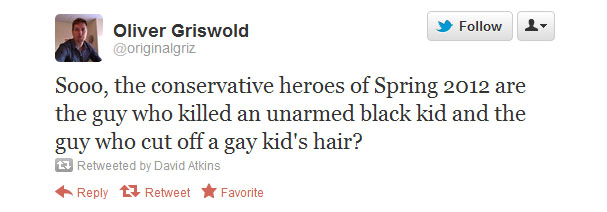
Via Oliver Griswold:

griswoldtweet

Sooo, the conservative heroes of Spring 2012 are the guy who killed an unarmed black kid and the guy who cut off a gay kid’s hair?

Share

Further evidence that bald is beautiful

Don’t watch this at work. I really don’t know what is going on in this video. She doesn’t look very happy, but it seems to all be part of the show:

If I’ve learned one thing in my own hair experience, it is that you have no way of knowing if you will look good bald until you actually lose the hair. She seems to pull it off pretty well. Here’s the description posted to YouTube:

Babi Panicat fica careca no Programa Pânico na Band Panico na TV RASPA raspando cabelo da panicat de babi ao vivo na BAND panico na band careca programa de 22/05/2012 22/04/12

And here’s the same text after getting the Yahoo! Babelfish treatment:

Babi Panicat is bald in the Program Panic in the Band Panic in the TV SCRAP scraping hair of panicat of babi to the living creature in the BAND panic in band bald program of 22/05/2012 22/04/12

I think the technology needs a bit of work. That, or the above text is not in Portuguese.

If you want to see more, or you speak Portuguese and want some broader context, YouTube has a longer video.

Share

Scary Childhood Memories: The Bunyip

I had managed to completely erase this bit of scarring from conscious memory until a Cracked writer had to go dig it up. The 1977 Australian children’s movie “Dot and the Kangaroo,” which I vaguely remember watching in what would have been the early 1980’s on cable TV (probably HBO), mostly consisted of singing cartoon animals like koalas and the eponymous kangaroo.

It also had a musical sequence, in a style unlike anything else in the movie, about the mythical bunyip. Try to watch this from the perspective of an 8 year-old:

Of course, growing up in the middle of a big city in Texas like I did, the bunyip didn’t exactly pose a great threat to me:

The bunyip, or kianpraty, is a large mythical creature from Aboriginal mythology, said to lurk in swamps, billabongs, creeks, riverbeds, and waterholes. The origin of the word bunyip has been traced to the Wemba-Wemba or Wergaia language of Aboriginal people of South-Eastern Australia. However, the bunyip appears to have formed part of traditional Aboriginal beliefs and stories throughout Australia, although its name varied according to tribal nomenclature. In his 2001 book, writer Robert Holden identified at least nine regional variations for the creature known as the bunyip across Aboriginal Australia. Various written accounts of bunyips were made by Europeans in the early and mid-19th century, as settlement spread across the country.

Dammit, though, that shit is terrifying to a kid.

Share