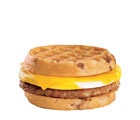
What could possibly go wrong here? I love waffles, eggs, and sausage, so why not put them all together? Presenting Jack in the Box’s Waffle Breakfast Sandwich!
The Expectation:
The Reality:
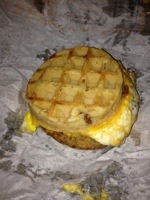



What could possibly go wrong here? I love waffles, eggs, and sausage, so why not put them all together? Presenting Jack in the Box’s Waffle Breakfast Sandwich!
The Expectation:
The Reality:
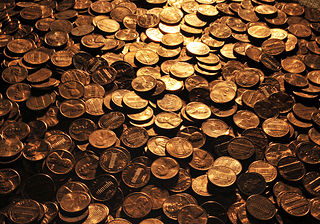 I award this week’s BAMF of the Day title to Thomas Daigle of Milford, Massachusetts. Out of a desire to make his final mortgage payment on his home, where he has lived for thirty-five years, “memorable,” he made his final $620 payment in pennies. Specifically, 62,000 pennies, weighing eight hundred pounds.
Daigle always wanted to make his last payment “memorable,” he told the Milford Daily News. He and his wife Sandra moved into their current home in 1977, and from then on, he began saving just a few pennies a day. After a few years, the coins’ original container — a grape crate — began to budge, so Daigle purchased two military rocket launcher ammo boxes to hold his bounty.
I feel like I should repeat that last clause, for the sake of history.
Daigle purchased two military rocket launcher ammo boxes to hold his bounty.
Thomas Daigle: serving up sarcasm in rocket launcher ammo boxes. Do not mess with this man.
Photo credit: ‘U.S. pennies’ by Roman Oleinik (Own work) [CC-BY-SA-3.0 or GFDL], via Wikimedia Commons.
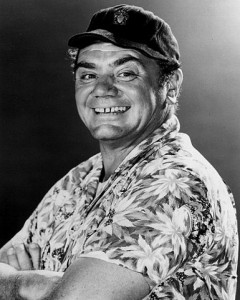 I am of course referring to Ernest Borgnine, who is hopefully not best-known for the role of Dominic Santini on the ’80s TV show Airwolf. He passed away Sunday at the age of 95.
As a kid, I knew his work in Airwolf, but I had no idea that he was an Oscar-winning actor who had appeared in more than a few classic ’50s and ’60s films: From Here to Eternity, The Dirty Dozen, and The Wild Bunch, to name a few. Oh, also Marty, which I still haven’t seen.
He was also the foolish (and doomed) Harry Booth in 1979’s The Black Hole, Disney’s attempt to capitalize on Star Wars. It’s not a good movie, except that it is. He played “Cabbie” in 1981’s Escape from New York, which in retrospect I probably should not have watched as a kid.
He apparently received an Emmy nomination at the age of 92 for a guest part on ER. The last role I saw him in was in a rather pretentious film called 11’09″1 September 11. As the name might indicate, the film is a series of vignettes about the September 11 terror attacks, each one by a different director from a different country, and each one exactly nine minutes, eleven seconds, and one frame in length. “Pretentious” might not be a strong enough word for the concept, but the execution was interesting, and Ernest Borgnine’s performance was great. He played an elderly widower, still in denial about his wife’s….you know what, just watch it:
Photo credit: ‘Ernest Borgnine McHale McHale’s Navy 1962’ by Milburn McCarty Public Relations. It was not uncommon for a network, program sponsor or studio to distribute publicity information through either an ad or publicity agency. (ebay itemphoto frontphoto back) [Public domain], via Wikimedia Commons.
If you want me to think that you are e-mailing me from the Federal Reserve Bank of America…

…use a better e-mail address than “Sparkylok6.” Seriously, folks.
Also, I’m pretty sure there is no entity specifically titled the “Federal Reserve Bank of America.”
 We know Obamacare is bad, according to many, because freedom is good. I think I’m representing the argument as accurately-yet-succinctly as possible. Many of Obamacare’s more strident opponents might object to my caps-lock-free use of the word “freedom,” preferring instead to use the sobriquet “FREEDOM.” I will use the lowercase version, but please understand that my refusal to express my stridency through capitalization does not necessarily reflect a lack of enthusiasm for my subject matter.
Now then, on to the point of today’s screed: libertarianism might be “back,” at least according to Pauline Arrillaga at the Associated Press, who writes that
Something’s going on in America this election year: a renaissance of an ideal as old as the nation itself – that live-and-let-live, get-out-of-my-business, individualism vs. paternalism dogma that is the hallmark of libertarianism.
It’s Saturday, so I’m not going to bother unpacking the various historical amd equitable inaccuracies in that statement. I’d be preaching to the choir, anyway. Where it gets interesting is where she starts talking to actual self-styled libertarians.
She interviewed Mark Skousen, an economist who founded FreedomFest, a conference starting this week in Las Vegas that talks about freedom, presumably with some liberty thrown in for good measure. I’m not saying that Skousen speaks for all libertarians, but he brings up some points that have long bothered me about the whole concept of libertarianism, or at least the way many people express it:
“It is a rebirth,” said Skousen, and a reaction to a feeling shared by many that America has moved too far afield from its founding principles. “This country was established for the very thing that we’re fighting right now: excessive government control of our lives. In today’s world everything is either prohibited or mandated. … You have to have medical insurance. You have to wear a seat belt. … They have to pat you down (at the airport).”
Skousen has a simple analogy for all of this: “If you restrict a teenager, they rebel. I think that’s what people are feeling.”
Perhaps he was speaking off the cuff, and had not had time to put together a better list of examples. Of course, he is also purporting to represent an ideology, so the examples of “excessive governmemt control” he cites are worth noting. Airport pat-downs are pretty obvious. I have yet to hear anyone who doesn’t actually work for the TSA defending the practice, but no one in Washington seems to have the guts to stand up to them. Complaining about that hardly sets this guy apart.
Seat belts: truly, our Founding Fathers fought, bled, and died, so that their descendants two centuries later could hurtle across paved roads in large steel carriages at speeds unknown anywhere else in the animal kingdom with no safety restraints. (This was covered in a song that unfortunately did not make the final selection cut for Schoolhouse Rock.) As an example of excessive government control, this makes Skousen look like a crybaby.
Medical insurance: this is the issue of the day, isn’t it? Never mind that most Americans want affordable health care and agree with the individual provisions of Obamacare. Never mind that we as a nation made a decision that health care should be a for-profit enterprise, meaning that drugs are developed and marketed for their ability to make money for shareholders more than for their ability to improve health. Never mind that ensuring people have basic access to health care is the right damn thing to do. The fact is that people both need and want health care, and they have to pay for it. The only people who would “suffer” under the mandate are the tiny percentage of people who can afford insurance but decide not to purchase it. Presumably because of FREEDOM. I am skeptical that someone who would refuse to buy health insurance under those circumstances, if faced with an illness or injury later on that required health care at a greater cost than they could not afford, would just go gently into that good night. Opposition to the mandate, once you get past all the “slippery slope” rhetoric and word salad about liberty, is really just about being a freeloader. And that brings me to my last observation.
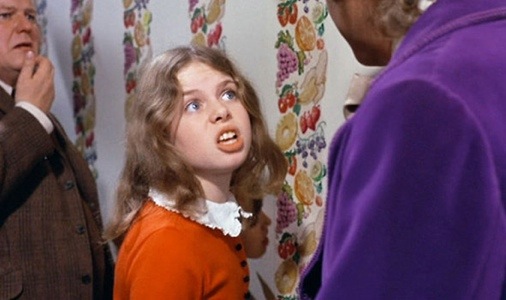
Skousen overtly compares libertarians to angry teenagers who don’t like rules. That is the perfect analogy, actually. He sounds like a sullen teen who is angry that his dad won’t let him borrow the car even though his mom needs the car right then to take his little sister to soccer practice. He wants the car right now, and screw the rest of the family. He’s probably not quite a bad as Veruca Salt from Willy Wonka and the Chocolate Factory, but he’s getting there.
In Skousen’s analogy, the teenager represents the libertarians, and the parents represent the government. There’s another word we can use to describe the parents, and it encompasses everything that libertarians like Skousen are not: grownups.
Photo credit: ‘Veruca Salt, from the film ‘Willy Wonka and the Chocolate Factory’ [Fair use], via Virginmedia.com.
This is what happens when you search for image files labeled “computer virus.”
Thousands could lose access to the Internet on July 9 due to a virus, DNSChanger, that once infected approximately 4 million computers across the world.
The Federal Bureau of Investigation first gave details about the virus last November, when it announced the arrest of the malware’s authors. The virus, as its name indicates, affected computers’ abilities to correctly access the Internet’s DNS system — essentially, the Internet’s phone book. The virus would redirect Internet users to fake DNS servers, often sending them to fake sites or places that promoted fake products. Once the FBI shut down the operation, it built a safety net of new servers to redirect traffic from those infected with the virus.
But that safety net is going offline next Monday meaning that anyone who is still infected with the virus will lose access to the Internet unless they remove it from their machine.
You can make sure your computer is okay in 2-3 relatively easy steps (I can’t say with 100% certainty that all of this is legit, but I’ve checked around quite a bit. Still, proceed at your own risk):
1. Get your IP address for your computer. If you don’t know it, use a site like WhatIsMyIP.com.
2. Check to see if your computer has the virus (specifically, check to see if your IP address is linked to one of the rogue DNS servers associated with the virus). You can do this through the FBI or through the DNS Changer Working Group (DCWG). If the test comes up negative, congrats, you’re done, go back to looking a lolcats or whatever it is you do during the day.
3. If you’re positive, the DCWG has tools you can use to clear the virus from your computer. My computer is clean, so I don’t know how this part works.
Good luck!
Photo credit: ‘Virus rezon’ By DROUET (Own work) [GFDL or CC-BY-SA-3.0-2.5-2.0-1.0], via Wikimedia Commons.
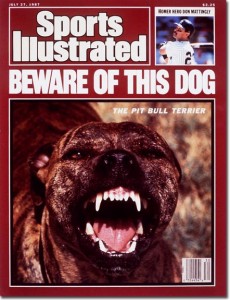
The caption for the cover just says “On the Cover: Don Mattingly, Baseball, New York Yankees; Photographed by: Jerry Wachter”
The 1987 article, written by E.M. Swift, gets it both right and wrong, in that it blames pit bull attacks on the human owners, but also blames the breed for being “aggressive:”
America has a four-legged problem called the American pit bull terrier. And the pit bull, its “ridiculously amiable disposition” notwithstanding, has a two-legged problem called Man, to whom Stratton’s second quote could also be applied. These two species are not new to each other. They have intermingled for some 200 years, and some say their common history goes back as far as the Romans. But something has happened to the pit bull in the last decade that says as much about the nature of American society as it does about the nature of this aggressive animal. Far from being an aberration, the American pit bull terrier has become a reflection of ourselves that no one cares very much to see.
“They’re athletes. They’re wrestlers. They’re dead game,” says Captain Arthur Haggerty, a dog breeder and trainer in New York City who owns five pit bull terriers and has trained hundreds of others. “They will literally fight till they’re dead. If you found that quality in a boxer or a football player, you’d say it was admirable. Will to win. That’s what a pit bull has.”
Others call it a “will to kill.”
The article goes on to cite discredited theories about “multiple bites” and “locked jaw.” It goes on quite at length. Pit bulls developed a reputation as dangerous dogs, so people who wanted a dangerous dog tended to select pit bulls. Continue reading
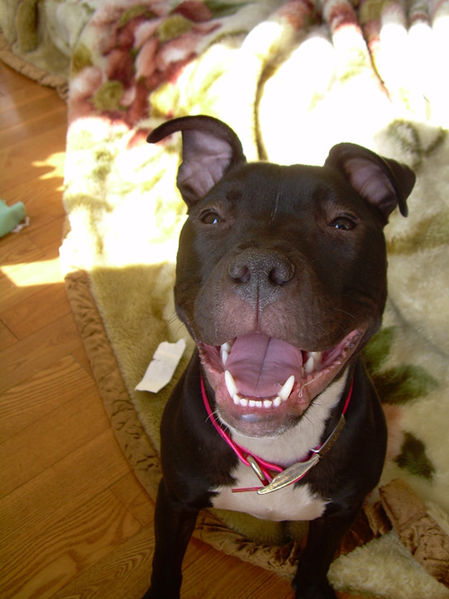
This little one had nothing to do with the reported incident. That’s just an awesome smile.
Aundrick Richard told KVUE News around 9:30 a.m. Wednesday, he, his wife, three daughters and pit bull, Cane, were walking at a nature trail off Arrow Point Drive in Cedar Park. He says it’s part of his family’s morning exercise.
Richard pointed to a grassy pathway and said a truck drove up close to the trail, off-road, toward his family. That’s when he says the driver of the truck let his two pit bull dogs out of the back of the pickup, and they came charging toward Richard’s children. Richard says his dog was on a leash but jumped in front of the baby stroller to fight off the dogs.
Richard says the dogs started fighting, the kids were screaming and his wife tried to kick the dog away.
“I’m telling the guy, ‘Hey come get ’em man, come get your dog. Your dog’s hurting my family man. Get your dog. Come get your dog. Please come here.’ The guy’s sitting there, he’s staring at me, and he goes, ‘Get ’em boy, get ,em. Get ’em boy, get ’em, antagonizing his dogs,'” said Aundrick Richard.
Richard says he grabbed a large tree branch and began hitting the man’s dog until it whimpered. Then he says the owner called the dogs back to the truck; they packed up and left.
“His dog screams. He says ‘Come on,’ clap, clap, calls them. They get in the truck. He burns out,” said Richard.
The full story is here (warning for somewhat graphic dog injury pictures).
Note that the only dog in this story that verifiably is a pit bull is the family’s dog, Cane, who by all accounts is a hero.
A friend posted this story to Facebook this morning, sparking one of the most thoughtful, least-combative combat threads in the history of my own Facebook use. Not all discussions of the incident have been so civil, apparently; one person said they were called a “one percenter” for defending pit bulls. Huh? Anyway, I’m re-posting my own comments from the thread here, for posterity or something. Please forgive the off-the-cuff writing style. Continue reading