Bill O’Reilly claims he’s been tasered and that that kid in Florida is a “wimp.” The search is apparently on for any footage of the tasering of Bill O’Reilly. I say why should we do all the work? If BillO could be tasered once, he could do it again. So bring a cop on your show and show us all how getting tasered is no big deal, Bill. I triple dog dare you…
Author Archives: wellsdc
That would depend on your definition of the word "round" – UPDATED
How many people are actually this dumb? Will there be anyone able to operate the utility grids a generation from now, or will we all be intelligently designed flat-earthers?
UPDATE – Enlightening commentary from Bad Astronomy Blog here and here. It’s even worth quoting:
Anyway, when Whoopi Goldberg (who is actually pretty smart) presses her on this, Ms. Shepherd demurs, saying that it’s more important for her to know how to care for her son. This is almost legitimate. Almost. But it misses. If this were a thousand years ago, and she were toiling in a cave someplace with no access to information and spending 20 hours a day trying to keep her family fed, then sure, some knowledge may simply be too esoteric to be useful and, worse, distract from the actual task of survival.
But that isn’t the case. Here we have an actress and singer who is living, if I read my calendar and atlas correctly, in the 21st Century in the United States. Has she never seen a picture of the Earth from space? As it happens, a vast majority of people in the U.S. can hold a job, care for their family, and also know that the Earth is, y’know, round. Some people (though sadly, not enough) also know it takes the Earth a year to go around the Sun, that gravity makes things fall, and that DNA is a big molecule in which genetic information is coded. None of this is needed to feed your family (unless you are a science writer), yet humans are in general capable of handling a vast amount of information not directly pertaining to immediate survival.
Then Amy got the bruise that wouldn’t go away
I suppose the Dickwad-in-Chief would tell the family in this AARP-produced video that they don’t need health insurance because they could just take their daughter to the ER for leukemia treatment. Bush should be forced to watch this video non-stop for as long as possible–it’s an incredibly important message, and it’s irritatingly cheesy.
Seriously, what the hell is wrong with us?
Vegetarianism wasn’t like this for me
I am not one to naysay the efforts of environmentalists. It probably is the case that the meat industry is doing more environmental damage than we realize. But I was a vegetarian for nearly eight years, from December 1996 until October 2004 (although I reintroduced fish into the diet starting in 2000). Eight years, which is exactly one-fourth of my total life (I’m 32), and it never looked anything like this (h/t to Salon):
Alicia Silverstone’s Sexy Veggie PSA
Order a FREE vegetarian starter kit at GoVeg.com
As I recall it (and I mean no disrespect), most vegetarians don’t look much like Ms. Silverstone (who has come a long way since Miss Match, it would seem). A somewhat more accurate (and decidedly NSFW) depiction of naked vegetarians can be found here (vegetarian porn–ah, the things you find with a simple Google search. Seriously, though, NSFW. I don’t want to be responsible for anyone getting fired).
Anyway, important environmental message vs. wet, naked Cher Horowitz–where would you expect my attention to be?
Here’s something from the glory days:
Today’s soundtrack of shred
Thanks to Litbrit for posting this clip of Joe Satriani’s recent performance of Surfing with the Alien. I will be whistling high-quality hair metal all day now, dangit. (Note, however, that he’s adopted the bald look.)
After all this time, the man still rocks, I must say.
Mans sues God
Specifically, a Nebraska state senator is suing God (h/t Volokh Consp.)
That’s not nearly as funny as the time someone sued Satan. It was dismissed in part for failure to plead personal jurisdiction or to include instructions for service of process.
The unsung hero of the Larry Craig case
I know Larry Craig is probably old news by now, and I’ve certainly beat the dead horse off…uh…too many puns… Anyway, I hadn’t given the matter any further thought, even despite my recent trip through several airports. Today, however, Barbara Ehrenreich raised a point that had not yet occurred to me:
Short of some undisclosed evidence that the 9/11 killers were closeted Wahabist gays, you may wonder, as I do, why – with the “threat level” at an ominous orange – agents of the law are being deployed to detect people of alternative sexualities. Larry Craig was apprehended by a man apparently consigned to spend his entire day on the can, watching for errant fingers. Possibly this fellow has some intestinal issues which made this a necessary posting. But, sphincter control permitting, could he not have been more usefully employed, say, interviewing passengers as to their willingness to blow themselves up to score some theological point?
How long, exactly, did this vice cop spend on that particular can, just waiting for somebody to tap their feet and do something with their fingers? How many superiors did this cop have to piss off to get this duty? And what happens if, say, he spends an entire eight-hour shift sitting in a stall…waiting…waiting…and no one taps their feet or does anything to invite attention–what kind of impact will that have on that officer’s self-esteem? I mean, eight hours and nobody wanted to give him a bathroom hummer??? That has to be hurtful on some level, be it professional or personal.
There actually is a more serious point to make here. The “threat level” does seem to still be hovering around orange, meaning that we should all be generically afraid and thank Bush for the safety we have–but given that “high” risk, can we afford to lose even a single law enforcement officer to “stall duty”? Unless, of course, the next terrorist plot is to unleash a mass public fellating in men’s rooms everywhere.
There is no country to hold together, really
Out of the ashes of World War I, the victorious Allies threw together an entirely new country, composed of disparate ethnic and national groups, perhaps somewhat linked by language or religion, but lacking any long-standing historical ties to one another. This “country,” as it were, had never existed before, nor had these people been expected to live together under a single flag. A strongman dictator held it all together, often through violence and repression and often through sheer force of personality. Eventually, however, the strongman fell, and all the pieces came apart in an explosion of violence that claimed hundreds of thousands of lives while the world looked on.
I’m talking, of course, about the Kingdom of Serbs, Croats, and Slovenes, which later came to be known simply as Yugoslavia. The “country” was cobbled together out of pieces of defeated Austria-Hungary and added to Serbia and Montenegro. The strongman I refer to is Josip Broz Tito, who led a partisan rebellion against the Nazis during World War II and then unified the “country” under a communist regime. The only thing “Yugoslavs” had in common was that they all belonged to “Slavic” ethnic groups and occupied a southern area of Europe (“yug” is a common Slavic root meaning “south”).
Tito was Yugoslavia’s president from 1953 until his death in 1980. He probably was the only force holding the country together, but his belief in a unified Yugoslavia seemed unflappable. Among his famous quotes is the following: “None of our republics would be anything if we weren’t all together; but we have to create our own history – history of United Yugoslavia, also in the future.”
It would be another 11 years before everything really hit the fan, but a lot happened in preparation for the breakdown. In my humble opinion, blame lies almost exclusively with Slobodan Milošević, who exploited Serb nationalism in his rise to power. Beginning in 1987, when he first played on the fears of the Serb minority in Kosovo, he set the stage for much of the chaos that followed.
The rest of the story is pretty well-known. Beginning in 1991, the pieces began to break off: within a year, Slovenia, Croatia, Macedonia, and Bosnia and Herzgovina declared independence. Serbia and Montenegro stuck together for a while, keeping the name Yugoslavia until 2003, and then finally separating in 2006. The process was painful and nasty, to say the least, and it added new phrases to the global lexicon like “ethnic cleansing.” In the end, the world sees that “Yugoslavia” was an artificial construct of Serbs, Croatians, Bosnians, Macedonians, Albanians (in Kosovo and Macedonia), Montenegrins, Slovenians, and Hungarians (in Vojvodina, northern Serbia).
Why do I bring all of this up? Well, after World War I, there was another defeated empire to dissect: the Ottoman Empire. Although it once extended to the outskirts of Vienna and deep into Africa, the Ottoman Empire was pretty much used up by 1918. France and Britain carved up the remnants–one of Britain’s spoils was the Mandate of Iraq, which combined three Ottoman provinces (Baghdad, Basra, and Mosul) into a single state. “Iraq” became independent of Britain in 1932 under a British-installed monarchy that lasted until 1958. Then there was a military coup, followed by Saddam Hussein’s rise to power and assumption of the presidency in 1979.
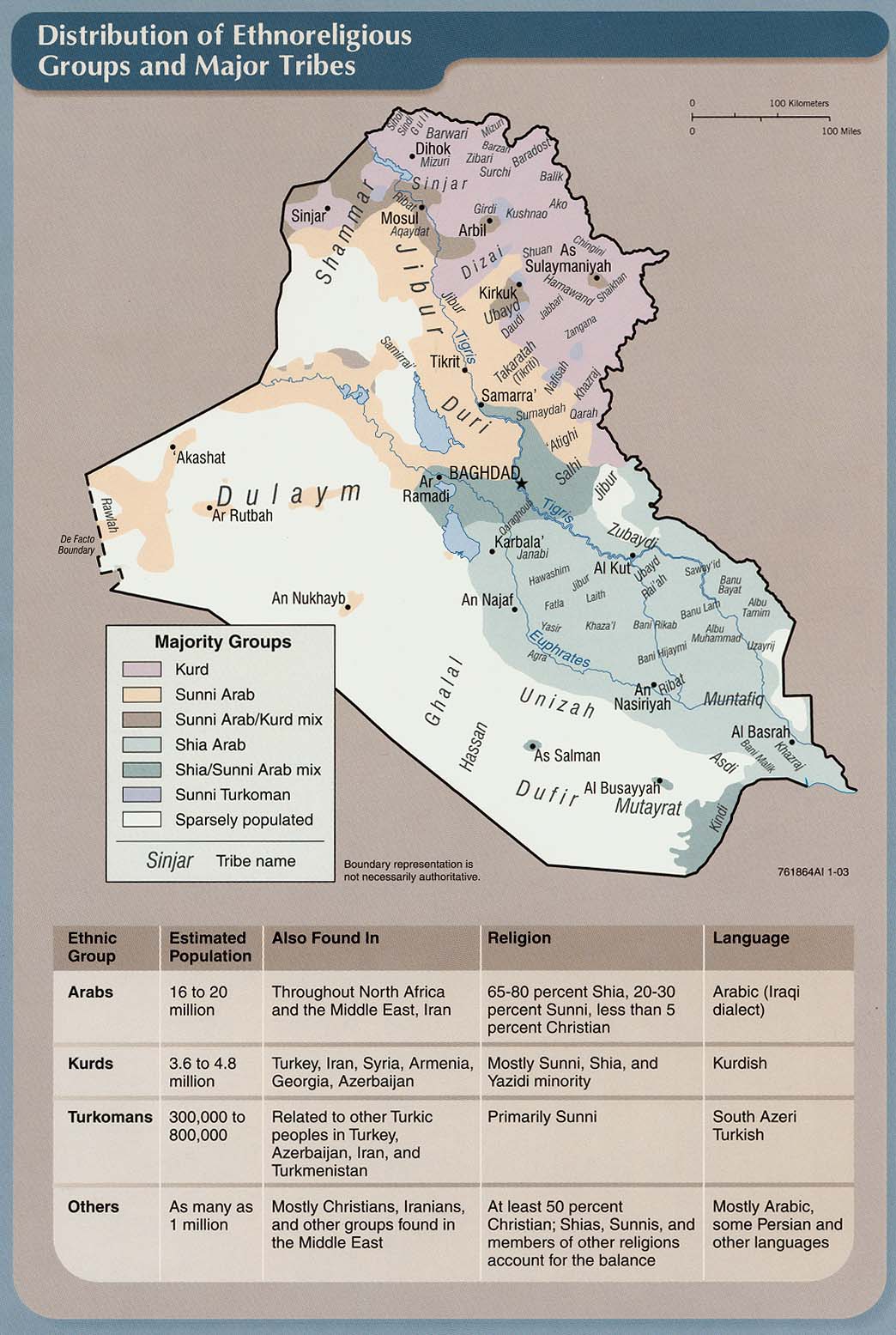
I have commented before on the vast array of ethnic identities present in Iraq: Sunni Arab, Shia Arab, predominately Sunni Kurd, Turkomen, Assyrian, Yazidi, and so forth. We have seen what can happen when a haphazard pastiche of ethnic groups are thrown together in a single state, held together by a dictator, and then that dictator leaves the scene one way or another (usually by death, let’s face it). Anyone with a shred of intellectual honesty and integrity will agree that Iraq is now in a civil war, one in which “ethnic cleansing” is once again an appropriate term to use. Iraq may still be a state appearing on a map, but it is not a nation.
There may be hope (although I feel like I am only including this final paragraph in order to not be totally depressed): another entirely new country was created after World War I, whose history and ultimate divorce was much less of a blot on history. That country was Czechoslovakia, which peacefully split into its two constituent parts in 1993, in what was called the “Velvet Divorce,” named after the country’s comparatively peaceful “Velvet Revolution” of 1989.
Iraq already looks a hell of a lot like Yugoslavia. Is there a chance for it to become more like Czechoslovakia? One can hope, but I doubt it. The ultimate breakup of Yugoslavia threatened wider conflagrations, as does the possible breakup of Iraq. Since neither country really existed as a nation to begin with, perhaps there is some sort of inevitability to it. The question then becomes whether we want or need to be in the middle of the mess.
Top 10 places to never, ever go
The 10 most polluted places on Earth have been identified by the U.S.-based Blacksmith Institute (h/t to Truthdig, and these are apparently in no particular order):
- Sumgayit, Azerbaijan; Potentially 275,000 affected
- Linfen, China; Potentially 3m affected
- Tianying, China; Potentially 140,000 affected
- Sukinda, India; Potentially 2.6m affected
- Vapi, India; Potentially 71,000 affected
- La Oroya, Peru; Potentially 35,000 affected
- Dzerzhinsk, Russia; Potentially 300,000 affected
- Norilsk, Russia; Potentially 134,000 affected
- Chernobyl, Ukraine; Potentially 5.5m affected
- Kabwe, Zambia; Potentially 255,000 affected
Of this list, I have previously heard of only one, Chernobyl, and it is hardly surprising that it is still not a good place to summer. Being me, of course, I want to know more. The BBC offered help on the three newest inductees to the list:
Among the new sites listed in 2007 were Tianying in China, where potentially 140,000 people were at risk from lead poisoning from a massive lead production base there.
The report also said that in the Indian town of Sukinda there were 12 mines operating without environmental controls, leaching dangerous chemicals into water supplies.
Sumgayit in Azerbaijan was also included in the report, which said the former Soviet industrial base was polluting the area with industrial chemicals and heavy metals.
According to the report, cancer rates in Sumgayit were as much as 51% higher than the national average and that genetic mutations and birth defects were commonplace.
That still leaves six cities undescribed, so now I turn to Google (I leave assessments of the objectivity and reliability of each account to the discretion of my intrepid readers, although it is clear some of the articles cited below have an axe to grind–which doesn’t mean they’re wrong).
According to China’s latest pollution rankings, the country’s most polluted city is now Urumqi. Linfen, the city that formally held this title, is showing some small progress, says a recent article in The Guardian. Swallowed up by 50m tonnes of coal mined each year in the nearby hills of Shanxi province and located smack in the middle of a 12-mile industrial belt, Linfen plains to shutdown 160 of 196 iron foundries, and 57 of 153 coking plants by the end of 2007. In 2006, if you lived in Linfen, you inhaled 163 days of unhealthy air—but that’s a 15 day improvement when compared to 2005.
If India’s environment is on the whole healthier than its giant neighbor China’s, that’s because India is developing much more slowly. But that’s changing, starting in towns like Vapi, which sits at the southern end of a 400-km-long belt of industrial estates. For the citizens of Vapi, the cost of growth has been severe: levels of mercury in the city’s groundwater are reportedly 96 times higher than WHO safety levels, and heavy metals are present in the air and the local produce.
The health and environmental crisis in La Oroya, Peru, reached a new stage in December, 2004, when the government stated its intention to allow a metal-processing plant to delay implementation of its environmental management plan for four years.
Owned by the Missouri-based Doe Run Corporation, the plant is largely responsible for the dangerously high blood lead levels found in the children of this community. Ninety-nine percent of children living in and around La Oroya have blood lead levels that exceed acceptable amounts, according to studies carried out by the Director General of Environmental Health in Peru in 1999. Lead poisoning is known to be particularly harmful to the mental development of children.
A once-secret manufacturing center of the Soviet Union’s defense industry, Dzerzhinsk (population 300,000) has hosted many chemical factories, including production facilities for Sarin and VX nerve gas. Lead additives for gasoline, mustard gas, munitions, and other highly-polluting products have also had their birth in this city. While many of these factories are now shuttered, the chemical industry still employs over a quarter of local residents.
The groundwater and soil around the city, about 250 miles east of Moscow, remain severely polluted with phenol, arsenic, dioxins, heavy metals, and a host of other toxins. Indeed, a dominant ecological landmark in the area is the “White Sea”, a 100-acre-wide lake of toxic sludge discharged from nearby factories.
Clearly, Dzerzhinsk faces huge challenges in managing this legacy of toxic wastes. It holds the ignominious title of “The Most Chemically Polluted Town” in the world. Greenpeace claims that the average life expectancy of city residents may have shrunk to a mere 45 years. The city’s annual death rate, 17 per 1,000 people, is much higher than Russia’s national average of 14 per 1,000. And, according to researchers at the Nizhny Novgorod Research Institute of Hygene and Occupational Pathology, rates of reproductive health disturbances affecting women and fetuses, as well as rates of respiratory and pulmonary diseases in children, are dangerously high. In study after study, the health impacts of these chemicals continue to dampen enthusiasm and drain resources needed for economic and social recovery in Dzerzhinsk.
Norilsk sits on a landscape stripped bare, its grizzled inhabitants choking on fumes not yet named in the periodic table of elements. For 100 miles in each direction a dead zone permiates, the snow is colored yellow, a putrid mix of mercury, cyanide, cobolt, and question marks. Seeds which blow in from greener pastures die on impact, with a rare few managing to sprout an inch, before turning gray and melting into dust.
Russians have toiled, eaten each other, and died here long before Soylant Green was filmed. Human bodies and their corresponding memories, hopes, and dreams are turned to nickel, melted down and sold for comforts of the West. A Russian expression goes like this: “The sooner you are imprisoned, the sooner you’ll get out”.
The road to Norilsk is no longer an involuntary one. Every slave of the smelter has a choice, work for $100 a month in your home city, or trek north for a salary of $600. The tradeoff is a life expectancy of 40 years. Weeds do not grow in Norilsk, but cancerous nodules do.
Kabwe, the second largest city in Zambia, has found itself on the top-ten of a new list of “the world’s worst polluted places” due to very high lead concentrations left over from previous mining operations. Average blood levels of lead among children in some townships are five to ten times the level considered dangerous.
Kabwe is one of six towns situated around the Copperbelt, once Zambia’s thriving industrial base. In 1902, rich deposits of lead were discovered here, leading to a century-long mining operation that never bothered too much about environmental standards and public health.
I suppose it’s some small relief for me personally that my six years spent in Houston were not as damaging as they might have been.
Mostly, though, it sounds like these countries, Russia especially, need more hippies.
Super calloused fragile mystic hexed by halitosis
No idea where this originally came from, but it’s worth sharing:
Here are the ten first place winners in the International Pun Contest:
1. A vulture boards an airplane, carrying two dead raccoons. The stewardess looks at him and says, “I’m sorry, sir, only one carrion allowed per passenger.”2. Two fish swim into a concrete wall. The one turns to the other and says “Dam!”
3. Two Eskimos sitting in a kayak were chilly, so they lit a fire in the craft.
Unsurprisingly it sank, proving once again that you can’t have your kayak and heat it too.4. Two hydrogen atoms meet. One says “I’ve lost my electron.” The other says “Are you sure?” The first replies “Yes, I’m positive.”
5. Did you hear about the Buddhist who refused Novocain during a root canal? His goal:
transcend dental medication.6. A group of chess enthusiasts checked into a hotel and were standing in the lobby discussing their recent tournament victories. After about an hour, the manager came out of the office and asked them to disperse.
“But why?”, they asked, as they moved off.
“Because,” he said,” I can’t stand chess-nuts boasting in an open foyer.”
7. A woman has twins and gives them up for adoption.
One of them goes to a family in Egypt and is named “Ahmal.” The other goes to a family in Spain; they name him “Juan. ” Years later, Juan sends a picture of himself to his birth mother. Upon receiving the picture, she tells her husband that she wishes she also had a picture of Ahmal. Her husband responds, “They’re twins! If you’ve seen Juan, you’ve seen Ahmal.”
8. A group of friars were behind on their belfry payments, so they opened up a small florist shop to raise funds. Since everyone liked to buy flowers from the men of God, a rival florist across town thought the competition was unfair. He asked the good fathers to close down, but they would not. He went back and begged the friars to close. They ignored him. So, the rival florist hired Hugh MacTaggart, the roughest and most vicious thug in town to “persuade” them to close.
Hugh beat up the friars and trashed their store, saying he’d be back if they didn’t close up shop.
Terrified, they did so, thereby proving that only Hugh can prevent florist friars.
9. Mahatma Gandhi, as you know, walked barefoot most of the time, which produced an impressive set of calluses on his feet. He also ate very little, which made him rather frail and, with his odd diet, he suffered from bad breath. This made him (Oh, man, this is so bad, it’s good) a super calloused fragile mystic hexed by halitosis.
10. And finally, there was the person who sent ten different puns to friends, with the hope that at least one of the puns would make them laugh. No pun in ten did.
Please tip your waitress.