I’m housebound because of a freak ice storm or something, so it’s getting a little weird.
One of my all-time favorite skits, from MTV’s The State:
Here’s some more weirdness:
Have a nice day.


I’m housebound because of a freak ice storm or something, so it’s getting a little weird.
One of my all-time favorite skits, from MTV’s The State:
Here’s some more weirdness:
Have a nice day.
What we saw the other night, when he proposed more war against more “foes” was the madman the last six years have created. This time, in his war against Iran, he doesn’t even feel the need for minimal PR, as he did before attacking Iraq. All he is bothering with are signals–ships moving here, admirals moving there, consulates being raided in this other place. He no longer cares about the opinions of the voters, the Congress, the generals, the press, and he especially disdains the opinions of B/S/and B. Thanks to Gerson, he identifies his own little ideas with God (a blasphemy, of course, but hey, there’s lots of precedent on this), so there’s no telling what he will do. We can tell by the evidence of the last two months that whatever it is, it will be exactly the thing that the majority of the voters do not want him to do, exactly the thing that James Baker himself doesn’t want him to do. The propaganda that Bush’s sponsors and handlers have poured forth has ceased to persuade the voters but succeeded beyond all measure in convincing the man himself. He will tell himself that God is talking to him, or that he is possessed of an extra measure of courage, or he that he is simply compelled to do whatever it is. The soldiers will pay the price in blood. We will pay the price in money. The Iraqis will pay the price in horror. The Iranians will pay the price, possibly, in the almost unimaginable terror of nuclear attack. Probably, the Israelis will pay the price, too.
I really do wonder if he has lost his mind.
The small pathologies of Bush the candidate have, thanks to the purposes of the neocons and the religious right, been enhanced and upgraded. We have a bona fide madman now, who thinks of himself in a grandiose way as single-handedly turning the tide of history. Some of his Frankensteins have bailed, some haven’t dared to, and others still seem to believe. His actions and his orders, especially about Iran, seem to be telling us that he will stop at nothing to prove his dominance.
I’ll be hiding for a while, in case anyone needs me…
Bonus points if you can identify all the Tom Hanks movies they “borrow” from:
Blogs for Bush: The White House Of The Blogosphere: The Widening War
Read the above post. Read Bush’s speech. Read every single freakin’ puff piece that has been written about Bush and his war for the past however many years. If anyone can find an actual definition of “victory” that bears some semblance of reality, please let me know. Does Bush expect to have Osama bin Laden seated on the deck of the Abraham Lincoln to sign an unconditional surrender? Moqtada al Sadr? The ghost of Zarqawi? People keep saying that opposing whatever ideas dribble out of Bush’s mouth is tantamount to opposing “victory” needs a dictionary, or they need to write to the Merriam-Webster with a new proposed definition. Anyone?
From Bush’s big speech:
Victory will not look like the ones our fathers and grandfathers achieved. There will be no surrender ceremony on the deck of a battleship.
Can we please stop comparing the Iraq war or the war on terror to World War II now? It’s still pissing me off.
This post put me in mind of my own political childhood. I was 6 years old when Ronald Reagan was first elected. Ford was president when I was born (a few months after Nixon’s resignation), but the first president I actually remember was Carter. I was a Reagan supporter mostly because everybody else around me was. I was a 10-year old Reagan supporter in 1984 and a 14-year old Bush supporter in 1988, even though I wouldn’t be able to vote until 1992. I still remember the exact moment when I gave up on the Republicans.
Surprising to many, it was on January 16, 1991, when the air war in Iraq began just in time for prime time coverage.
As I sat there watching Bush 41’s televised speech, I realized just how much the president was enjoying the moment. It seemed like he could barely hold back a smile. Of course, in comparison to Bush 43’s neverending smirk, the 1991 speech seems to overflow with gravitas by comparison. But it seemed clear to me at the time that Bush 41 was leaping up and down on the inside at the opportunity, once and for all, to shed the “wimp label” that had dogged him for so long.
What’s wrong with going to war to prove you’re a man? I can’t honestly say that war is never justified. I can’t honestly say that there weren’t justifications for Desert Storm. I can, however, say that no one should ever enjoy going to war.
I grew up in San Antonio, Texas, where it was often accepted wisdom that we would be among the first to go in the event of a Soviet nuclear attack. I guess I didn’t grow up with fear of nuclear annihilation–it was more a grudging acceptance that I would at least get out of all the “Day After”-survival crap. But there was trust–faith, even–that no one really wanted a war. Now I’m not so sure.
Daily Kos: Who’s Divided Now? That’s Right – Republicans.
Just a quick note to add on to my “turnabout is fair play” theme.
Since I mentioned him earlier, I thought I’d link to this. This guy has always fascinated me.
A stickler for the Constitution, Mr. Goldwater refused to join the Republicans of the New Right during the 1980s when they began to press for legislation that would limit the authority of the federal courts to curb organized prayer in public schools or to order busing for school integration. He opposed busing and he backed prayer in schools, Mr. Goldwater said, but he thought it a dangerous breach of the separation of powers for Congress to be telling the courts what to do.
Mr. Goldwater’s political philosophy also included a strong military posture, a deep mistrust of the Soviet Union and a conviction that increasing the scope of government programs was not the way to solve social problems.
In all, he served 30 years in the Senate, but he was out of office for four years after losing his bid for the presidency, and he was in a political limbo for almost 10 years after that defeat. He reemerged during the Watergate crisis of the early 1970s.
Then, the bluntness and candor that had so often damaged Mr. Goldwater’s presidential campaign a decade earlier and his outspoken and harsh criticism of Nixon’s failure to deal with the growing Watergate scandal were among the vital ingredients of his political renaissance.
The president, he contended, had shown “a tendency to dibble and dabble and argue on very nebulous grounds like executive privilege and confidentiality when all the American people wanted to know was the truth.”
Read the post linked above by Chris Kelly. I think he says it better than I ever could. I have long wondered what qualified this duck to sit alongside Doonesbury on the comics and/or editorial page every day. I know, I know, Garry Trudeau can seem like a zoked-out ’70s liberal more than a few times, but at least the commentary offers some sort of insight. Mallard Fillmore is the editorial cartoon equivalent of the aging jock who insists on wearing his letter jacket well into old age (despite rampant weight gain) and tries to score at high school reunions with the divorced former cheerleaders.
I’ll probably get in some sort of trouble for this, but let’s take a look at a few strips from the frist week of December 2006:
December 2, 2006: A righteous rant about prejudice against…dinosaurs??? Paging Dr. Freud???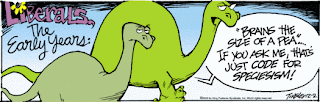
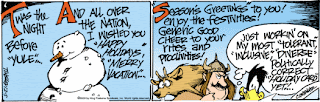
Next, we have more whining about the “War on Christmas” (which I will now forever refer to as the War on Xmas, just for the heck of it).
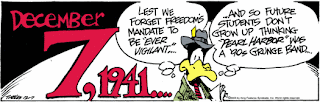
And finally, let us never forget…what Japan did to us…what the hell am IK supposed to do with this, anyway??? Go beat up an Asian dude??? No thanks.
When a parody of a comic strip is almost indistinguishable from the actual strip, you should know there’s a problem. From America: The Book by Jon Stewart et al:

I’m not sure what more there is to say about this strip. Looking at a list of his frequent targets, I get the image of an elderly conservative shut-in swatting at flies with his cane and calling them “damn commie flies.” Anyone who actually likes this strip (a) will not have their mind changed by anything at all and (b) will become senile in the not-too-distant future.
It’s not to say that I never ever agree on some level with what Mallard has to say, but it is rare. On occasion, he comes across as a Goldwater conservative, which doesn’t bother me much, but those times are few and far between. Mostly, Mallard Fillmore comes across as a half-baked slipshod part of the media’s willingness to provide even the most pathetic hacks (yes, I called someone names) a forum in the name of “balance.” If Mallard and the above-linked hacks (I said it again, and I’ll back it up) are the best modern “conservatism” has to offer…damn.
The Blog Cenk Uygur: The White House Threatens to Ignore Congress The Huffington Post
This has been bouncing around in my brain for a while–the following seem to be common premises of contemporary thought on the “right”:
Premise #1: It is unpatriotic, if not outright treasonous, to impede the President’s ability to protect the nation in a time of war.
Premise #2: Criticism of the President impedes his ability to protect the nation.
Premise #3: The nation is currently in a state of war.
Conclusion: Criticism of the President in a time of war is unpatriotic, if not outright treasonous.
Now, I personally think all three premises are debatable, but for this little exercise, let’s take everything as true.
Let’s change it up a little:
Premise #1: It is unpatriotic, if not outright treasonous, to impede the President’s ability to protect the nation in a time of war.
Premise #2: Impeachment of the President impedes his ability to protect the nation.
Premise #3: The nation has been in a state of war with Al Qaeda since 1996.
Conclusion: Impeachment of the President in a time of war is unpatriotic, if not outright treasonous.
I still don’t agree with #1, #2 could be taken as a matter of common sense, and #3 is pretty much a matter of record. So see, Republicans are even less patriotic than Democrats! Or something like that.
So what’s my point? Hell if I know. I guess I just want to stop the name-calling that is still going on, even in 2007. Nobody did enough to prevent 9/11 or to deal with the aftermath, neither Clinton nor Bush, so let’s move on. The Bush administration keeps saying something to the effect that “9/11 changed everything,” but no one ever asks them to elaborate on that point. What exactly changed after 9/11, other than our smug sense of security, and how does it justify such radical changes in the balance of power between the branches of government? If the terrorists hate our freedoms, how does one justify radically changing the nature and applicability of those freedoms?
Since I already brought up Bill Clinton…in for a penny, in for a pound. So all you administration-supporting, Iraq-war-supporting folk out there, imagine all the acts taken to broaden executive authority in the wake of 9/11…taken to broaden executive authority in the wake of the 1998 embassy bombings.
Unitary executive with the authority to override acts of Congress…what if Bill Clinton did it?
Executive with the authority to intercept phone transmissions without any resort to FISA courts or other oversight…what if Bill Clinton did it?
Authority solely vested in the executive to determine who is and is not an enemy combatant…what if Bill Clinton did it?
Just a thought.
Seriously, though, ask yourself if, in 1998, you would have been okay with that.
I don’t think you would have.
So why is it okay now?
Please, tell me I’m wrong, then tell me why I’m wrong. Convince me. I dare you.
“When the President takes measures incompatible with the expressed or implied will of Congress, his power is at its lowest ebb, for then he can rely only upon his own constitutional powers minus any constitutional powers of Congress over the matter. Courts can sustain exclusive presidential control in such a case only by disabling the Congress from acting upon the subject. Presidential claim to a power at once so conclusive and preclusive must be scrutinized with caution, for what is at stake is the equilibrium established by our constitutional system.” Youngstown Sheet & Tube Co., et al v. Sawyer, 343 U.S. 579, 637-38 (1952, J. Jackson, concurring)
