Rare Footage from a Ted Cruz-Led Republican Strategy Meeting

I found the following on YouTube, and I think it offers some useful insight into how Ted Cruz has handled the debate leading up to this week’s government shutdown.

A few relevant quotes:

I bought this pen exactly one hour before my bike was stolen! Why? What’s the significance? I DON’T KNOW!!!!!!!

And:

The mind plays tricks on you. You play tricks back! It’s like you’re unraveling a big cable-knit sweater that someone keeps knitting and knitting and knitting and knitting and knitting and knitting and knitting…

Thanks to Marley for transcription assistance.

Share

That Time the Heritage Foundation Promoted the Individual Mandate, Citing “an Implicit Contract Between Households and Society”

Stuart Butler publicity shotIf you have the means to purchase insurance for yourself, but refuse to do so because freedom, the taxpayers of the U.S. will  foot the bill to treat you for catastrophic injuries, because we are fundamentally a decent people. Don’t take my word for it, though. The Heritage Foundation said so back in 1989, when its Director of Domestic Policy Studies, Stuart M. Butler, Ph.D., promoted the idea of an individual health insurance mandate:

Many states now require passengers in automobiles to wear seatbelts for their own protection. Many others require anybody driving a car to have liability insurance. But neither the federal government nor any state requires all households to protect themselves from the potentially catastrophic costs of a serious accident or illness. Under the Heritage plan, there would be such a requirement. This mandate is based on two important principles. First, that health care protection is a responsibility of individuals, not businesses. Thus to the extent that anybody should be required to provide coverage to a family, the household mandate assumes that it is the family that carries the first responsibility. Second, it assumes that there is an implicit contract between households and society, based on the notion that health insurance is not like other forms of insurance protection. If a young man wrecks his Porsche and has not had the foresight to obtain insurance, we may commiserate but society feels no obligation to repair his car. But health care is different. If a man is struck down by a heart attack in the street, Americans will care for him whether or not he has insurance. If we find that he has spent his money on other things rather than insurance, we may be angry but we will not deny him services – even if that means more prudent citizens end up paying the tab. A mandate on individuals recognizes this implicit contract. Society does feel a moral obligation to insure that its citizens do not suffer from the unavailability of health care. But on the other hand, each household has the obligation, to the extent it is able, to avoid placing demands on society by protecting itself.

(Emphasis added.)

Here’s a PDF copy of the lecture (source), in case the HTML page goes away.

Photo credit: By Stuart Butler [CC-BY-SA-2.0], via Wikimedia Commons.

Share

Republicans Really Don’t Understand Negotiation, It Seems

greyerbaby from morguefile.com

Pictured: Republican House member (via morguefile.com)

Negotiation is the process of reaching a compromise between two or more opposing parties, each of whom has something the other wants, and who has the legal right to grant or withhold it. My experience has mostly been in litigation, where a plaintiff has a viable claim, and a defendant has the ability to offer a monetary and/or injunctive settlement. The usual purpose of a settlement in litigation is to avoid the future costs/risks of continuing to prosecute or defend the case.

If one party to a lawsuit is asserting claims or withholding evidence in bad faith, proper negotiation is impossible. In many litigation scenarios, a party who engages in such bad faith, or their counsel, may be subject to penalties. In a contract negotiation, the subsequent discovery that a party has withheld or misrepresented material information could be construed as breaching the contract, could invalidate the contract, or could justify modifying the contract on terms favorable to the other party. Our political system, apparently, does not have equivalent checks, unless voters actually go to the effort of holding their elected representatives accountable. This brings us to the current hubbub over House Republicans’ determination to get rid of the Affordable Care Act (ACA, or “Obamacare”) at all costs. Continue reading

Share

We’re Number Four! Sort Of.

I came across this chart on Wikipedia the other day, showing the distribution of the various orders among the 5,416 currently living and recently extinct species of mammals.

By Aranae (Own work) [Public domain], via Wikimedia Commons

You might note that primates rank fourth among all orders of mammals. This order includes humans, other apes (yeah, I went there), gibbons, baboons, monkeys, lemurs, tarsiers, lorises, aye-ayes, etc. I’d say we’re in good company.

In substantial first place, of course, are the rodents, e.g. mice, rats, squirrels, beavers, porcupines, hamsters, guinea pigs, and capybaras.

In sizeable second place, making up nearly 1/4 of all mammal species, are the bats, e.g., uh, bats and flying foxes.

Third place threw me for a second, because I had not heard of Soricomorpha. Turns out that’s the relatively new classification for most types of shrews and moles. They used to be in a bigger order that included hedgehogs, which I remember from my nerdy childhood.

By José Luis Bartheld from Valdivia, Chile (Monito del Monte) [CC-BY-2.0 (http://creativecommons.org/licenses/by/2.0)], via Wikimedia Commons

The monito del monte. My autocorrect tried to change it to “mojito.”

In last place, we have the single species of aardvark, a taxonomically lonely beast that is cute in its own special way. Another single-species order comes in second-to-last (really making this a tie for last place) is the monito del monte, a marsupial that looks like a mouse and lives in South America. The next-to-last few orders only have two extant species: the marsupial moles and the flying lemurs.

Anyway, I guess I’m still pretty nerdy about this stuff.

Photo credits: Aranae (Own work) [Public domain], via Wikimedia Commons; José Luis Bartheld from Valdivia, Chile (Monito del Monte) [CC-BY-2.0], via Wikimedia Commons.
Share

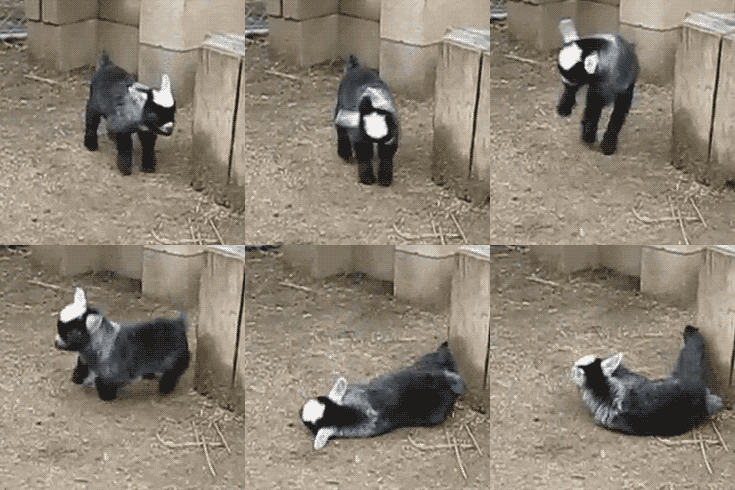
Monday Morning Cute: The Kids Are Alright.

Get it? The kids are alright? Oh never mind. Here are some goats.

Via tumblr.com

This kid should not have messed with this other kid:

Via youngnyquil.tumblr.com

Via youngnyquil.tumblr.com

This kid has crazy tail!!!

Via aimlessme.tumblr.com

Via aimlessme.tumblr.com

Go home, kid. You’re drunk:

Via spectacularhead.tumblr.com

Via spectacularhead.tumblr.com

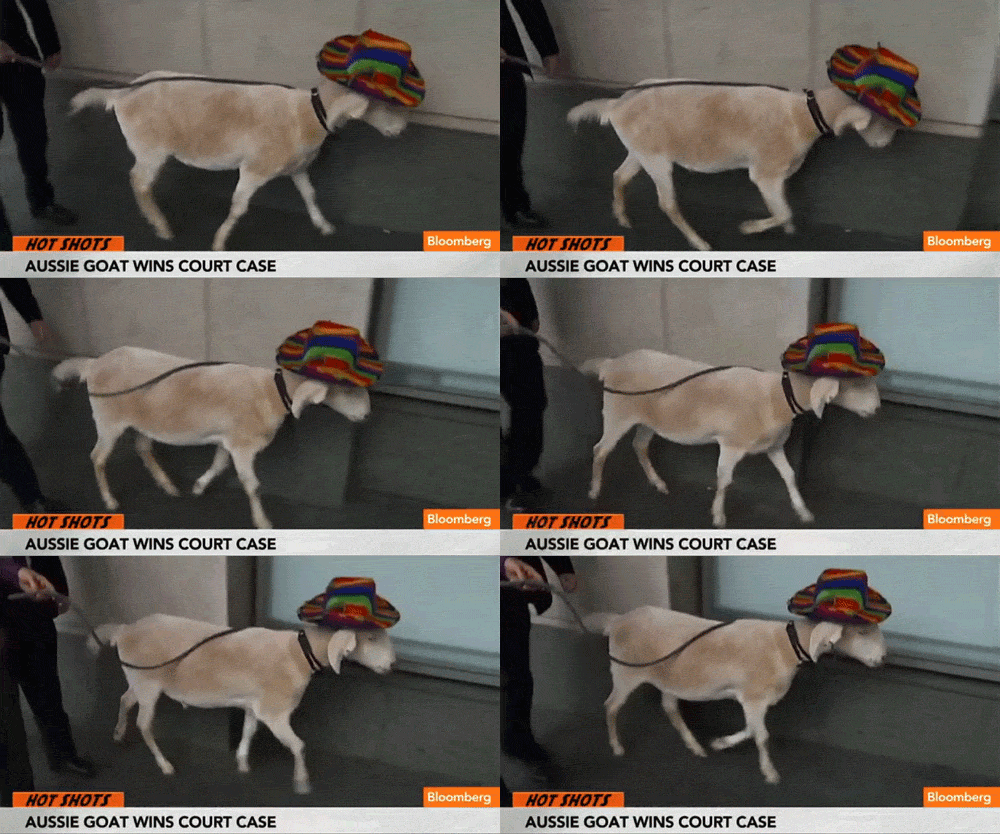
Kids these days:

Via lilmissmessie.tumblr.com

Via lilmissmessie.tumblr.com

Yes, technically, that is an adult goat, but shut up.

Finally, here is a goat riding a tortoise, thus bringing balance to the universe.

Via sirfucknuggets.tumblr.com (yes, really)

Via sirfucknuggets.tumblr.com (yes, really)

Share

Defamation Threats: A Quick Guide

If you spend enough time putting stuff on the internet, you will eventually:
1. Say something about someone that just ain’t true;
2. Get a few details wrong about a person, or a situation involving that person; or
3. State an opinion about someone, which that person finds objectionable.

Any of these could result in the threat of a defamation suit, but only #1 has any real chance of going badly for you. Regardless, you have to respond if someone doesn’t like something you wrote and subsequently accuses you of libel. (I know of what I speak. Just trust me.) You even have to respond if someone accuses you of slander because of something you wrote, and pointing at that person while laughing is not a sufficient response.

Ken White of Popehat fame has compiled a helpful list of steps to take if you receive any sort of notice, even an incoherent or delusional one, accusing you of any sort of defamation. It is not legal advice, because legal advice is. not. free, but it’s very helpful nonetheless.

Share

This Week in WTF, September 27, 2013

See page for author [Public domain], via Wikimedia Commons– Let’s start off with a happy one. A cat that went missing during the Bastrop wildfires in 2011 showed up back at her house two years later, with her own adopted kitten in tow.
– While this happened at least two years ago, I came across the headline this week: “Olga Moskalyova Killed By Bear as Her Mother Listens in Agony on Phone.” Do I actually need to say anything else?

– A man in England interrupted the preparations for a wedding by showing up at the church sans testicles, having just removed them himself. The article notes that the man was rushed to the hospital, the bride arrived at the church thirty minutes later and none the wiser, and the show went on as planned. This leads me to wonder exactly when the bride learned of the unconventional wedding crashed.

– Another headline that pretty much stands on its own: “Auto-Brewery Syndrome: Apparently, You Can Make Beer In Your Gut.”

– The parent company of Penthouse magazine, FriendFinder Networks, Inc., filed for bankruptcy last week. The company also owns various “dating” sites like the eponymous FriendFinder.com and its offshoots. It’s tough times in the adult entertainment biz, indeed.

Photo credit: See page for author [Public domain], via Wikimedia Commons.

Share

Whose Liberty?

Senator Ted Cruz’s not-quite-filibuster today has the goal (I presume) of making the nation so sick of Ted Cruz that we’ll agree to do anything—e.g. “defund Obamacare”—in exchange for his promise never to speak in public again. I have to admit, it’s the best plan Republicans have come up with so far.

Anyway, during the festivities, Sen. Mike Lee (R-UT) reportedly added this nugget of wisdom:

Whenever government acts, it does so at the expense of our own individual liberty. (Emphasis added.)

For someone who has been denied coverage due to a “pre-existing condition,” or who has not been able to access any healthcare, it seems clear that the new law will increase their liberty, by allowing them the opportunity to be healthy and not die avoidable deaths.

But I don’t think Sen. Lee is talking about those people when he talks about “our own individual liberty.” It would be nice if he would be more honest about who he actually means. Then we could ask him how much personal convenience is worth another person’s death from a pre-existing condition.

Share

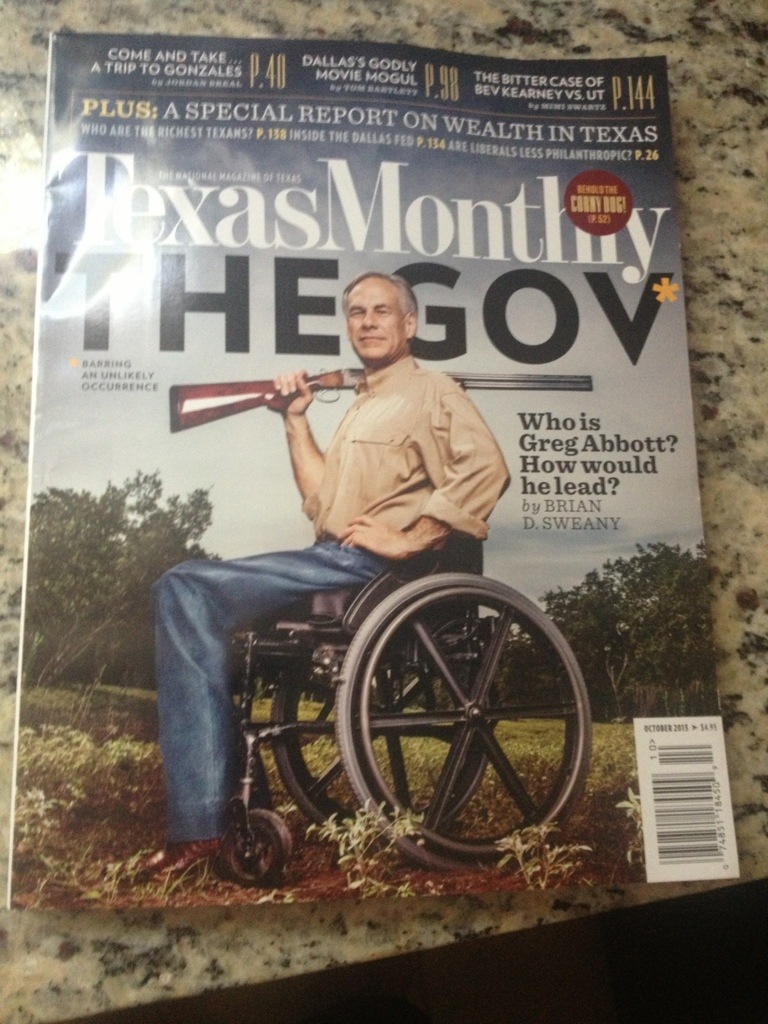
Texas Monthly is playing it safe

The latest issue of Texas Monthly arrived in the mail today:

20130923-160759.jpg

I really can’t blame the magazine for adhering to the “red state” paradigm. Progressives are generally viewed as mythical beings in Texas, except when they are making too much noise to ignore. Besides that, the editors have better things to do than sift through the petabytes of psychotic, barely-literate RWNJ screeds that would follow anything remotely nice about liberals and progressives. A Greg Abbott victory might not actually be inevitable, but an onslaught of keyboard poundings from the mouth-breathing class most certainly is.

Share

Modern Politics and Joseph Heller

20130922-192041.jpgIf ever there was a character who managed to be memorable without inspiring many specific memories, it would have to be Major Major Major Major from Joseph Heller’s Catch-22. (I enjoyed the book immensely, but mostly only remember Major Major’s tragic haplessness.) Heller’s ridiculously clasic novel also proved to be quite prescient, as Atrios noted:

From Catch-22.

Major Major’s father was a sober God-fearing man whose idea of a good joke was to lie about his age. He was a longlimbed farmer, a God-fearing, freedom-loving, law-abiding rugged indi­vid­u­al­ist who held that fed­er­al aid to any­one but farm­ers was creep­ing social­ism. He advo­cat­ed thrift and hard work and dis­ap­proved of loose women who turned him down. His spe­cial­ty was alfal­fa, and he made a good thing out of not grow­ing any. The gov­ern­ment paid him well for every bushel of alfal­fa he did not grow. The more alfal­fa he did not grow, the more money the gov­ern­ment gave him, and he spent every penny he didn’t earn on new land to increase the amount of alfal­fa he did not pro­duce. Major Major’s father worked with­out rest at not grow­ing alfal­fa. On long win­ter evenings he remained indoors and did not mend har­ness, and he sprang out of bed at the crack of noon every day just to make cer­tain that the chores would not be done. He invest­ed in land wise­ly and soon was not grow­ing more alfal­fa than any other man in the coun­ty. Neigh­bors sought him out for advice on all sub­jects, for he had made much money and was there­fore wise. “As ye sow, so shall ye reap,” he coun­seled one and all, and every­one said, “Amen.”

Major Major’s father was an out­spo­ken cham­pi­on of econ­o­my in gov­ern­ment, pro­vid­ed it did not inter­fere with the sacred duty of gov­ern­ment to pay farm­ers as much as they could get for all the alfal­fa they pro­duced that no one else want­ed or for not pro­duc­ing any alfal­fa at all. He was a proud and inde­pen­dent man who was opposed to unem­ploy­ment insur­ance and never hes­i­tat­ed to whine, whim­per, whee­dle and extort for as much as he could get from whomev­er he could.

Our pol­i­tics never changes.

Share