Ignorance vs. Stupidity

I prefer to think that most people who espouse creationist ideas are just lacking in a solid understanding of science, and continue to receive misinformation—as opposed to lacking in actual intelligence. In other words, I prefer the word “ignorant,” which while pejorative, still has its valid uses, to “stupid,” which is little more than an insult.

It’s getting harder and harder to tell which is which these days, though.

Share

A Very Handy Parody

A few weeks ago, a short film called “First Kiss” went viral. It was sweet and all, but let’s face it, it was also unbearably cheesy. Not only that, it’s actually an ad disguised as a short film, using actors instead of random strangers.

I only made it about halfway through. I guess there’s only so much I can take of overly-earnest good-looking hipsters being cheesy. But the internet did not let us down, because of course, we have parodies. Continue reading

Share

What I’m Reading, March 28, 2014

The Internet, Where Languages Go to Die?, Ross Perlin, Al Jazeera America, March 18, 2014

We’re used to the triumphalist universalism of the digital utopians: Google organizes the world’s information. Facebook connects everyone. Twitter tells you what’s happening. Wikipedia is the encyclopedia that anyone can edit. It’s all true — for a mere 5 percent of the world’s languages.

What few acknowledge is that the online world — when compared with offline, analog diversity — is very nearly a monoculture, an echo chamber where the planet’s few dominant cultures talk among themselves. English, Chinese, Spanish, Arabic and just a handful of other languages dominate digital communication. Thanks to their sheer size and to the powerful official and commercial forces behind them, the populations that speak and write these languages can plug in, develop the necessary tools and assume that their languages will follow them into an ever-expanding range of virtual realms.

Copyright Alliance Attacks ChillingEffects.org As ‘Repugnant,’ Wants DMCA System With No Public Accountability, TechDirt, March 17, 2014

Sandra Aistars of the Copyright Alliance issued a statement during the recent DMCA-related hearing in front of the House Judiciary Committee. As was noted earlier, a bunch of effort was made to turn the “notice and takedown” system into a “notice and stay down” system, and weirdly, the word “free” was thrown about as if it was synonymous with “infringement.”

Her statement details the shortcomings of the DMCA system from the expected position, citing the personal travails of creators like Kathy Wolfe, who for some reason has chosen to spend half her profits battling infringement. In general, it painted a bleak picture for future creativity, claiming that unless infringement is massively curbed, creators will stop creating. (There seems to be no place in this argument about the lowered barriers to entry, and the swell of creation that has enabled.)

But where her statement really goes off the rails (even for the Copyright Alliance) is with the attack on the popular copyright notice clearinghouse, Chilling Effects.

We Shouldn’t Arrest One More Person for Having Marijuana, Dice Raw, Blog of Rights, March 18, 2014

When you look at marijuana arrest data in the U.S., you’ll be floored to know that every 37 seconds, someone gets handcuffed and booked for weed-related crime, and Black people are 3.73 times more likely to be the ones arrested (communities of color have felt this to be true for a long time, and now we have the stats to back us up).

That doesn’t reflect the true voice of the people. In fact, 9 out of 10 adults in the U.S. don’t think a person should face jail time for a small amount weed. In 2010 alone, states spent $3.61 billion enforcing marijuana possession laws, yet many cities also experienced mass school closings that threaten to hinder the progress of our youth.

Share

This Week in WTF, March 28, 2014

– Worth every penny: How much would you pay to keep Ted Nugent from performing in your town? If you’re Longview, Texas, that amount is $16,000. Someone had the bright idea of agreeing to pay him $32,000 to play a Fourth of July event, and then the town realized what a horrible waste of space he is. I guess the $16K is a settlement to avoid a breach of contract suit. Still totally worth it.

– I’m pretty sure this is not a joke: Secretary of State John Kerry is apparently sending a group of scientists to Uganda to try to explain gay people to Ugandan President Yoweri Museveni.

– Everyone has an Achilles heel: An MMA fighter tapped out if a fight recently, and vomited, because his opponent allegedly farted in his face. Now we know how far is too far in MMA.

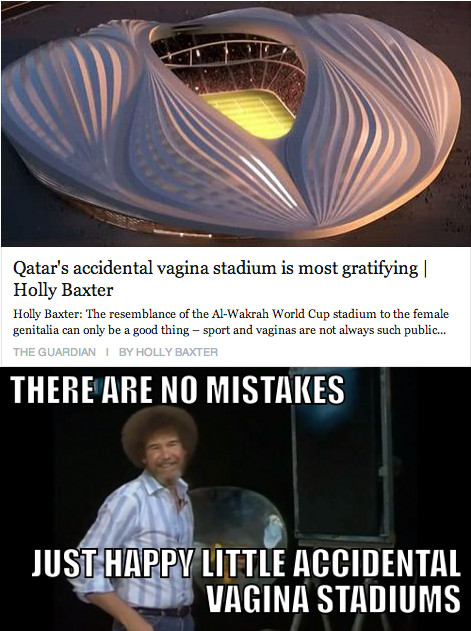
– There are no mistakes: First we had the Vagina Building in Chicago. Now we have the Vagina Stadium in Al-Wakrah, Qatar. I mostly bring it up so that I have an excuse to post this meme again:

There are no mistakes...

Thank you, Bob Ross.

Share

What I’m Reading, March 27, 2014

Sometimes You Need A Boogeyman, Anne Laurie, Balloon Juice, March 26, 2014

Republicans have relied for many, many electoral cycles on advertising boogeymonsters to scare voters to turn out and vote against their own best interests. If Democratic candidates are finally beginning to understand that we can, and should, use the vast supply of actual GOP monsters — people like Charles & David Koch, malefactors of great wealth — as an argument for our voters to get down to the polling places, more power to us!

Race Is Real…But Not in the Way Many People Think, Agustín Fuentes, Ph.D., Psychology Today, April 9, 2012

There is currently one biological race in our species: Homo sapiens sapiens. However, that does not mean that what we call “races” (our society’s way of dividing people up) don’t exist.  Societies, like the USA, construct racial classifications, not as units of biology, but as ways to lump together groups of people with varying historical, linguistic, ethnic, religious, or other backgrounds. These categories are not static, they change over time as societies grow and diversify and alter their social, political and historical make-ups. For example, in the USA the Irish were not always “white,” and despite our government’s legal definition, most Hispanics/Latinos are not seen as white today (by themselves or by others).

This is a difficult concept and it seems to come up again and again, so let me provide a few points to bust the myth and to clarify the reality…

There is no genetic sequence unique to blacks or whites or Asians. In fact, these categories don’t reflect biological groupings at all. There is more genetic variation in the diverse populations from the continent of Africa (who some would lump into a “black” category) than exists in ALL populations from outside of Africa (the rest of the world) combined!

There are no specific racial genes. There are no genes that make blacks in the USA more susceptible to high blood pressure, just as there are no genes for particular kinds of cancers that can be assigned to only one racial grouping. There is no neurological patterning that distinguishes races from one another, nor are there patterns in muscle development and structure, digestive tracts, hand-eye coordination, or any other such measures.

Charles Murray Responds To Allegations Of Racism Following Paul Ryan Remarks, Caitlin MacNeal, Talking Points Memo, March 18, 2014

Charles Murray, the social scientist cited by Rep. Paul Ryan (R-WI) last week in his comments about the inner city “culture problem” of men not wanting to work, on Monday responded to allegations that he has drawn racist conclusions in his works about poverty in America.

Murray defended his book “The Bell Curve,” the piece many criticize as racist for suggesting that African-Americans are less intelligent than white Americans due to genetic differences.

“Our sin was to openly discuss the issue, not to advocate a position. But for the last forty years, that’s been sin enough,” Murray wrote in a piece published by the American Enterprise Institute.

Murray argues that in “The Bell Curve,” he and co-author Richard Herrnstein merely deliberated whether genetics had anything to do with racial differences without drawing a conclusion.

Share

A Few Totally True Facts

I have plenty of unfinished posts and important topics that deserve my attention, but instead I want to share a few items from “77 Facts That Sound Like Huge Lies But Are Actually Completely True,” by Dave Stopera at BuzzFeed. Most of the ones I picked deal with the passage of time, and our oft-skewed perception of it. The links are in the original, but I added a picture or two.

5. The name Jessica was created by Shakespeare in the play Merchant of Venice.

"Shylock e jessica" by Maurycy Gottlieb [Public domain], via Wikimedia Commons

8. Cleopatra lived closer to the invention of the iPhone than she did to the building of the Great Pyramid.

20. Oxford University is older than the Aztec Empire.

21. Not once in the Humpty Dumpty nursery rhyme does it mention that he’s an egg. Continue reading

Share

What I’m Reading, March 26, 2014

You play ball like a GIRL!

Via pordl.com

Playing “Too Womany” and the Problem of Masculinity in Sport, Joanna L. Grossman and Deborah L. Brake, Verdict, September 17, 2013

Title IX indeed has changed the face of education. It has been invoked to protect students against sexual harassment by teachers and peers, to ensure fair treatment of pregnant and parenting students, to remove obstacles to women’s education in non-traditional fields like science and math, and to curtail the use of single-sex education that was rooted in stereotype. But Title IX is most known for its impact on athletics, even though that was probably the furthest thing from the legislators’ mind when they enacted it. (The legislative history suggests little more than some chuckling over the prospect of co-ed football and co-ed locker rooms.)

***

There is no question that sports have changed women. Female sports participation has proven positive effects that are related to academic achievement; job success; positive self-esteem; reduced incidence of self-destructive behaviors like smoking, drugs, sex at a young age, and teen pregnancy; and physical and mental health benefits. By and large, sports have been empowering and have even changed, in fundamental ways, what it means to be a woman.

But have women changed sports? Why is it that despite the widespread participation of women and girls in sports, a team of ten-year-old boys would be told by their male coach (as recently happened to one of our sons) that the reason they lost their soccer game is because they “played too womany”? And why is it that this remark strikes so few people as offensive? Has women’s participation in sports changed the norms of femininity for women, but not the norms of masculinity for men?

[Ed. note: We generally hear “you throw like a girl” as an insult, based on women’s perceived categorical inferiority at sports.

Throw like a girl

Via fugly.com

Well, do you know who else “throws like a girl”? Continue reading

Share

The History of the United States in One GIF

Animated U.S. history

Click to embiggen.

From a set posted by dayyad to Imgur.

The GIF only covers the time period from 1789 to the present, so it leaves out a lot of colonies and (going further back) nations, but there’s only so much you can pack into one animated GIF.

Share

What I’m Reading, March 25, 2014

By Mike Kalasnik from Fort Mill, USA [CC-BY-SA-2.0 (http://creativecommons.org/licenses/by-sa/2.0)], via Wikimedia CommonsThe Breadth of Hobby Lobby’s Attack On Its Employees, Scott Lemieux, Lawyers, Guns & Money, March 22, 2014
Hobby Lobby et al. are citing a “burden” on religious practice so trivial as to be non-existent in order to impose actual burdens on the rights of their employees. This nicely summarizes how American conservatives think about “freedom.”

Nauru–From Island Paradise To Hell On Earth, Down With Tyranny! March 22, 2014

I remember Nauru from the time I was a pre-teen stamp collector. It was– still is– just a speck of a South Pacific Island, about 8 square miles and less than 10,000 people. Earlier, it had been a German colony that was taken over by the Brits after World War I– like Tanganyika (which, coincidentally, also has a village named Nauru). I haven’t thought about Nauru in half a century until last night. I didn’t even know that around the time Nauru became independent, phosphate mining had given it the highest per-capita income of any country in the world– almost all of which has been swindled. They went from wealth to poverty and Nauru was reduced to taking money from Australia to host a virtual concentration camp for refugees from Sri Lanka, Afghanistan, Iran, Palestine and Pakistan.

Ladders on Everest are just the latest step in our commodification of nature, Philip Hoare, The Guardian, posted at Raw Story, March 20, 2014

For a place already blighted by litter, fistfights and unburied dead bodies, it’s not so much “health and safety” as “access all areas”. Its greatest hero, Edmund Hillary, declared in 2006, two years before he died: “I think the whole attitude towards climbing Mount Everest has become rather horrifying. The people just want to get to the top.” His successor, Stephen Venables, the first Briton to climb the peak without oxygen, agreed. “The mountain has become a commodity, to be bought and sold like any other,” he said. We humans have come to expect the natural world to come commodified, negotiated, shaped to our needs. From high to low, there’s nowhere we can’t go, nothing we can’t do. In this age of the Anthropocene – the era of human manipulation heralded by the industrial revolution – it is a given that we have tuned the environment to suit ourselves. Dominion is all; human ingenuity has encompassed the planet. Now pass me the phone: “I’m on the mountain.”

More like the Dork Enlightenment, am I right?, PZ Myers, Pharyngula, March 7, 2014

I am told I’m supposed to take The Dark Enlightenment seriously. I can’t. I just can’t. What it is is mostly a bunch of pretentious white dudebro computer programmers with a fascist ideology who write tortuous long-winded screeds off the top of their heads, with most of their ‘data’ coming from pop culture movies like The Matrix, and a few similarly clueless nerds who think it’s neat-o. I take it seriously only in the same way I take Libertarianism seriously: it’s a nucleus for idiots to coalesce around.

They also throw the term HBD around a lot. If you’re not in the know, HBD is short for Human BioDiversity, and it’s the hot new sciencey word for racism. The only people who use it are racists.

Photo credit: By Mike Kalasnik from Fort Mill, USA [CC-BY-SA-2.0], via Wikimedia Commons.

Share

Memories of LEGO

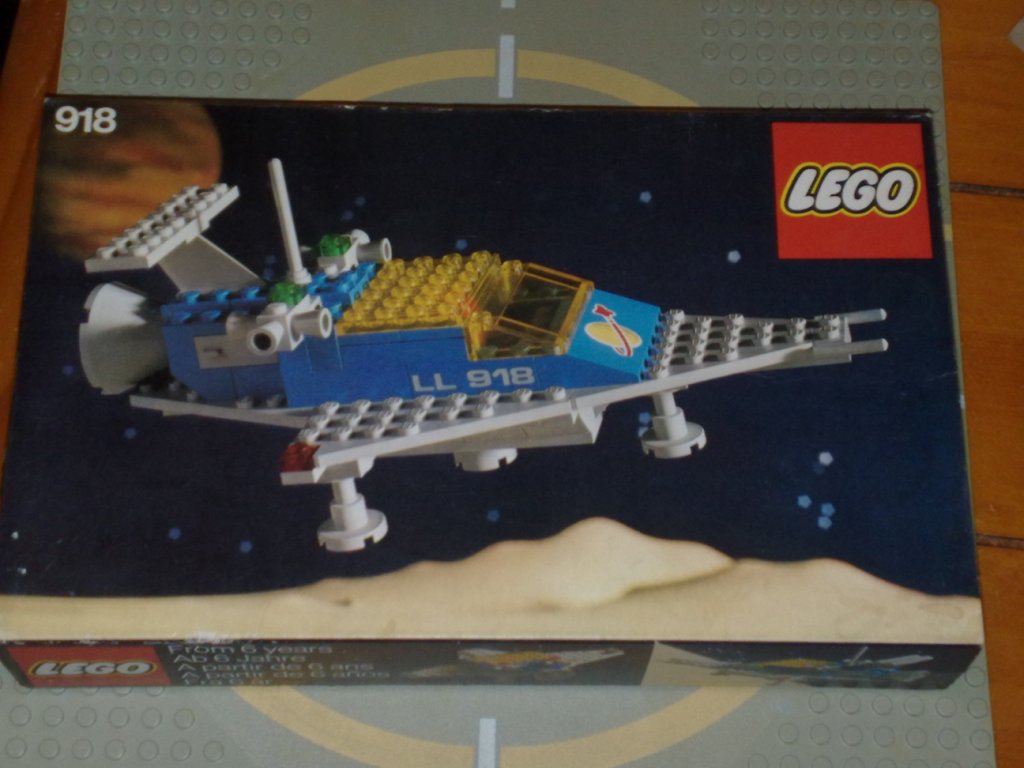
I came across an eBay listing a few weeks ago, now ended, for a vintage LEGO space set, the Space Transport, model no. 918, from 1978.

Via eurobricks.com

Via eurobricks.com

It caught my eye for several reasons. First of all, the eBay listing price was $875.00. Second, this was one of the sets that I knew about in my youth, and it is very evocative of childhood memories. The 918 Space Transport set was actually never available in the U.S., but two similar sets were: the Space Cruiser, sold in Europe as model no. 924 and in the U.S. as no. 487; and the Galaxy Explorer, model no. 928 in Europe and 497 in the U.S.

I had the Galaxy Explorer, which was by far the coolest of the three, but could never find the Space Cruiser—even though LEGO made a point of showing it in their catalog, flying alongside the Galaxy Explorer.

Some of the first Space sets in a catalog from 1979

The Galaxy Explorer was the biggest LEGO set my parents had ever gotten me. I remember that at age 5 or so, it was pretty overwhelming, so my dad helped me put it together. (I don’t have kids, but if you do and you’re reading this, build stuff with them. Lots of stuff.)

That pretty much kickstarted a fascination (obsession?) with LEGO that persisted for years, and continues still to a certain extent. I don’t feel the same sense of wonder when presented with a pile of bricks, which makes me sad, but I still enjoy the nostalgia.

I put together an Imgur album of the three spaceship sets, if you want to relive some memories, too:

Share