See If You Live in a Bubble, According to One Guy’s Quiz

Screen Shot 2013-05-22 at 4.28.14 PMDo you live in a bubble?

I should probably explain what that means, except I don’t think I can. Here’s what some folks at PBS said:

White America is coming apart at the seams.

That’s the thesis Charles Murray, a libertarian political scientist at the American Enterprise Institute, puts forth in his new book, “Coming Apart.” In a piece soon to appear on the NewsHour, Murray argues that the super wealthy, super educated and super snobby live in so-called super-ZIPs: cloistered together, with little to no exposure to American culture at large.

Murray came up with a 25-question quiz to determine the size of your bubble. I’ve heard of Murray, but don’t know much about him. Since I tend to agree with libertarians on roughly 50% of issues (the issues involving keeping government out of the business of individual humans, as opposed to corporations that only exists because of government blah blah blah. I digress), I try to give the benefit of the doubt to those with whom I’m not familiar. Murray and I align at least somewhat on issues like marriage equality and some aspects of reproductive rights, but I’m sure there’s divergence elsewhere. His “bubble quiz” told me a lot more about what Charles Murray thinks of city folk than about any bubbles I may inhabit. (HINT: Eating at chain restaurants, identifying military rank insignia, and personally knowing at least one evangelical Christian will significantly reduce your bubblage.)

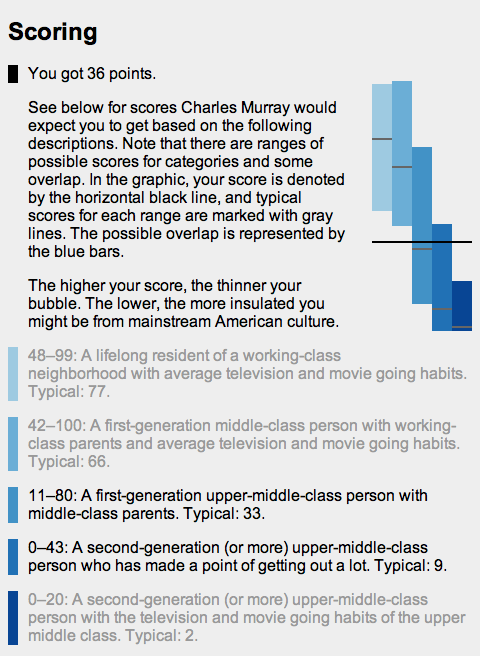
At any rate, I got a 36 out of 99, which overlaps two different bubbles. A 99, by the way, would mean the broadest exposure to American culture, while a 0 would be a Howard Hughes-esque bubble. Of the two bubbles in which my score fits, the one that seems closer to me is “A second-generation (or more) upper-middle-class person who has made a point of getting out a lot.” It was actually all the upper-middle-class evangelical Baptists I knew growing up that gave me most of my supposedly non-bubble experiences, but whatever. Take the quiz yourself and see how a 70 year-old libertarian who works for a think tank judges your life!

Share

Helping the People of Oklahoma, While Not Forgetting the Kind of Leaders They Elected

Oklahoma isn’t a place. It’s something in your blood. It’s something that you do. It’s the shirt off your back and a tear in your eye and the giddyup in your soul.
Nicole Hill

Moore_Oklahoma_Tornado_DamageThe comments regarding yesterday’s deadly tornado in Oklahoma seem to range from unconditional pleas for help on the one hand, to “political cheap shots” against the people who elected Senators Tom Coburn and James Inhofe on the other. The need for help, and the obligation for us to provide whatever help we can, however much or little, both individually and as a society, should be without question. We are all Americans, we are all humans, and we are all in this together. I disagree, however, with those who say that now is not the time for politics. We are capable enough of multitasking that we can give aid while remembering what the elected leaders of Oklahoma have said in the past. (Coburn and Inhofe stand out right now because they have been so outspoken in the past about these types of issues. I know less about, say, Governor Mary Fallin or the local authorities in Moore, who appear to be doing a stellar job.)

First off, here’s what any of us can do to help. Senator Coburn actually has a good list of aid resources on his Senate website, including the Red Cross, Food Bank, and United Way. The Red Cross operates a service called “Safe and Well” that allows people in the affected areas to report that they are okay, and lets others check on their status. Red Cross Oklahoma tweeted information on how to contribute yesterday:

The tornado left many animals stranded and lost, and the Central Oklahoma Humane Society has information on how to help, both with financial and in-kind donations.

Donate money, blood, supplies, time, or whatever you can. Just do something.

Once we have helped, I believe it is important to note that the senators from Oklahoma might not offer the rest of us help in similar circumstances. They both opposed federal aid to the region affected by Hurricane Sandy, and have generally sought to reduce funding for disaster relief. I have to give Senator Coburn credit for sticking to his principles, as he has stated that he will oppose disaster relief for his own state without corresponding spending cuts. Still, I have to wonder what Ralph Waldo Emerson might have said about Coburn’s style of consistency.

As for Senator Inhofe, the notorious climate change denier seems to be playing dumb. He has his reasons for wanting disaster relief aid for his state, and whether it is genuine concern for his constituents or rank political self-preservation doesn’t even interest me right now. He has to fold himself into pretzels, though, to account for his change of tune.

If we don’t talk about this now, then when? When the incident is receding from the memories of all but those directly affected? No. If Senators Coburn and Inhofe are the kind of people who will stand on principle by refusing to support disaster relief for the rest of the country but humbly request it for their own constituents, they deserve to be called out on it every second of every day, and they should be reminded constantly that they owe thanks to the taxpayers from the other 49 states. Oklahoma is one of those red states, by the way, that receive more federal money than they pay in taxes, around $1.01-$1.50 for every dollar paid.

The voters of Oklahoma that put these clowns in office should be reminded that the people they elected would deny to other states the aid they are receiving, until they either vote Coburn and Inhofe out of office or admit that the majority of the state’s voters does not have the nation’s back. My heart goes out to the people of Oklahoma who have suffered and lost, and my money is going to the Red Cross or whomever is making a difference up there, but I will not neglect to point out the shame that is the Oklahoma Congressional delegation. This is not mockery. Call it judgment if you must. I won’t poke fun at people in Oklahoma, but I do expect them to live with the leaders they have chosen, just as we Texans may have to atone for Senators Cornyn and Cruz.

(NOTE: The inspiration/impetus for this post came from Julie Gillis, whom I love and admire, and with whom I hope I can amicably disagree now and then.)

Photo credit: By National Oceanic and Atmospheric Administration National Weather Service staff. (PHOTOS OF DESTRUCTION) [Public domain], via Wikimedia Commons.

Share

Morality Clauses in the Modern Era

When I was practicing family law, I sometimes included “morality clauses” in the divorce decrees that I drafted. This is a clause prohibiting either parent, during their periods of possession of the child/ren, from allowing an unmarried adult who is not a family member, and with whom that parent has a romantic or dating relationship, from staying overnight.

I was never proud of including such a clause, and I hated calling it a “morality” clause. I saw situations where it was most likely necessary to protect the child/ren, though, usually where one parent had, after separation from the other parent, become a, ahem, player. The idea was to shield the child/ren from that parent’s dating life until that parent was ready to get hitched again, and the other parent usually had to accept a similar restriction. While I thought it was overkill in most cases, it seemed necessary in a few.

Here’s the thing, though: it applies to unmarried adults who are dating a parent. The morality clause is moot if the parent marries the person, so the restriction is not permanent……..provided the parent can legally marry the person they are dating.

See where this is going?

What happens if the parent is in a same-sex relationship? The courts of Texas are always ready to answer questions like that in the most restrictive and invasive way possible:

Carolyn Compton is in a three year-old relationship with a woman. According to Compton’s partner Page Price, Compton’s ex-husband rarely sees their two children and was also once charged with stalking Compton, a felony, although he eventually plead to a misdemeanor charge of criminal trespassing.

And yet, thanks to a Texas judge, Compton could lose custody of her children because she has the audacity to live with the woman she loves.

According to Price, Judge John Roach, a Republican who presides over a state trial court in McKinney, Texas, placed a so-called “morality clause” in Compton’s divorce papers. This clause forbids Compton having a person that she is not related to “by blood or marriage” at her home past 9pm when her children are present. Since Texas will not allow Compton to marry her partner, this means that she effectively cannot live with her partner so long as she retains custody over her children. Invoking the “morality clause,” Judge Roach gave Price 30 days to move out of Compton’s home.

Ah, Texas. Where it’s better for a parent to be a convicted criminal than to be gay.

Price posted about the judge’s ruling on Facebook last week, writing that the judge placed the clause in the divorce papers because he didn’t like Compton’s “lifestyle.”

“Our children are all happy and well adjusted. By his enforcement, being that we cannot marry in this state, I have been ordered to move out of my home,” Price wrote.

To be fair, much of the state has emerged from whatever mass bigotry led to the 2005 constitutional amendment banning same-sex marriage, but it hasn’t reached wide segments of the judiciary yet. State law allows district judges to make custody orders consistent with the “best interest of the child,” which is often whatever the district judge says it is, and which appellate judges view as findings of fact that they rarely question.

Few, if any, reported cases have addressed the enforceability of morality clauses. A Texas appellate court took a moment recently to dismiss a dad’s claim that a morality clause restricting him, but not his ex-wife, violated the Equal Protection Clause. Roberts v. Roberts, No. 04-11-00554-CV, opinion (Tex. App.—San Antonio, May 1, 2013).

As far as I know, the purpose of morality clauses is to protect kids from confusion if a parent starts dating after a divorce by trying to shield them from all but the most serious relationships. That this is still called “morality” reflects an origin in an earlier era. A blogger at the site Mr. Custody Coach offers a good take on the nature and effect of morality clauses today:

On the surface, the thought is about protecting the children from a revolving door of romantic partners from being introduced to the children, only to have them disappear from their lives in short order. It goes without saying that this would be detrimental to the children’s psyche, though how much and to what extent is hard to measure. However, there are far too many loopholes in even the tightest of morality clauses. Further, they simply can’t stop the children from being introduced to new significant others in a parent’s life.

There are some recent trends in child parenting agreements/orders that really should be avoided. In fact, morality clauses should be avoided, in our opinion, due to the reality that they are quite difficult to enforce and don’t afford children the “protection” that is intended.

First, the use of a parent’s sexual behavior to restrict visitation or withhold custody, even when there is no evidence that such behavior has any effect on the child. Children have close friends. Adults have close friends. It stands to reason that these friends may come in go in any of our lives. It seems counter-intuitive that a new adult “close friend” should be restricted from introduction or noticed as a part of a parent’s life. In fact, it may introduce suspicion to the children about the new person in their parent’s life without any real understanding of why it’s necessary, which can be detrimental in its own right.

Secondly, the use of restraining orders nowadays is used to introduce the family court’s opinion regarding the child’s best interests when in reality – it’s a tool to circumvent the parent’s judgments about what’s best for their child.

In each situation, the court is able to impose its view of moral behavior with the force of law. With all of the other intrusions that divorce and custody litigation affords the family court – this one is another that is an alarming trend. Further, it has been our experience that those initiating such clauses are doing so simply to control the life of their ex-partner and are even the person who violates the clauses that they are trying to impose on the other party

It is undoubtedly important to deal carefully with introducing a child to a new significant other, but the assumption of the standard morality clause is that the S/O could become a spouse. For Compton and her partner, this restriction could apply for the rest of their lives. A mostly-absentee dad seems to have gotten an assist from a regressive judge, and now the children may have to live in a single-parent household.

I hope the opponents of marriage equality are proud of themselves.

If we’re really going to talk about “morality” in a post-divorce scenario, as seen through the eyes of a conservative Republican state judge, I feel like I ought to break out the big guns:

I tell you that anyone who divorces his wife, except for sexual immorality, and marries another woman commits adultery.

Matthew 19:9 (NIV)

Just once, I’d like to see a sanctimonious parent in a post-divorce custody proceeding have that thrown in their face.

Of course, there are those who want to ban divorce entirely, forcing children to live with two miserable parents trapped in an unhappy marriage for the children’s own good because Jesus, so maybe I should keep the in-context Bible-quoting to a minimum.

Share

Porn and Prejudice: Letting Teenage Boys Determine School Policy With Their Libidos

I’m going to talk about sex and stuff in a minute, but first, some exposition: I frequently save links to articles that give me an idea for a blog post, but then never get around to writing the post. I also start posts, save them as drafts, then never finish them. I have over a hundred saved WordPress drafts, and countless links saved in my iCloud reading list, Evernote, Instapaper, and elsewhere. Maybe I’ll get to some of those ideas eventually, but sometimes I go through my blog post drafts and delete the ones that are hopelessly outdated. This is an attempt to consolidate ideas accumulated over months into a single post.

Holly_Sampson_-_My_First_Sex_Teacher_Vol._18_cover_original

To be fair, the adult industry is kind of encouraging the horndogs here.

I. The Long-Winded Introduction

Teachers, at this point in American history, are not allowed to have pasts. Nor are they allowed to have much in the way of lives outside of teaching. This applies to other professions as well, but teachers seem to bear the brunt of our society’s perfectionism.

I’m going to talk a bit about sex, as well as portrayals of sex in entertainment, so stop reading if you’re easily offended. I’ll warn you if a link goes somewhere NSFW (not safe for work.) The gist of what I’m saying is that we as a society have profoundly conflicted views of sexuality, especially female sexuality. People who routinely interact with children are often expected to be effectively asexual, even if no one ever quite puts it in those terms. People who have expressed their sexuality in overt ways, from basic modeling to outright porn, while breaking no laws, often lose their jobs as teachers and in other fields. Sometimes, we can justify it as “protecting the kids,” while other times, t really makes no sense at all.

Even when it is supposedly about protecting children, what is it really teaching kids? (Disclosure: I do not have kids, but I used to be a teenage boy.) The most common justification offered for dismissing a teacher because of modeling, porn, etc. is that it creates a “disruption” or “distraction” in the school environment. I assume that this refers to the idea that students will not be able to learn as effectively because they might have seen their teacher in a state of undress or more, perhaps online.

That is, at least initially, a compelling argument. What is it actually teaching kids, though? This is not about teachers who actually have sex with their students, or who call their students “jailbait” on Twitter. Those are pretty obviously illegal and/or inappropriate. I can also see an argument against letting teachers moonlight as bikini models or whatever, but what about something a teacher did years ago? I don’t necessarily know the best answer for how to deal with it, but firing a teacher for modeling bikinis or more in the past might have more negative long-term consequences: Continue reading

Share

How Not to Improve a Political Party’s Public Image

The UK Independence Party (UKIP) seems to be having some PR problems. I’m not much up on British politics, but UKIP is, according to Wikipedia,

a Eurosceptic right-wing populist political party in the United Kingdom, founded in 1993. The party describes itself in its constitution as a “democratic, libertarian party” and, as of May 2013, has a membership of 27,000.

UKIP currently has 11 of the 73 UK seats in the European Parliament, three members in the House of Lords, one seat in the Northern Ireland Assembly and 147 local councillors. The UKIP performance in the 2013 local election was the best result for a party outside the big three in British politics since the Second World War, coming fourth in the number of council seats won and third in terms of projected nationwide votes. UKIP has not won a seat in the House of Commons to date.

file5061259016861

Stock photo found in a search for “trousers.”

The British media describes the party as “anti-EU.” The party seems to be having a problem with protests, including one in Scotland in which an angry mob shouting “racist, Nazi scum” led to police escorting the party’s leader to safety. What intrigues me are the views of its top contributor, “Greek shipping tycoon”* Demetri Marchessini. They are quite intriguing in their outspokenness:

Greek tycoon Demetri Marchessini, who believes not wearing a skirt is ‘hostile behaviour’, gave UKIP £10,000 this year – a fifth of all its cash donations.

***

He is the author of a book entitled Women In Trousers: A Rear View in which he photographed women from behind and then commented on their clothes. In it he claimed that the ratio Britain of women wearing trousers to skirts is 10 to 1. Continue reading

Share

Asparagus!

U.S. Representative Louie Gohmert (R-TX) is a national embarrassment.

A visibly infuriated Rep. Louie Gohmert (R-Texas) tore into Attorney General Eric Holder after his time expired in a House Judiciary Committee hearing Wednesday. The exchange, about the FBI’s investigation into deceased Boston Marathon bombing suspect Tamerlan Tsarnaev, marked a low point in congressional civility.

Gohmert alleged that the FBI failed to question Tsarnaev in a “thorough enough” manner despite a tip from Russia that he had been “radicalized,” even as the federal government was “going after” Christian groups like that of Billy Graham.

“You’ve made statements as matters of fact–,” Holder began in response.

“You point out one thing that I said that was not true,” shot back Gohmert.

[Procedural assertions, ya-ta ya-ta ya-ta]

Gohmert asked again for a point of personal privilege and said that Holder was “wrong on the things that I asserted as fact.” The other members of the committee disputed that his contention was a point of personal privilege.

“The attorney general will not cast aspersions on my asparagus,” said Gohmert, in a malapropism for the ages.

(Emphasis added) I didn’t actually hear the word “asparagus,” but that’s not really the point.

Gohmert, whom George Lopez called “fucking crazy” just yesterday, represents the district in east Texas from which 1/2 of my family originates. That is my shame (because of Gohmert, not my family).

For my part, it does not sound as though Holder was calling Gohmert a liar, but that seems to be Gohmert’s takeaway here. Saying that a person said something that is not true is not the same thing as calling them a liar. He might have just been saying Gohmert was misinformed, or at worst, ignorant. I’m okay with that.

Share

Health, Preventive Surgery, Boobs, and Other Things That Are None of My Dang Beeswax

angelina-jolie-breasts-0514-27-580x435

Via thesuperficial.com

I gotta run. They’re doing a breast reduction on 3, and I want to get up there to try and stop it. You know what I’m talkin’ about!
Todd, Scrubs season 2 episode 15, “His Story”

So about Angelina Jolie’s preventive double mastectomy. The reaction seems to range from “this is none of my business” to “how very brave of her” to “NOOOOOOOOO, BOOOOOOOOOOOBS!!!!!!!!!” To one degree or another, these are all fair reactions.

None of My Business: This is by far the best reaction, because people’s personal medical decisions should be just that—personal. Still, Angelina Jolie has lived much of her life in the public eye, and whether she likes it or not, people will take notice of her decisions.

Courage: Angelina Jolie is not like most famous people in Hollywood. I’ve never quite been able to put what I mean in words, and I’m not sure anyone else has either. She is beyond doubt a talented actress and an all-around good human being, but she brings something to all of her movies that overpowers everyone and everything else on screen. This manages to make even her not-very-good movies (e.g. Taking Lives) memorable, and makes her the most noticeable part of movies where she plays a bit part (e.g. Sky Captain and the World of Tomorrow.) Even when she’s doing something silly, people take notice en masse. It’s a unique combination of beauty and gravitas, for lack of a better description.

This makes her an ideal spokesperson for various causes, and she can’t seem to help but be a role model. Of course, much of the media attention she has received over the years has focused on her lips and other……attributes. She is and will still be a phenomenally beautiful woman, but there is a bold element to her decision. She may or may not have intended this, but she is basically daring people to assess whether this will affect her entertainment career.

Her mother died of cancer in 2007. She had an eighty-seven percent chance of developing breast cancer, a chance which is now much lower. She has six children, all of whom now have a greater chance of seeing their mother grow old.

Boobs: Let’s just say it. Angelina Jolie had fantastic breasts. I think it is okay to lament the world’s loss, given that it was, is, and will aways be a breast owner’s decision what to do with them. We may think of this as the loss of a great American treasure, but it is not the same as, say, the loss of the Old Man of the Mountain. That was a public trust. These were somebody’s body parts. Let us say no more about them, except to celebrate someone’s courage to take whatever control she could of her own health.

Wait, There’s More! Joe Patrice at Above the Law has a piece on the gene that led to Jolie’s decision, BRCA1. The only test capable of detecting the gene is patented, and therefore very expensive. This means that people like Jolie, who have resources, can get the test, while millions more cannot. Even after the Affordable Care Act takes full effect, “grandfathered” plans may not have to provide coverage for the test. This may change, though, when the U.S. Supreme Court rules on the issue of the patentability of human genes in a few months in Assoc. for Molecular Pathology v. Myriad Genetics, Inc.

And a Little More: It is impossible to Google Angelina Jolie’s name without quickly venturing into NSFW territory. Here’s an NSFW GIF of her taking off her shirt. Thanks for reading my blog.

Share

The Only Thing I Have to Say About Abercrombie & Fitch, feat. Dr. Seuss (UPDATED)

1822626

I could have written this post without showing headless, topless beautiful people, but where’s the fun in that? (Via hollywood.com)

I still own a few articles of clothing that I obtained at the Abercrombie & Fitch store in the Houston Galleria around 1997 or 1998. Shortly after that time period, I realized that the store no longer had anything to offer me. Around 1997, Abercrombie & Fitch was best described as a slightly fancier Eddie Bauer, a style that might still suit me to this day. One day, probably in 1999, I went into the Houston store and found myself knee- to waist-deep in douche. Not literally, of course, but the store seemed to have abruptly changed from a place that offered durable clothes that appealed to me (as evidenced by the fact that some of the clothes I got there have held on for 16+ years) to a place where beautiful people go to feel superior.

We have known for a long time that the current CEO of the company is a douchenozzle, and that he has designed a store for his fellow douchenozzles:

As far as [Mike] Jeffries is concerned, America’s unattractive, overweight or otherwise undesirable teens can shop elsewhere. “In every school there are the cool and popular kids, and then there are the not-so-cool kids,” he says. “Candidly, we go after the cool kids. We go after the attractive all-American kid with a great attitude and a lot of friends. A lot of people don’t belong [in our clothes], and they can’t belong. Are we exclusionary? Absolutely. Those companies that are in trouble are trying to target everybody: young, old, fat, skinny. But then you become totally vanilla. You don’t alienate anybody, but you don’t excite anybody, either.”

Recently, the company has been under fire for not even bothering to sell women’s XL sizes, which has brought Jeffries’ pontifications on coolness and beauty back to the fore. It has also given many of us an opportunity. More on that later.

In a heartfelt and moving piece at Huffington Post, Sara Taney Humphries writes to Jeffries: Continue reading

Share

The Point of Legal Writing is Precision, Not Mass Appeal (UPDATED)

Au_marché_-_choux

The Lord’s Prayer is 66 words, the Gettysburg Address is 286 words, and there are 1,322 words in the Declaration of Independence. Yet, government regulations on the sale of cabbage total 26,911 words.
David McIntosh, writing in National Review, October 24, 1995

I have seen variations on the above quote passed around via email and social media for years. The implication, I suppose, is that government regulations are needlessly verbose. According to Snopes.com, the sentiment long predates McIntosh’s article.

Black_rot_of_cabbage_symptoms

If you don’t think that the government has anything whatsoever to say if someone tries to sneak this into the stream of commerce, please stay away from my kitchen

I generally have the same response whenever I see this posted somewhere, although usually the person posting the quote has no interest in actually learning more about why our laws tend to be wordy. The Lord’s Prayer, Gettysburg Address, and Declaration of Independence all had very specific subjects and objectives; briefly stated, a recommendation on how to pray, motivation in wartime, and grounds for independence from England. History has generally deemed the number of words used in each of these writings sufficient to achieve these aims, but it is always possible to say the same thing with more or fewer words. In the event of a listeria outbreak in the nation’s cabbage supply, none of these writings will be of any assistance whatsoever (unless you believe that a few “Our Father”s will be enough to protect the public, in which case I sincerely hope you do not have a high-level position in a health department.) These documents, not to mention the number of words used in each of them, is completely, totally, utterly irrelevant to the nation’s cabbage supply. It is possible that regulations pertaining to cabbage are too wordy, but this comparison does not even come close to making that case. It’s just a less-clever-than-it-thinks attempt to rail against big guv’mint. If you don’t know much of anything about public safety regulations and/or have no desire to understand them, you might find the comparison compelling.

I bring this up because of a broader tendency among people who do not know much about law or legislation to lament the inscrutability of legal writing, arguing that it should be written in a way that nearly anyone could understand. Scott Greenfield, in a post with the ridiculously awesome title “The Fallacy of Simplicity,” annihilates this argument (go read his post. I’ll wait.) Continue reading

Share

Depression, in Pictures

Depression is impossible to describe in words. Any attempt to convey the experience in words ends up sounded clichéd. I have had the opportunity to try to explain my experiences in images in “The Depression Chronicles,” but the best portrayals of life with depression that I have ever seen have come from Allie Brosh, who writes the webcomic Hyberbole and a Half.

In October 2011, she wrote a post called “Adventures in Depression,” in which she described how she fell into a deep period of depression, with the attendant immobility and self-loathing. Her post captured the way someone suffering from depression can recognize the purposelessness of it, while remaining powerless to do anything about it.

sad10alt2

She goes on to describe how her depression “got so horrible that it actually broke through to the other side and became a sort of fear-proof exoskeleton.”

Screen Shot 2013-05-14 at 11.31.51 AM Screen Shot 2013-05-14 at 11.32.09 AM

Then she basically disappeared from the internet for over a year.

She returned the other day with a follow-up post, “Depression Part Two,” that offers perhaps the best analogy for depression I have ever seen.

I remember being endlessly entertained by the adventures of my toys. Some days they died repeated, violent deaths, other days they traveled to space or discussed my swim lessons and how I absolutely should be allowed in the deep end of the pool, especially since I was such a talented doggy-paddler.

I didn’t understand why it was fun for me, it just was.

But as I grew older, it became harder and harder to access that expansive imaginary space that made my toys fun. I remember looking at them and feeling sort of frustrated and confused that things weren’t the same.

I played out all the same story lines that had been fun before, but the meaning had disappeared. Horse’s Big Space Adventure transformed into holding a plastic horse in the air, hoping it would somehow be enjoyable for me. Prehistoric Crazy-Bus Death Ride was just smashing a toy bus full of dinosaurs into the wall while feeling sort of bored and unfulfilled.  I could no longer connect to my toys in a way that allowed me to participate in the experience.

Depression feels almost exactly like that, except about everything.

[Emphasis added, and pictures omitted.] Seriously, go read the whole post. The pictures are the key, but I don’t want to copy too many of them here.

ADTWO4

Depression has social stigma, to be sure, but the difficulty goes beyond that. Even if you don’t have a sore throat, or have never had a sore throat somehow, you can probably imagine the difficulties faced by someone with a bad case of strep throat. Everyone has bad moods, or gets in funks, but not everyone (most people, actually) have difficulty relating to a major depressive episode. I doubt that my experiences even remotely compare to those described in Brosh’s posts.

Clark, a blogger at Popehat, calls depression a color most people cannot see:

Depression is hard to talk about. I don’t mean “there’s a social stigma to it”, although that’s true. I don’t mean “modern society calls minor mood swings ‘depression’ and medicates them with lifestyle drugs, so the depths of true depression are hard to convey to someone”, although that’s also true.

I mean that depression is a color, and people who haven’t experienced it are color blind to its hue. There are no words to bridge the gap, to make it clear.

Much like Clark, I cannot add any words of real wisdom to what Allie Brosh has to say about her experiences. She faced the prospect of suicide and, for reasons that may not make sense to many, and that I wish did not make sense to me, is still here. I am very grateful for that.

If you need help, or know someone who does, help is out there: National Suicide Prevention Lifeline, 1-800-273-TALK (8255).

Photo credits: All pictures are by Allie Brosh [CC BY-NC-ND 3.0 US].

Share