If you spend enough time putting stuff on the internet, you will eventually:
1. Say something about someone that just ain’t true;
2. Get a few details wrong about a person, or a situation involving that person; or
3. State an opinion about someone, which that person finds objectionable.
Any of these could result in the threat of a defamation suit, but only #1 has any real chance of going badly for you. Regardless, you have to respond if someone doesn’t like something you wrote and subsequently accuses you of libel. (I know of what I speak. Just trust me.) You even have to respond if someone accuses you of slander because of something you wrote, and pointing at that person while laughing is not a sufficient response.
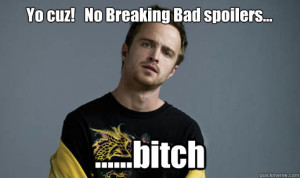
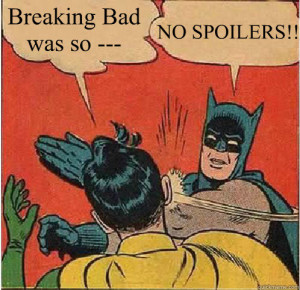
(Nonspecific spoilers ahead.) In an era where almost everyone has a TV show marketed directly to them, AMC’s Breaking Bad has developed a remarkably widespread—and fanatically devoted—following. The show now only has two episodes left of its five-season run, and it has been building up to what is generally predicted to be a humdinger of a finale. Last night’s episode, “Ozymandias,” certainly hit many people in the feels. That, in and of itself, should not be much of a spoiler. A spoiler, in my opinion, would have been to say that nothing of interest happened, or that the entire episode was about Data learning to be more human. Oops, wrong show, sorry.
Via quickmeme.com
I’ll be honest here: I think Breaking Bad is an incredible show, perhaps one of the best in television history, but I don’t love it the way some people do. I don’t feel the same emotional investment that I felt in characters from The Wire, not by a long shot.
Getting back to last night’s episode: in the era of the DVR, not everyone watches a show at the same time, meaning that some people were not interested in discussing “Ozymandias” at the water cooler this morning. In the era of social media, the water cooler discussion has expanded far beyond the water cooler. This raises an interesting question. In social media forums like Facebook, it is relatively easy to post spoiler warnings, but not so much on Twitter. What sort of etiquette, if any, exists to guard against accidentally revealing key plot developments to people who are not ready for them. Conversely, what is the responsibility of the spoilee to avoid discussions that might lead to spoilers? It hardly seems fair to ask people who have seen the episode, in all of its [redacted], to wait to discuss it until everyone has had a chance to see it. Continue reading →
It was a party to reme—wait, what? (Via morguefile.com)
A Chicago student is suing a doctor, hospital, and medical school after the doctor allegedly took pictures of her in the hospital, where she had been admitted for overindulgence in alcohol, and posted them on Facebook. The student was reportedly taken to the hospital by ambulance at about 3:00 a.m. on June 13, 2013. The defendant, who was not the student’s treating physician, allegedly looked at her medical records around noon that day, using his medical ID card to gain access to the files. According to Courthouse News Service:
It continues: “At or around 4 p.m., on June 13, 2013, [defendant] came down to the ER again and commenced taking pictures of plaintiff while she was on the hospital bed, crying, and attached to an IV.
“[Defendant] was seen by hospital security in the hospital taking the pictures and was asked to delete them immediately, which he refused to do.
“[Defendant] decided to public said photographs on the Internet through Facebook and Instagram online sharing programs.
“[Defendant] attached statements of commentary describing [plaintiff]’s condition in those photographs. Continue reading →
Random example of a selfie. (Via Wikimedia Commons)
When I saw Mrs. Hall’s open letter to the teenage harlots who tempt her teenage sons, my only way to directly relate to the material was through my own experience as a teenage boy. I mostly recall it as a chaotic mixture of hormones and angst, but I feel very fortunate that I had people around me who taught me about self-control, as opposed to trying to impose restrictions on those around me. (Of course, I came of age in a pre-social-media era, so maybe things are significantly different now—I doubt it, though.)
I pondered writing my own response to Mrs. Hall’s letter, addressing my concern about how her overt slut-shaming is harmful to girls, or how her implicit denial of her sons’ moral agency in the presence of braless teen girl selfies is extremely harmful to boys and girls, or the remarkable irony in chastising girls about their own states of undress in the midst of muscle-beach photos of her own beefcakey brood. The only criticism Mrs. Hall seems to have heard and processed involves the beefcake angle, so she re-posted the same piece minus the teenage boy-flesh. I’d posit that the other issues are more important. Enough people have weighed in now that I doubt I can add much more, so here are excerpts from some of my favorite responses: Continue reading →
Earlier this year, I authored a post entitled “5 Tips for Successful Blogging,” in which I offered advice based on my years of experience remembering to put food in my mouth and not my nose.
It seems as though other self-styled “experts” are still out there, offering their own bits of sage advice, but still missing the most important aspects of being an effective blogger. So, here are five more tips that I can offer the bloggers of today and tomorrow. Technology keeps advancing every day, so all of this may be obsolete by the time you finish this
New technology has made blogging even easier, only requiring the parts of your brain that aren’t watching those judge shows on Fox every morning. Here are five tips for successful blogging for the bloggers of today and tomorrow.
1. Carpal tunnel syndrome continues to be a major problem for office workers around the world. You can delay the onset of carpal tunnel syndrome by refusing to learn how to type, and using only your two index fingers (or the nearest available fingers.)
2. Sirius, also known as the “dog star,” is approximately 8.6 light years from Earth. Factor that into your marketing plan.
3. The keys on your keyboard should face up (unless you practice inverted blogging, in which case there is nothing more I can teach you.)
4. Tardigrades, also known as “water bears,” are a terrible target demographic for most bloggers. Studies have shown that tardigrades have little interest in most blog topics, with the as-yet unexplained exception of Gaelic football.
I think it wants to hug you!
5. List-style blog posts will remain extremely popular forever. Always blog in list form. Even if your post only has one point to make, number it.
There is a core of about 1500-2000 of Austin residents college, homeless, and others) that could just about qualify as semi-professional protestors. We’ve seen the same ones at education rallies, pro-abortion rallies, gay rights rallies, etc. They consider it fun and worthwhile WHEN the free food is involved. But try asking them who their state rep or state Senator is.
(Dawnna Dukes and Kirk Watson. I did not have to look that up. But I digress.)
And now, our folks have found Craiglist entries offering to PAY people to show up, as has happened before; a standard MoveOn tactic. Add to that a NATIONALLY orchestrated effort for buses from all over (some possibly out of state) by the well-oiled community organizor types.
I was there yesterday. If there was free food, no one offered it to me. I was cheering and wearing orange, and yet I had to buy my own lunch. It’s almost like I wanted to be there because I believe in the cause. Hmmmm….
I’m wondering if anyone has photographs of these buses “possibly” coming from out of state. It would take many, many buses to get so many people to the Capitol. Anyone?
Then there’s the thing about the Craigslist ad. The NTTP blog does not provide a link or any other evidence of these ads, so I asked the author if he had links or screenshots. A quick Google search, however, turned up two pages addressing it.
That sounds very….general. At the very least, the fact that an organization is trying to hire activists in a town with more than 50,000 university students should not be surprising to anyone. To link this ad directly to the current protest effort at the state Capitol takes a bit of imagination.
A rather thorough debunking of the Craigslist claim came from Breitbart.com, of all places. John Sexton contacted the group that posted the ad and wrote the following:
I called Grassroots Campaigns and spoke to an individual there familiar with the ad. He explained it is part of an ongoing campaign being run on behalf of Planned Parenthood. PP has been hiring grassroots fundraisers since last summer. The Craigslist ad is part of that fundraising campaign, not an attempt to hire protest organizers.
There is another link on the ad itself which leads to this page offering full time “Assistant Canvas Director” jobs. The job description reads in part “Canvass in the field for four days per week, to train new and experienced staff in the field and meet personal fundraising requirements.” So it’s definitely a fundraising job.
Planned Parenthood is working with Grassroots Campaigns to hire fundraisers in Austin and also, it appears, in other locations around the country. These job listings are not part of the recent attempts to block SB5 though it’s probably not a stretch to imagine some of the folks will be participating in the protests.
From looking at his Twitter feed, I feel confident in saying that Mr. Sexton and I disagree on many things. That said, I am immensely grateful for his work to debunk this claim. The only way any progress is possible in the long-term is if the two (or more) sides can argue the actual issues, not slander one another. I try to refute misinformation on my side when I see it—and it does happen. I couldn’t leave a comment on the Breitbart story, so I tweeted my gratitude to Mr. Sexton.
Google is shutting down its Google Reader service on July 1, 2013, I recently learned. I have used Google Reader for all my RSS feeds for over a year, and have liked it far more than any other similar service that I have used. It works particularly well with an iPad app called Flipboard, which arranges posts in a style reminiscent of a newspaper. Apparently, Flipboard will allow its users to transfer Google Reader subscriptions directly to its service, to the gratitude of many users. I’m pretty sure Flipboard did not have to do that, just like Google does not have any obligation to keep Reader going. The reason for that is that I, and as far as I know everyone else in the world, do not pay for the Reader service, or for Flipboard.
As my friend Kevin said (or quoted), if you are not paying for a service that you are receiving, you are not the customer. You are the product.
Google has no obligation to continue offering a service that does not make it money, even if everyone loves it. Google makes money from its online services by selling advertising, justlikenearlyeveryotherinternetservice that does not charge a fee directly to users. You, the user, are the recipient of that advertising. Google’s revenue is based on how it can monetize your online behavior. The company has an interest in keeping users happy, because it needs us to keep coming back to the site, or any other site plugged into Google (which is probably most of the world’s websites by now.) Its bigger concern, though, is keeping those advertising bucks coming in and keeping costs low. If a service costs enough that it impacts the acceptable profit margin, it goes. If you are not a Google shareholder or an actual customer, you ultimately have zero clout in influencing the decision to discontinue a service.
Google Reader is not an essential service for me, but rather a convenience. My life will not suffer for a lack of centralized RSS feeds in a handy newspaper-style format. At worst, I’ll have to get used to a different way of reading the news/blogs. The convenience offered by Google Reader/Flipboard is not something so important that I think it should be a public service. I do think that other services that benefit the public much more directly need to remain public, for the very reason that public service, not profit, should be the primary motivator. Prisons come to mind. So do roads and sewer mains.
I would consider paying something for a service like Google Reader. Maybe no one else would anymore. Maybe that is the problem.
[Typed on an iPad with minimal proofreading.] Since it was a Saturday, I could use my fiancee’s parking pass downtown. No bus for me!
I almost immediately regretted trying to drive downtown. I got one of the last parking spaces on the roof of the garage, which I only obtained after a lengthy process of abruptly stopping to avoid rear-ending the driversnwho seem to think that you must close every 10-foot gap between you and the car in front of you at 20 mph or more.
Te first session I attended was entitled Tweets from the DMZ: Social Media in North Korea with Jean H. Lee, AP Bureau Chief for North Korea. While there was some interesting “slice of life” information about a Seoul-based journalist’s regular trips to North Korea, it mostly consisted, quite literally, of screenshots of tweets she has sent. I learned some interesting stuff, though. She said that the regime never stops her from taking pictures, but they always know what she is doing. They try to make sure she is “respectful” to her subjects more than almost anything else. South Korea has very strict limits on access to online material from the north. It is apparently illegal in South Korea to access North Korean websites, and the government has a strict firewall in place. It is illegal even to retweet something from North Korea. People in South Korea, she said, must be careful even following people in North Korea. North Korea has a few government-run sites, including Flickr, Twitter, and Instagram. The main goals of these government-run social media sites are propaganda, getting pictures of the leader out, etc. One person, during questions, basically suggested that she was a dupe of Pyongyang, doing their bidding by presenting their side of things, but she disputed this. He even suggested that North Korean agents might be in the room keeping eyes on her. She responding by inviting any North Koreans in the room to stand up and say hello. No one did, and I decided that would be a good time to leave.
Last year, I met some interesting people in the Samsung Blogger’s Lounge, so I headed there next. Let me try to be charitable here……while I recall that they used the room last year both to give bloggers a place to work and socialize and to do webcasts of interviews with people who are “buzzing” at SXSW, this year the interviews were harder to ignore. Impossible to ignore, actually. The host of these interviews is probably a very nice person, but her style is, I dare say, not suited to any room where anyone is expected to pay attention to anyone except her. She’s bubbly, goofy, and loud, is all I’m saying. I was able to finish my Day 1 blog entry, but couldn’t hold a conversation with anyone for long.
I hesitated to attend the next panel, for pretty basic social reasons of taboo and embarrassment. I’m glad I did, because it was one of the best sessions I’ve attended at any conference, ever. Not just because the presenter, Cindy Gallop, has an awesome British accent. The session was entitled The Future of Porn, and the line to get in extended out of the ballroom quite a long way. (She noted that nearly everything she was going to say in her talk could be a double entendre, andit was good to get that out of the way.) This was not a discussion of smut per se. In fact, she maintains that the sites she created, MakeLoveNotPorn.com and MakeLoveNotPorn.tv, are not porn, but “real world sex.” I’m just going to paste some things from my notes (shout-out to Evernote here):
What happens when you combine easy access to porn online with societal reluctance to discuss sex at all?
MakeLoveNotPorn compares porn world to real world. Led to TED Talk in 2009.
Not anti-porn. Issue is lack of honest conversation about sex in the real world.
Social media platforms generally won’t deal with sex. She wants to “socialize sex.” Launched MakeLoveNotPorn.tv, where people can submit their own videos of real sex. Site is curated, so it’s not like YouPorn. $5 submission/curation fee, $5 rental fee for 3 weeks unlimited viewing, 50% of revenue shared with submitters. The “Etsy of Sexy.”
Not porn, not “amateur.” They are #realworldsex. Community tells them what real world sex is.
Real world sex is funny, while porn sex is “earnest.” Sexual equivalent of “America’s Funniest Home Videos”
Real world sex is messy. Porn is “clean,” i.e. hairless, and you never see lube. No sex during periods [Ed. note: no judgment here. Whatever floats your boat.].
Real world sex is responsible. Porn either doesn’t have condoms, or they magically appear. More condom use if it seems sexy.
“Lazy person sex” – after long day, really tired, but horny. Don’t want to lift a finger to get off. No representation of that in porn or other media.
Thumbnails & copy are all SFW, so no one has to slam down the laptop when someone walks by.
You can make personalized playlists, send them to people. Lets you tell people what you like w/o awkward conversations [Ed. Note: I don’t get how this is less awkward than talking, necessarily, but what do I know?].
Could be the “Kinsey of today.” Had to design in-system scoring that is easy to use and one-handed. You hit the space bar to say “yes!”
Porn industry has been supportive. Gen Y in porn has reached out to her (entrepreneurial, ambitious, want to be part of the “new world order” of things.)
They’re not competing with porn. Most porn labeled “amateur” isn’t.
One viewer told her “Porn makes me want to jerk off. Your videos make me want to have sex.”
No bank in the U.S. will work with her because “porn” is in the name. No mainstream payment processor would work with her. Finally got PayPal challenger Douala (?) on board, had to go with a European bank and payment processor.
Porn is falling prey to the same dynamics as the music and publishing industries. Businesses play it safe by doing what everyone else is doing. Porn’s way of dealing with it is more controversial.
***”It’s not that porn degrades women. It’s that business degrades porn” Pushing any business into the shadows enables bad things to happen. She’s trying to change the world through sex, make sex better for everybody. Business world is trying to stop her. She says the business world is driven by men who believe men are their target audience. She listed women entrepreneurs who are doing great work (Nina Hartley, etc.) “Women challenge the status quo because we are never ‘it.'”
She listed a few other products or sites she felt were worth mentioning:
Vibease – device for couples in LTRs.
Offbeatr – website for sex projects
They Fit – custom-made condoms, no FDA approval in the US
Bang with Friends – launched about a month ago.
Average age of first seeing hardcore porn online today is 8. They don’t necessarily go looking for it.
Less than 5% of parents, she says, ever talk to their kids about sex. The talk has changed, as it needs to include discussion of what shows up in porn.
Legalities: 2 forms of ID, “no children, no poop, no animals.” Brought in adult industry lawyers to help.
Protecting privacy and IP: members-only site, no way to guarantee no piracy, though. They review everything submitted to the site before posting it. They remove videos on request if a couple breaks up.
Finance: adult industry-specific companies, payment processors, etc. She wants business partners who get their mission. AI-specific processors think they’re just porn, have extortionate rates. Even they though MLNP was too risky. Company like Manwin has $$$, has easier time with banking.
None of their videos have an “extraneous” cameraman. Spouse might record other spouse, or person might use webcam.
Difference between porn and sex ed. Teachers have asked to use MLNP dot com in their sex ed classes. So few people are willing to stand up for these issues, that everyone wants Cindy to do all of it.
A couple of questions stood out. Someone eventually asked if Cindy appears in any of the videos on her site. Less predictably, the questioner was a woman, and the question was asked very earnestly (as opposed to a pervy manner). A mother of teenagers got up and described how her kids have used the family computer to access adult content. She is worried about the false impressions they will get about sex, and so asked about how to use the MNLP video site to give her kids access to more realistic, perhaps even “educational” material. Mom of the Year? Quite possibly.
I could write for weeks about everything I think is wrong in the way we deal with the issue of sex. It’s prety screwed up in most of the world, but I’ll focus on the U.S. Her opening statement summed it up very well, though: we have unprecedented access to “adult” material, and not just through porn, but through an overall sexualization in our culture. At the same time, we still lack almost any ability to discuss it like rational adults, and we still attach ridiculous forms of stigma to people regarding sex. This applies to people who have sex a lot (cf. Sasha Grey), people who don’t have it at all (cf. Lolo Jones), and everything in between. And that’s only covering the conventionally-attractive young white woman demographic. Don’t get me started.
I went to a 15-minute session on copyright law after that. Blah blah fair use and so on. Then I went home to assemble more IKEA furniture.
I’m going to be honest here: I’m not really feeling it this year. I suspect that is approximately 100% due to the fact that I moved into a new house at the beginning of this week, and am experiencing the associated anxiety and odd depression that always seems to come with that. Don’t get me wrong, I love our new house. It’s just that I also sort of hate it at the moment.
It was in the midst of this chaos that I embarked on my second year as a badge holder at SXSW Interactive. Once again, I don’t really have a clear notion of my goals, other than to meet people, learn more about tech, blogging, and social media, and just be around talented, interesting, and occasionally self-important people. I’m sucking at the “meeting people” part so far, but being at the Austin Convention Center in a relatively festive atmosphere is a welcome reprieve from a week spent mediating between furniture deliveries, movers, and contactors. (Also, the purchase of a house with enough repair needs to quickly burn through most of our money, but let’s not go there just now.)
I took the Capital Metro rail for the first time, parking where I’m probably not supposed to park and riding the train to the final stop just outside the Convention Center. I don’t know if the train is usually that crowded, or if that is a SXSW effect, but it was a decent ride. It certainly beats trying to find parking downtown.
Since I don’t do much late-night partying anymore, I was able to arrive downtown at about 9:30, give or take, and it took a mere 5 minutes to get my badge. I remember last year needing about 20 minutes, but then seeing that the line had circumscribed the Convention Center later in the day. This would be an example of the hipness of being square – less time waiting in lines, or something.
I spent much of the morning catching up on work, and found the environment to be oddly conducive for work. Maybe there was some osmosis of creative power, or maybe I was just determined to finish so I could move on to fun things.
By the time I broke away from the siren call of legal-blogging-for-hire, I was not sure where I wanted to go. I considered catching a shuttle to a different venue for a panel on the business potential of animated GIFs, but ran into a friend who was going to a panel on disaster relief.
Disaster: The Future of Crisis Communications addressed how the Coast Guard has made use of social media and other technologies in disasters like Hurricanes Sandy and Irene. Very interesting stuff. Much of what they said seems obvious at first, but when you consider conditions after a disaster, you understand their importance, and how easy it might be to overlook them. In sufficiently serious crises, the very network we rely upon for information might be out of commission. How would we get information without our smartphones? Yes, many people still use things like radio or newspapers, but social media allows responders to get information out in, to use a cliché, real time.
Teaching Cheetahs: Disruptive Education in Africa was the only other panel I went to this day, partly because it sounded interesting, and partly because I didn’t have to change rooms. A group of panelists included two executives from a nonprofit that funds scholarships for top students from African to study at American universities, the founder of a Kenyan startup that provides tablets to students loaded with school curricula, and the director of an organziation that produces documentary videos highlighting educational needs. There was far more than I can justifiably summarize here, but the overall theme was “African solutions to African problems.” I just read an article the other day about well-intentioned but catastrophic efforts at aid to Africa, most of which amounted to dumping America’s leftovers in rural Africa rather than supporting infrastructure and education. It is also generally annoying that people in the U.S. often refer to “Africa” in a unitary sense, when in reality it is a continent with 54 countries (I think that’s the right number), about 1 billion people, and a wide diversity of culture, history, and language. It’s also more than twice the size of the U.S., so it’s big. Here are the organizations and companies represented, and I’d say they are worth checking out:
African Leadership Academy in South Africa
African Leadership Bridge in Austin, Texas
The Nobelity Project, also in Austin
eLimu, a startup based in Nairobi, Kenya
After that, I went home to assemble IKEA furniture.
Other highlights of the day included getting my picture taken in the Iron Throne…
…and also with Clifford the Big Red Dog…
There was also this odd display by 3M, which I call 3M’s 2D Hottie.
Blog posts about blogging abound on the internet, usually with titles like “5 Tips for Writing Blog Posts that Make $$$” or something. They pretty much all have the same advice, which I might summarize as follows:
Update often.
Optimize.
Share among social media platforms.
Have guest bloggers.
Have compelling content. (This is my all-time favorite, for its shameless redundancy.)
I might as well add some advice of my own to the mix. My additions to this would be:
Drink plenty of water.
Try to write in the predominate language spoken in your market.
Type with your fingers.
Make sure the CO2 concentration in the environment in which you blog stays below 360 ppm.
Do not allow ferrets to proofread your work.
Not the editorial staff you’re looking for.
Follow these tips, and blogging success is yours for the taking!




![By Alwaysthefearless (Own work) [CC-BY-SA-3.0 (http://creativecommons.org/licenses/by-sa/3.0)], via Wikimedia Commons](http://crypticphilosopher.com/wp-content/uploads/2013/09/Selfie3-300x225.jpg "By Alwaysthefearless (Own work) [CC-BY-SA-3.0 (http://creativecommons.org/licenses/by-sa/3.0)], via Wikimedia Commons")
![By Goldstein lab - tardigrades (originally posted to Flickr as water bear) [CC-BY-SA-2.0 (http://creativecommons.org/licenses/by-sa/2.0)], via Wikimedia Commons](http://crypticphilosopher.com/wp-content/uploads/2013/08/Adult_tardigrade.jpg)

 Google is