I have this theory about the hubbub surrounding Iranian president Ahmadinejad’s visit to the Big Apple–I think the neocons who are chanting the loudest for war with Iran are pants-wettingly terrified of actually facing the man, mano a mano, and having to say directly, out loud, what they think, as well as face the fact that many Iranians had the gall to support us after 9/11 (which undercuts the neocon view of all Iranians as Evil Brown People). It’s so much easier to keep him at arm’s length and portray him as a cartoon villain, isn’t it?
Category Archives: Politics
I’d love to see BillO take a taser hit
Bill O’Reilly claims he’s been tasered and that that kid in Florida is a “wimp.” The search is apparently on for any footage of the tasering of Bill O’Reilly. I say why should we do all the work? If BillO could be tasered once, he could do it again. So bring a cop on your show and show us all how getting tasered is no big deal, Bill. I triple dog dare you…
Then Amy got the bruise that wouldn’t go away
I suppose the Dickwad-in-Chief would tell the family in this AARP-produced video that they don’t need health insurance because they could just take their daughter to the ER for leukemia treatment. Bush should be forced to watch this video non-stop for as long as possible–it’s an incredibly important message, and it’s irritatingly cheesy.
Seriously, what the hell is wrong with us?
The unsung hero of the Larry Craig case
I know Larry Craig is probably old news by now, and I’ve certainly beat the dead horse off…uh…too many puns… Anyway, I hadn’t given the matter any further thought, even despite my recent trip through several airports. Today, however, Barbara Ehrenreich raised a point that had not yet occurred to me:
Short of some undisclosed evidence that the 9/11 killers were closeted Wahabist gays, you may wonder, as I do, why – with the “threat level” at an ominous orange – agents of the law are being deployed to detect people of alternative sexualities. Larry Craig was apprehended by a man apparently consigned to spend his entire day on the can, watching for errant fingers. Possibly this fellow has some intestinal issues which made this a necessary posting. But, sphincter control permitting, could he not have been more usefully employed, say, interviewing passengers as to their willingness to blow themselves up to score some theological point?
How long, exactly, did this vice cop spend on that particular can, just waiting for somebody to tap their feet and do something with their fingers? How many superiors did this cop have to piss off to get this duty? And what happens if, say, he spends an entire eight-hour shift sitting in a stall…waiting…waiting…and no one taps their feet or does anything to invite attention–what kind of impact will that have on that officer’s self-esteem? I mean, eight hours and nobody wanted to give him a bathroom hummer??? That has to be hurtful on some level, be it professional or personal.
There actually is a more serious point to make here. The “threat level” does seem to still be hovering around orange, meaning that we should all be generically afraid and thank Bush for the safety we have–but given that “high” risk, can we afford to lose even a single law enforcement officer to “stall duty”? Unless, of course, the next terrorist plot is to unleash a mass public fellating in men’s rooms everywhere.
There is no country to hold together, really
Out of the ashes of World War I, the victorious Allies threw together an entirely new country, composed of disparate ethnic and national groups, perhaps somewhat linked by language or religion, but lacking any long-standing historical ties to one another. This “country,” as it were, had never existed before, nor had these people been expected to live together under a single flag. A strongman dictator held it all together, often through violence and repression and often through sheer force of personality. Eventually, however, the strongman fell, and all the pieces came apart in an explosion of violence that claimed hundreds of thousands of lives while the world looked on.
I’m talking, of course, about the Kingdom of Serbs, Croats, and Slovenes, which later came to be known simply as Yugoslavia. The “country” was cobbled together out of pieces of defeated Austria-Hungary and added to Serbia and Montenegro. The strongman I refer to is Josip Broz Tito, who led a partisan rebellion against the Nazis during World War II and then unified the “country” under a communist regime. The only thing “Yugoslavs” had in common was that they all belonged to “Slavic” ethnic groups and occupied a southern area of Europe (“yug” is a common Slavic root meaning “south”).
Tito was Yugoslavia’s president from 1953 until his death in 1980. He probably was the only force holding the country together, but his belief in a unified Yugoslavia seemed unflappable. Among his famous quotes is the following: “None of our republics would be anything if we weren’t all together; but we have to create our own history – history of United Yugoslavia, also in the future.”
It would be another 11 years before everything really hit the fan, but a lot happened in preparation for the breakdown. In my humble opinion, blame lies almost exclusively with Slobodan Milošević, who exploited Serb nationalism in his rise to power. Beginning in 1987, when he first played on the fears of the Serb minority in Kosovo, he set the stage for much of the chaos that followed.
The rest of the story is pretty well-known. Beginning in 1991, the pieces began to break off: within a year, Slovenia, Croatia, Macedonia, and Bosnia and Herzgovina declared independence. Serbia and Montenegro stuck together for a while, keeping the name Yugoslavia until 2003, and then finally separating in 2006. The process was painful and nasty, to say the least, and it added new phrases to the global lexicon like “ethnic cleansing.” In the end, the world sees that “Yugoslavia” was an artificial construct of Serbs, Croatians, Bosnians, Macedonians, Albanians (in Kosovo and Macedonia), Montenegrins, Slovenians, and Hungarians (in Vojvodina, northern Serbia).
Why do I bring all of this up? Well, after World War I, there was another defeated empire to dissect: the Ottoman Empire. Although it once extended to the outskirts of Vienna and deep into Africa, the Ottoman Empire was pretty much used up by 1918. France and Britain carved up the remnants–one of Britain’s spoils was the Mandate of Iraq, which combined three Ottoman provinces (Baghdad, Basra, and Mosul) into a single state. “Iraq” became independent of Britain in 1932 under a British-installed monarchy that lasted until 1958. Then there was a military coup, followed by Saddam Hussein’s rise to power and assumption of the presidency in 1979.
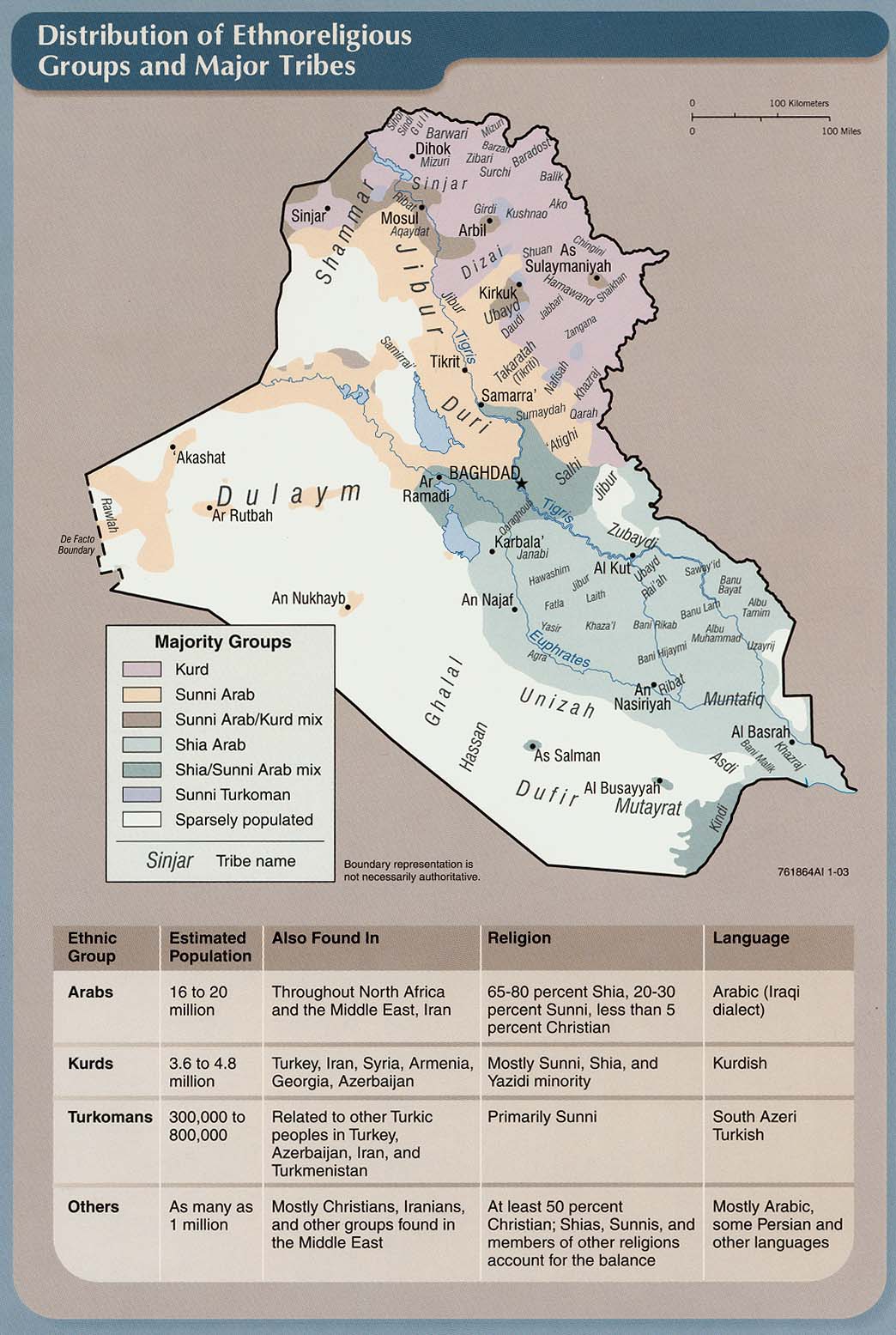
I have commented before on the vast array of ethnic identities present in Iraq: Sunni Arab, Shia Arab, predominately Sunni Kurd, Turkomen, Assyrian, Yazidi, and so forth. We have seen what can happen when a haphazard pastiche of ethnic groups are thrown together in a single state, held together by a dictator, and then that dictator leaves the scene one way or another (usually by death, let’s face it). Anyone with a shred of intellectual honesty and integrity will agree that Iraq is now in a civil war, one in which “ethnic cleansing” is once again an appropriate term to use. Iraq may still be a state appearing on a map, but it is not a nation.
There may be hope (although I feel like I am only including this final paragraph in order to not be totally depressed): another entirely new country was created after World War I, whose history and ultimate divorce was much less of a blot on history. That country was Czechoslovakia, which peacefully split into its two constituent parts in 1993, in what was called the “Velvet Divorce,” named after the country’s comparatively peaceful “Velvet Revolution” of 1989.
Iraq already looks a hell of a lot like Yugoslavia. Is there a chance for it to become more like Czechoslovakia? One can hope, but I doubt it. The ultimate breakup of Yugoslavia threatened wider conflagrations, as does the possible breakup of Iraq. Since neither country really existed as a nation to begin with, perhaps there is some sort of inevitability to it. The question then becomes whether we want or need to be in the middle of the mess.

"We are strong in ways that cannot be measured by arsenals"
One day after the day that supposedly changed everything, I read this column by Leonard Pitts of the Miami Herald that allowed me to breathe again, and gave me a sense of calm pride that We (by that I mean we Americans) could weather whatever storm was about to be unleashed. I am reposting it in its entirety (from a site where it had been reposted before) because I so desperately want to feel the way I felt the first time I read it.
By Leonard Pitts Jr.
Published Wednesday, September 12, 2001
We’ll go forward from this moment
It’s my job to have something to say. They pay me to provide words that help make sense of that which troubles the American soul. But in this moment of airless shock when hot tears sting disbelieving eyes, the only thing I can find to say, the only words that seem to fit, must be addressed to the unknown author of this suffering.You monster. You beast. You unspeakable bastard.
What lesson did you hope to teach us by your coward’s attack on our World Trade Center, our Pentagon, us? What was it you hoped we would learn? Whatever it was, please know that you failed.
Did you want us to respect your cause? You just damned your cause. Did you want to make us fear? You just steeled our resolve. Did you want to tear us apart? You just brought us together.
Let me tell you about my people. We are a vast and quarrelsome family, a family rent by racial, social, political and class division, but a family nonetheless. We’re frivolous, yes, capable of expending tremendous emotional energy on pop cultural minutiae — a singer’s revealing dress, a ball team’s misfortune, a cartoon mouse. We’re wealthy, too, spoiled by the ready availability of trinkets and material goods, and maybe because of that, we walk through life with a certain sense of blithe entitlement. We are fundamentally decent, though — peace-loving and compassionate. We struggle to know the right thing and to do it. And we are, the overwhelming majority of us, people of faith, believers in a just and loving God.
Some people — you, perhaps — think that any or all of this makes us weak. You’re mistaken. We are not weak. Indeed, we are strong in ways that cannot be measured by arsenals.
IN PAIN
Yes, we’re in pain now. We are in mourning and we are in shock. We’re still grappling with the unreality of the awful thing you did, still working to make ourselves understand that this isn’t a special effect from some Hollywood blockbuster, isn’t the plot development from a Tom Clancy novel. Both in terms of the awful scope of their ambition and the probable final death toll, your attacks are likely to go down as the worst acts of terrorism in the history of the United States and, probably, the history of the world. You’ve bloodied us as we have never been bloodied before.But there’s a gulf of difference between making us bloody and making us fall. This is the lesson Japan was taught to its bitter sorrow the last time anyone hit us this hard, the last time anyone brought us such abrupt and monumental pain. When roused, we are righteous in our outrage, terrible in our force. When provoked by this level of barbarism, we will bear any suffering, pay any cost, go to any length, in the pursuit of justice.
I tell you this without fear of contradiction. I know my people, as you, I think, do not. What I know reassures me. It also causes me to tremble with dread of the future.
In the days to come, there will be recrimination and accusation, fingers pointing to determine whose failure allowed this to happen and what can be done to prevent it from happening again. There will be heightened security, misguided talk of revoking basic freedoms. We’ll go forward from this moment sobered, chastened, sad. But determined, too. Unimaginably determined.
THE STEEL IN US
You see, the steel in us is not always readily apparent. That aspect of our character is seldom understood by people who don’t know us well. On this day, the family’s bickering is put on hold.As Americans we will weep, as Americans we will mourn, and as Americans, we will rise in defense of all that we cherish.
So I ask again: What was it you hoped to teach us? It occurs to me that maybe you just wanted us to know the depths of your hatred. If that’s the case, consider the message received. And take this message in exchange: You don’t know my people. You don’t know what we’re capable of. You don’t know what you just started.
But you’re about to learn.
Six years later, I shudder to ask what has been learned. The list of blunders committed in all our names since then is by now familiar enough to anyone who cares to hear it that it need not be repeated yet again. The opportunities missed and the goodwill squandered is too much to bear. Have we truly risen “in defense of all that we cherish”? I have seen no end to the “recrimination and accusation,” no real talk of “what can be done to prevent it from happening again.”
The “monsters,” the “beasts,” and the “unspeakable bastards” are still out there. We are still arguing over who strutted most bravely on that day, and who will fail to protect us the least.
So I ask again, what have the unspeakable bastards learned about us? What have we learned about us?
Am I now one of the cool kids?
A recent World Net Daily article bemoans “The Rise of Atheist America.”
In earlier eras, atheists were on the fringes of society, mistrusted by the mainstream. Those few who dared to publicly push their beliefs on society, like Madalyn Murray O’Hair, were widely regarded as malevolent kooks. But today, Hitchens’ No. 1 New York Times bestseller, which has dominated the nonfiction charts for months, boldly condemns religion – including Christianity – as “violent, irrational, intolerant, allied to racism, tribalism, and bigotry, invested in ignorance and hostile to free inquiry, contemptuous of women and coercive toward children.”
The article goes on to raise a number of points (I won’t quite call them interesting, or apply any adjective, for that matter), but at no point does it actually refute any of the allegations references in the above quote.
I have to agree with Skepchick’s idea to make this into a poster:

Blogging from Bergstrom
Bringing back Caesar
I’m not sure if the original article is even available anymore, but I wouldn’t link to it even if it were–discussion of it is available here and here.
By elevating popular fancy over truth, Democracy is clearly an enemy of not just truth, but duty and justice, which makes it the worst form of government. President Bush must overcome not just the situation in Iraq, but democratic government ….
That’s someone named Philip Atkinson from somewhere called “Family Security Matters” (clearly an irony-free area), arguing that Bush is hamstrung by the whims of the American electorate, and that the real problem with Iraq is that we did not kill every single person there:
If President Bush copied Julius Caesar by ordering his army to empty Iraq of Arabs and repopulate the country with Americans, he would achieve immediate results: popularity with his military; enrichment of America by converting an Arabian Iraq into an American Iraq (therefore turning it from a liability to an asset); and boost American prestige while terrifying American enemies.
Perhaps I am naive, but I do not automatically associate the extermination of an entire nation (whose people, I might add, did nothing to us) with greater morale and poluarity in the U.S. military. It gets even better:
He could then follow Caesar’s example and use his newfound popularity with the military to wield military power to become the first permanent president of America, and end the civil chaos caused by the continually squabbling Congress and the out-of-control Supreme Court.
This actually makes a military coup sound kind of quaint, almost.
I’m sure this is nothing more than another case of right-wing penis envy, given that the host website has apparently eliminated everything related to this guy. There is probably a greater chance of people like this holding actual sway in Washington than of the mythological fear of Islamists seizing power there, but still not likely. I suppose the question to ask is: Is Atkinson’s view the kind of America we want?
The revolution will have a sinus infection
I’m not big on conspiracy theories, but it seems pretty much undeniable that the extremely rich are getting extremelyer rich, while the not-extremely-rich are getting, uh, poorer. Also, the number of uninsured people is getting higher and higher, and all Dear Leader can think to say is that people can always go to an emergency room.
We are moving towards a system (if we’re not already there) where the wealthy and powerful elite get all the health care they need while the poor and wretched are forced to fend for themselves in the emergency rooms of the world.
Perhaps when Bush and his cohorts begin to relaize that the cooks and busboys are sneezing in their foie gras because they can’t get any treatment for their colds and flus, then there will be change.
Or not. Perhaps this is all predicated on the idea that the sick will not be able to revolt against the system because they need bed rest.
Full disclosure: I have a PPO plan and still entertain dreams of actually having enough money someday to benefit from the Bush tax cuts. This still pisses me off.