Some Conservatives Love America Far More as an Idea Than an Actual Country

From Fareed Zakaria:

The era of crises could end, but only when this group of conservatives makes its peace with today’s America. They are misty-eyed in their devotion to a distant republic of myth and memory yet passionate in their dislike of the messy, multiracial, quasi-capitalist democracy that has been around for half a century — a fifth of our country’s history. At some point, will they come to recognize that you cannot love America in theory and hate it in fact?

Share

You Can’t Argue With Folks Who See a Different Reality Than You

The following is an excerpt from a conversation between Washington Post reporter Jonathan Capehart and Belmont, NC resident David Jackson:

Capehart: [Y]ou — and correct me if I’m wrong, I’ve been listening to you these last few minutes — you don’t think President Obama loves this country?

Jackson: Not at all. Not one bit, not one breath that comes out of his body.

Capehart: So why would he run for president of a country that he doesn’t love?

Jackson: Because he wanted to change it.

Capehart: And change into what?

Continue reading

Share

Quick Reference Guide to the Shutdown/Debt Ceiling Deal

I haven’t written much about the government shutdown debacle of the past 2+ weeks, partly because of the Thumper Rule (“If you can’t say something nice…” Not that I ever really follow that rule.) I am still gathering my thoughts about the almost-literally-last-minute deal that seems to have kicked the can down the road a bit.

Paul Waldman at The American Prospect has a quick guide to the deal that outlines the various points and offers “an easy-to-digest set of opinions you can adopt as your own.” This should appeal to conservatives who believe that liberals are incapable of independent thought. (If that last sentence describes you, please keep reading, just in case I decide to put some erotic pictures of guns at the end of this post.) Here are his points with the conclusions. Read the whole article for his full analysis: Continue reading

Share

That Other Time the Heritage Foundation Advocated for Affordable Health Care

Khan approaching and looking at me

The inventory of Creative Commons images in a search for “Heritage Foundation” is rather small, so this is a picture of a jaguar named Khan from the Wildlife Heritage Foundation. How do you not include a picture of a Jaguar named Khan?

The Heritage Foundation, the conservative think tank that has been on the front lines of recent opposition to the Affordable Care Act (a/k/a “Obamacare”). It has not always been so opposed to aspects of the law like the individual insurance mandate, as it rather strongly supported such an idea way back in 1989. As it turns out, its support for various parts of the ACA was in evidence much more recently.

The “universal health care” that many Republicans have recently touted is formally known as the Emergency Medical Treatment and Active Labor Act (EMTALA) of 1986. In short, EMTALA states that hospitals accepting payment from federal programs, including Medicare and Medicaid, cannot deny treatment to a person due to inability to pay or insufficient insurance coverage, if that person is experiencing an acute medical emergency. The government does not directly cover the costs of care required by EMTALA, meaning that the costs either get unloaded as tax write-offs for bad debt, or they are covered by higher hospital costs charged to other patients and private insurers. EMTALA had the best of intentions, but it has had the effect of shifting the costs onto other private actors, not the public. Although the Tea Party has tried, no one has ever seriously argued in recent years that people should not have access to acute care because of a lack of ability to pay. It’s a fundamental human decency thing, at least in my opinion.

The Heritage Foundation generally agreed with these sentiments, i.e. that EMTALA had good intentions but caused many problems, as recently as 2007, and their analysis and recommendations included features now found in the Affordable Care—sorry, Obamacare that they so vehemently oppose all of a sudden. Back in July 2007, John S. O’Shea, M.D., a Health Policy Fellow at The Heritage Foundation’s Center for Health Policy Studies, wrote the following:

The Emergency Medical Treatment and Active Labor Act (EMTALA) is another example of federal legislation that hurts the very people that it was meant to protect: low-income patients in need of emergency medical services. Enacted in 1986, the law is a con­gressional response to well-publicized cases in which patients were refused immediate medical treatment based on their inability to pay. Continue reading

Share

Health Insurance is Not Being “Forced on You,” but Your Health Care Might Be Forced on the Rest of Us

By Thierry Geoffroy (Thierry Geoffroy) [CC-BY-SA-3.0 (http://creativecommons.org/licenses/by-sa/3.0)], via Wikimedia CommonsThe individual insurance mandate originated as a conservative, free-market alternative to the single-payer system, with the significant support of the Heritage Foundation, and it was one of the signature achievements of Romney’s term as MA governor. It acknowledges that health insurance should principally be an individual and family responsibility, not something employers should be required to provide en masse, and it takes into account the fact that a person who declines to obtain health insurance becomes a drain on society when they become sick or injured. Republicans, and conservatives in general, were mostly on board with it until the instant that President Obama supported it.

So please, spare us the “forced upon people” *%#@*!#. People who refuse to obtain health insurance because of liberty, if they are otherwise able to do so, ought to agree in advance to decline all health care that they do not pay for out-of-pocket. Otherwise, they are the drain on society, because many hospital emergency rooms cannot turn them away for inability to pay for services. This means that, if you are in a traumatic accident, have no health insurance, and don’t have enough cash on hand to pay for the emergency room, you agree in advance that you’re probably going to die and the taxpayers are not going to help you. You should probably wear a wristband or something so people will know that you do’t want to participate in the social contract.

Here’s the thing, though. If a person refuses to obtain insurance because they think that the individual mandate infringes upon their freedom to do…..whatever it is they think is being infringed, I would still support them receiving medical care in the emergency room regardless of their ability to pay. I would support this because I am not a monster. I just wish that those people would have the courage of their convictions and agree to risk dying rather than accept the government-mandated healthcare that is (to them) such obvious tyranny.

Photo credit: By Thierry Geoffroy (Thierry Geoffroy) [CC-BY-SA-3.0], via Wikimedia Commons.

Share

Rare Footage from a Ted Cruz-Led Republican Strategy Meeting

I found the following on YouTube, and I think it offers some useful insight into how Ted Cruz has handled the debate leading up to this week’s government shutdown.

A few relevant quotes:

I bought this pen exactly one hour before my bike was stolen! Why? What’s the significance? I DON’T KNOW!!!!!!!

And:

The mind plays tricks on you. You play tricks back! It’s like you’re unraveling a big cable-knit sweater that someone keeps knitting and knitting and knitting and knitting and knitting and knitting and knitting…

Thanks to Marley for transcription assistance.

Share

That Time the Heritage Foundation Promoted the Individual Mandate, Citing “an Implicit Contract Between Households and Society”

Stuart Butler publicity shotIf you have the means to purchase insurance for yourself, but refuse to do so because freedom, the taxpayers of the U.S. will  foot the bill to treat you for catastrophic injuries, because we are fundamentally a decent people. Don’t take my word for it, though. The Heritage Foundation said so back in 1989, when its Director of Domestic Policy Studies, Stuart M. Butler, Ph.D., promoted the idea of an individual health insurance mandate:

Many states now require passengers in automobiles to wear seatbelts for their own protection. Many others require anybody driving a car to have liability insurance. But neither the federal government nor any state requires all households to protect themselves from the potentially catastrophic costs of a serious accident or illness. Under the Heritage plan, there would be such a requirement. This mandate is based on two important principles. First, that health care protection is a responsibility of individuals, not businesses. Thus to the extent that anybody should be required to provide coverage to a family, the household mandate assumes that it is the family that carries the first responsibility. Second, it assumes that there is an implicit contract between households and society, based on the notion that health insurance is not like other forms of insurance protection. If a young man wrecks his Porsche and has not had the foresight to obtain insurance, we may commiserate but society feels no obligation to repair his car. But health care is different. If a man is struck down by a heart attack in the street, Americans will care for him whether or not he has insurance. If we find that he has spent his money on other things rather than insurance, we may be angry but we will not deny him services – even if that means more prudent citizens end up paying the tab. A mandate on individuals recognizes this implicit contract. Society does feel a moral obligation to insure that its citizens do not suffer from the unavailability of health care. But on the other hand, each household has the obligation, to the extent it is able, to avoid placing demands on society by protecting itself.

(Emphasis added.)

Here’s a PDF copy of the lecture (source), in case the HTML page goes away.

Photo credit: By Stuart Butler [CC-BY-SA-2.0], via Wikimedia Commons.

Share

Republicans Really Don’t Understand Negotiation, It Seems

greyerbaby from morguefile.com

Pictured: Republican House member (via morguefile.com)

Negotiation is the process of reaching a compromise between two or more opposing parties, each of whom has something the other wants, and who has the legal right to grant or withhold it. My experience has mostly been in litigation, where a plaintiff has a viable claim, and a defendant has the ability to offer a monetary and/or injunctive settlement. The usual purpose of a settlement in litigation is to avoid the future costs/risks of continuing to prosecute or defend the case.

If one party to a lawsuit is asserting claims or withholding evidence in bad faith, proper negotiation is impossible. In many litigation scenarios, a party who engages in such bad faith, or their counsel, may be subject to penalties. In a contract negotiation, the subsequent discovery that a party has withheld or misrepresented material information could be construed as breaching the contract, could invalidate the contract, or could justify modifying the contract on terms favorable to the other party. Our political system, apparently, does not have equivalent checks, unless voters actually go to the effort of holding their elected representatives accountable. This brings us to the current hubbub over House Republicans’ determination to get rid of the Affordable Care Act (ACA, or “Obamacare”) at all costs. Continue reading

Share

Whose Liberty?

Senator Ted Cruz’s not-quite-filibuster today has the goal (I presume) of making the nation so sick of Ted Cruz that we’ll agree to do anything—e.g. “defund Obamacare”—in exchange for his promise never to speak in public again. I have to admit, it’s the best plan Republicans have come up with so far.

Anyway, during the festivities, Sen. Mike Lee (R-UT) reportedly added this nugget of wisdom:

Whenever government acts, it does so at the expense of our own individual liberty. (Emphasis added.)

For someone who has been denied coverage due to a “pre-existing condition,” or who has not been able to access any healthcare, it seems clear that the new law will increase their liberty, by allowing them the opportunity to be healthy and not die avoidable deaths.

But I don’t think Sen. Lee is talking about those people when he talks about “our own individual liberty.” It would be nice if he would be more honest about who he actually means. Then we could ask him how much personal convenience is worth another person’s death from a pre-existing condition.

Share

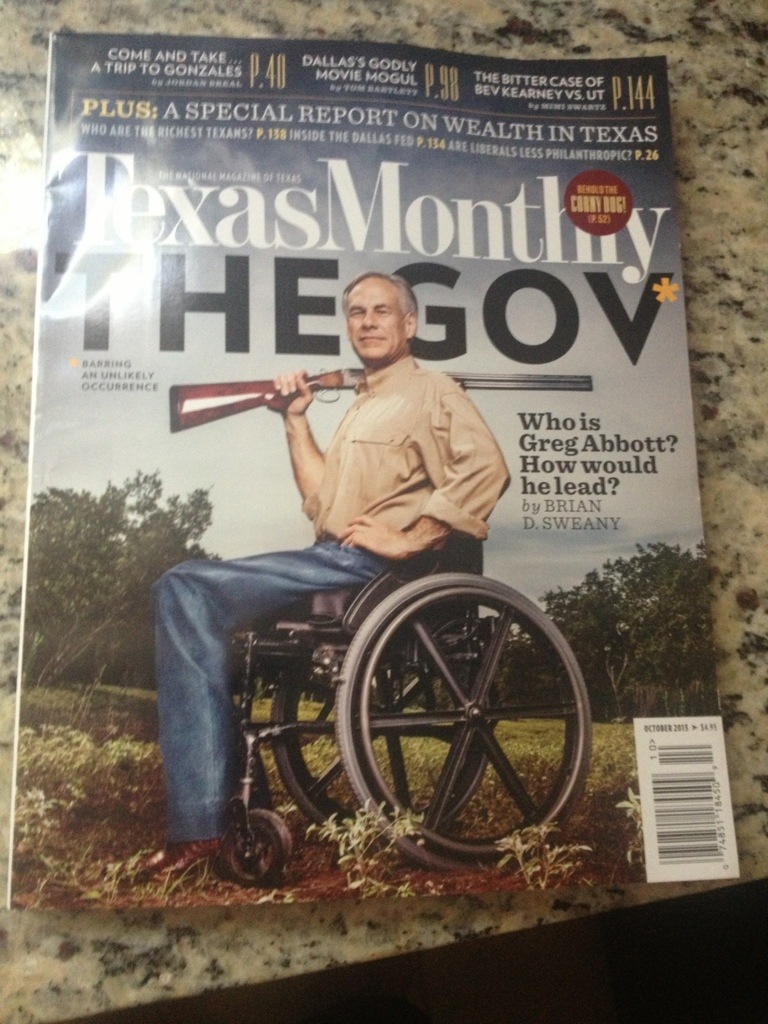
Texas Monthly is playing it safe

The latest issue of Texas Monthly arrived in the mail today:

20130923-160759.jpg

I really can’t blame the magazine for adhering to the “red state” paradigm. Progressives are generally viewed as mythical beings in Texas, except when they are making too much noise to ignore. Besides that, the editors have better things to do than sift through the petabytes of psychotic, barely-literate RWNJ screeds that would follow anything remotely nice about liberals and progressives. A Greg Abbott victory might not actually be inevitable, but an onslaught of keyboard poundings from the mouth-breathing class most certainly is.

Share