SXSW Diary, Day Three

Today began with something spooky. With no alarm clock, I woke up at exactly the same time as yesterday. Except that the “exact same time” today isn’t really the same time as yesterday, it’s one hour earlier!!! How did my un/subconscious self know???

Of course, I followed that up by trying to do some work, without coffee. I got a decent bit done, as in I’m only two days behind instead of four, but I didn’t get to the Convention Center until around 11:00 a.m. In my own warped sense of time, that’s what counts for “late.”
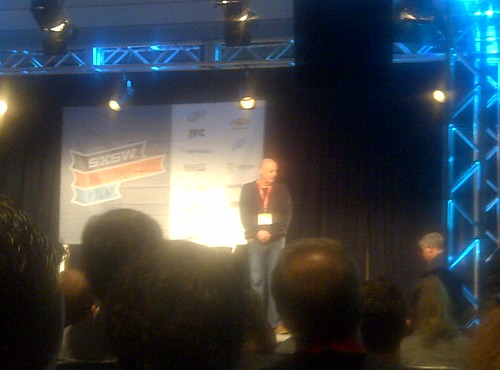
Jeffrey Tambor at SXSWiOn the plus side, it is finally sunny!!!

I had a respite because, according to the SXSW website, a panel I wanted to see at 9:30 a.m. was canceled, rescheduled, or something. At any rate, it disappeared from the schedule.

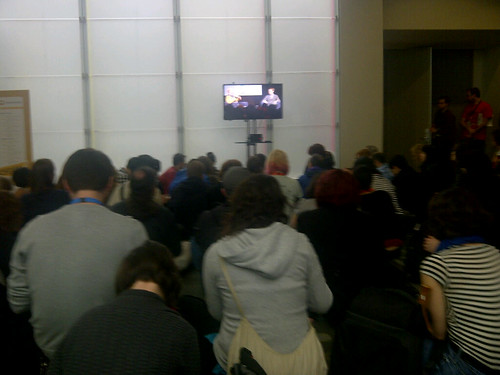
I had a hearty breakfast of coffee and two danishes from one of the many Jo’s Coffee stands scattered around the Convention Center, and made my way to the fourth floor. I was particularly excited this morning, because Jeffrey Tambor, George Bluth himself, was leading an “acting workshop” (#SXtambor on Twitter). Nothing was going to keep me from this. I really mean nothing. I sat through part of a presentation called “What is ‘Social TV’?” (#SXsocialweb on Twitter) just so I would already be in the room (the same Room 18abcd that had caused me so much grief over Joss Whedon yesterday). It was interesting, although it was a bit over my head in terms of both technological and marketing jargon.

Jeffrey Tambor

All I can really say about Jeffrey Tambor’s presentation is that it was awesome. He coached two young actors, Matt and Caitlyn, for our entertainment and edification. As an improvisermand possibly-aspiring actor, it was incredibly useful. Mr. Tambor also confirmed that they will be making an “Arrested Development” movie and ten episodes for Netflix. Life is good.

Laugh by Deborah ArgyropoulosBlogging, hanging out, art appreciation

I just hung out for a while after that. I did some writing, met a fellow starving artist, and did not make it to the Funny or Die panel.

In the afternoon, I made my way up 6th Street, bathed in sunlight and surrounded by hipsters, to an open house at GoLab Austin. I noticed a distinct but gradual shift as I walked a mere two blocks north from the hip-but-bookish vibe of the Interactive attendees to the full-on-ironic atmosphere of the early music festival arrivals on 6th Street. It foreshadows what is about to befall my city.

GoLab Austin is a coworking space and art gallery. Some good art, and we heard from Shea Little, one of the founders of E.A.S.T. (East Austin Studio Tour) and the forthcoming West Austin Studio Tour. It was a nice break from the technological themes I had been hearing for several days.

Adult entertainment

I met up with a buddy and we decided to hit one more panel at the Stephen F. Austin Hotel. This was only the second panel I had attended away from the Convention Center. On a side note, even though the panels that might be most relevant to my field are at the Sheraton, roughly ten blocks to the north of the Convention Center, I have enjoying the atmosphere and the energy of the Convention Center enough to just stay there so far.

We went to a panel called “Maintaining Sanity and Profitability in Adult” (#SaneProfit on Twitter), largely out of curiosity about how they approach their business models. (Lest you think there was anything prurient whatsoever about this panel, all four presenters were middle-aged and decidedly casual, and there were no visual aids whatsoever.)

The discussion was mostly about trends in both brick-and-mortar and online adult businesses. The owner of Austin boutique Forbidden Fruit, Lynn Raridon, talked about the advantages of a physical retail location over the internet when selling, ahem “intimacy enhancement devices” (her words: “feeling is believing”). At the same time, operating a retail S.O.B. (sexually-oriented business) has its challenges, mostly in the form on legal restrictions. A business where more than a certain percentage of its products or services are legally deemed “sexual” in nature (I think they said 30%) faces extensive zoning restrictions, pretty much limited to industrial areas.

As for the internet, file sharing and “tube” sites (like YouTube but, you know…) are screwing up the profitability of sites that offer prepared content. The growth areas, they say, that cannot be pirated, are live webcam sites and “adult dating” sites. Setting up a webcam site from scratch requires a substantial investment in both hardware and software (make a pun about that and you are dead to me), but “white label” sites offer much of the technology and ongoing support. A person can put their own name on a white label site, the company provides the software, website, etc., and revenues are split, often as much as 50/50 between the company and the performer.

They talked a bit about a Canadian company called Manwin that apparently owns a lot of these tube sites. It you are interested in the business side of such things, I Googled them and found this New York Magazine article from a few years ago.

They talked quite a bit about the stigma of having any involvement at all in the adult industry, even if it is only peripheral, like by offering technical help. Opinions differed as to whether people should downplay their involvement or wear it proudly. Sid Grief, president of AAA News, has been involved in the adult business for 37 years. He said (and I paraphrase somewhat): “Being a pornographer is like being pregnant. There’s no such thing as a little bit pregnant, so be glorious in it.” Connor Young, a webmaster and marketing consultant, said that he thinks it is okay to dabble in adult, but to be careful how much of that you let show.

Jay Kopita, VP of YNOT.com and a marketing consultant with Young, made a very interesting point about social media and marketing. As social media companies are trying to get users to basically market to each other, they are looking into people’s search histories, and psychologists and other professionals are analyzing this data to try to determine what kind of person you are. This does not refer to a value judgment so much as a marketing category. I am not as familiar with Google’s new privacy policy as I should be, but I think it might play a big part in this.

Benedict Cumberbatch filming Sherlock croppedNot going to SXSW parties

A friend told me about a PBS party downtown, featuring the cast of the BBC’s “Sherlock.” Although I know several people who would never forgive me if they knew I had the opportunity to meet, or even stand in the same room with, Benedict Cumberbatch and didn’t do it, they would never forgive me (And if they read this, now they know.) Despite his delightfully-British name and the fact that even I will admit the dude is quite handsome, I went home to watch TV with the girlfriend (having probably neglected to mention thay whole “handsome” thing.)

I did, however, find this unintentionally-funny blog post from a libertarian-leaning blogger on how last year’s PBS and NPR parties during SXSW were a waste of taxpayer dollars since the entire public was not able to go to them. To be fair, even without a badge, I heard you could get in if you waited in line. The bar isn’t big enough to hold all of America, though.

Two days of interactive fun left, so I needs my rest.

Photo credits: ‘Jeffrey Tambor at SXSWi,’ ‘Laugh by Deborah Argyropoulos’ by wondermutt, on Flickr; Benedict_Cumberbatch_filming_Sherlock.jpg: Fat Les from London, UK derivative work: RanZag (Benedict_Cumberbatch_filming_Sherlock.jpg) [CC-BY-2.0 (www.creativecommons.org/licenses/by/2.0)], via Wikimedia Commons


Share

SXSW Diary, Day Two

Today began with great anticipation and mild disappointment, with a bit of admiration of the inherent goodness of humanity thrown into the mix. Upon my arrival at the Convention Center this morning, I had hoped to attend “A Conversation with Joss Whedon” (#SXjosswhedon on Twitter), featuring the man himself. If you are unfamiliar with Joss Whedon, I first have to wonder how you even found this blog and why you’ve read this far. Joss Whedon is responsible for making “shiny” a culturally-relevant adjective. He brought us the long-running television classic (in some circles) “Buffy the Vampire Slayer” and the ahead-of-its-time science fiction western “Firefly.” He has perhaps the most devoted fan base in all of American entertainment, so I was quite excited.

Everything at SXSW involves waiting in lineBut I got there too late.

Not actually late, mind you. His talk began at 11:00 a.m., and I arrived at the Convention Center at around 10:20 a.m. I stopped to buy coffee, which might have been my big mistake. By the time I made it to the fourth floor, where he would be talking in the imposingly-titled Room 18abcd, the line snaked back around on itself. At around 10:50, a SXSW volunteer inserted himself into the line, about forty people ahead of me, and announced that everyone standing behind him wasn’t going to get in.

So, like Malcolm Reynolds at Serenity Valley (seriously, you need to watch “Firefly”), I withdrew from the line and took a seat along the wall. A volunteer then informed us that a live feed of the talk would be available at a “hearable” volume. 11:00 arrived, and something remarkable happened. The throngs of people denied the opportunity to see Joss Whedon in the flesh sat down on the floor to watch the video screen, allowing everyone there a relatively unimpeded view.

Joss Whedon

Joss Whedon speaks! (via live feed)I tweeted a bit of what was discussed. As is common with filmmaker conversations at conferences, it was mostly thoughts on film, the creative process, and maddeningly vague hints and references to current and future projects.

He mostly talked about “Cabin in the Woods,” a recent horror-esque project, with a bit of commentary on “The Avengers.” Of course, the question of when “Firefly” will be coming back was raised, to which Joss said he’s waiting for a call from a network and he is “not ruling it out.” I tweeted some of my favorite bits from his talk, which I now attempt to reproduce here:

  • “My favorite thing is going into a movie not knowing what to expect.”
  • He spoke very highly of Danny Boyle’s “Sunshine,” which is a good way to endear oneself to me.
  • Of the “Evil Dead” films, he believes part 1 is “the real classic,” because it established the various tropes of the genre. Bold words, sir.
  • He often prefers working with a lower budget. Budget restrictions, he says, make it easier for “things to feel lived in.”
  • The genre of torture porn is not really horror, because it mostly consists of people the audience hates getting killed in inventive ways for about 90 minutes. In other words, it’s not actually scary.
  • Numerous studio executives asked him if “Buffy the Vampire Slayer” was a working title. The network apparently wanted to change it to “Slayer” for years. I guess, had that happened, “Buffy” could have joined “and a Pizza Place.”
  • “I dislike revision, and I’ll tell you why. It’s more work.”
  • The first question from the audience was simply a request for a high-five. Joss gave the guy one. It was awesome.
  • Best question from the audience: “Why do the networks keep fucking with you?”
  • Joss’ answer to the best question, in brief: Networks have their own agenda and a business model to follow. Great content, by itself, will not sway them.
  • “Dollhouse” was about sex on a fundamental level (duh.) The network apparently asked him to take out the sex and replace it with shooting.

That was pretty much it. Then they quickly cleared people off of the hallway floor so that the multitudes of people coming out of the presentation room wouldn’t trample them.

Weather

Are You New to Texas?It’s cold and rainy and generally nasty. I only mention that so I have an excuse to use this Willy Wonka meme picture.

Remixes

I wandered a bit and came back to the same room (after concluding it would take too long to stand in line for coffee or food) for a talk called “Everything is a Remix, so Steal Like an Artist” (#SXREMIX on Twitter) with Austin Kleon and Kirby Ferguson. I had not heard of either of these guys before, but the subject sounded interesting, and it was.

They said that their goal for the presentation was to “demystify creativity.” Kirby says that “all artists spend their formative years doing derivative work.” After copying for some time, we create art through transformation. Edison, as but one example, didn’t invent the light bulb. He improved on it & made it commercially viable.

They outlined the three basic elements of creativity: Copy, transform, combine.

If you only “combine” things, then you are not really putting your own voice into it. Kirby compares what that process creates to Frankenstein’s monster.

In a video presentation on influences in “Star Wars,” Kirby showed the influence of Joseph Campbell, Kurosawa, “The Searchers,” World War II films, and more.

“Creativity is not magic, Kirby says. Does it ruin “Star Wars” to see how much material George Lucas “stole?” In a sense, it may not make “Star Wars” itself more interesting, but it turns the film into a film history lesson.

“Nothing is completely original” – this just means we need to redefine “original.” “Original” could mean “new & exciting” as opposed to “unprecedented.”

“Halo effect” – people want to make something wholly new, but they shouldn’t have to. This could be viewed as empowering. Don’t worry too much about being derivative, just create.

Mythical idea of the “lone genius”: Film is a collaboration requiring collaboration. Terry Gilliam calls himself a filter for the ideas. God used to get all the credit for creativity. The Romantics (Lord Byron, et al) changed it to themselves alone, & we still have that idea. The lone genius idea tends to excuse bad behavior and frequently destroys young talent. It is more important, Austin said, to be a good human being than a good artist (Kirby sort of disagreed).

Most of us have no problem with copying as long as we’re the ones doing it.

On the difference between a “remix” and a “ripoff”: Remixes acknowledge the source material. Ripoffs pretend to be original. Austin says plagiarism and forgery are two sides of the same coin.

A final quote from Austin: “Imitation is only flattery if it’s any good.”

A Blogging Interlude

I had a bit of free time, so I headed back over to the Samsung Bloggers’ Lounge, where they unfortunately did not have any free food or coffee. Still, it offered a good, albeit crowded, place to sit down and write for a little while. It’s also a good place to strike up conversations with random people. Let me throw a little SEO love to the people I met today: there was a Chicago marketing consultant (Lon Taylor), a Los Angeles online live chat service provider (Ben Congleton), and a Houston mobile technology provider (the awesomely-named Paul Steel). I also finally got to meet Jen Wojcik in person. That was awesome. I forgot to mention that yesterday I finally met The Q in person too! It’s great to actually meet the Tweeters you follow.

Story Wars

Next up was “Winning the Story Wars” (@SXstorywars on Twitter), a reading by Jonah Sachs from his forthcoming book of the same name. It was very marketing-oriented, but offered some excellent pointers for storytelling in general, I think.

He first talked about how we began telling stories through oral tradition. This eventually led to the Broadcast Era, which in turn led to the “Digitoral” Era (don’t you just love marketing neologisms?)

There was discussion of Joseph Campbell, the second time I’d heard about him today! The ingredients of myth are explanation, meaning, story, and ritual. Religion, science, & entertainment can’t offer all four at the same time, but marketing can. (At this point I was a bit skeptical, but keep reading). He gave the example of the Marlboro Man: the Marlboro Man made it okay for men to smoke filtered cigarettes, which was an issue back in the day, and then became a major cultural icon. In other words, the myth and storytelling is not always a good thing for society, but I digress.

He then talked about the model of “freaks, cheats, and familiars,” and this was pretty interesting. People, by which he meant the human race, have existed in our current biological state for at least 70,000 years. Understanding how people thought 70,000 years ago, when times were presumably less complicated, helps us understand how people think today. Back then, people lived in small tribes, and they evolved to react to unfamiliar people, viewing them as either a threat or an opportunity. “Freaks” in a story grab people’s attention and draw them in.

Next, he addressed the “problem of altruism”: people have to both compete and cooperate to survive. Stories of “cheats” uphold cultural norms, because people want to see them punished. “Cheats” could also be used in a story to defy a cultural norm we hate.

As for “familiars,” stories are told in “tribes” that the marketer can’t control, so the story is encoded in a language or setting the audience will accept. This is sort of like the “everyman” character.

Then he read a story about Robert Oppenheimer and the Trinity test, which was interesting. That’s all I have in my notes.

A Carlin Home Companion

Kelly Carlin in "A Carlin Home Companion"I stuck around in the same room because I was intrigued by the next presentation. Kelly Carlin, daughter of George Carlin, presented a one-woman show about her father, “A Carlin Home Companion” (#SXcarlin on Twitter). It was amazing. George Carlin, in my humble opinion, was and remains one of the greatest comics of our era, and he was simply a great wit and intellect to boot. She tells a deeply personal and moving story of growing up in his home, watching the course of his career, from standard “Tonight Show” comic, to countercultural icon, to drug addict, to stand-up hero, and more. It is too personal a story for me to possibly do it justice as a summary here. I’ll leave it at a paraphrase of how she ended the show, saying of her father:

He had to give up who he thought he was supposed to be to become who he was meant to be.

Photo credits: ‘Madness!’ by imtheq on instagram; ‘Everything at SXSW involves waiting in line’, ‘Joss Whedon speaks! (via live feed)’, and ‘Kelly Carlin in “A Carlin Home Companion”‘ by wondermutt, on Flickr; Willy Wonka meme obtained here.

Share

SXSW is nearly upon us! Some advice for the hipsters…

State Theater, Austin, TXFor the first time in my 12 years, 6 months, and 15 days as an Austin resident (I wasn’t counting, I just remember the date I moved in), I have purchased a badge. It’s only for the Interactive festival, but dammit, I’m going to be one of those cool kidz strutting around downtown with that icon of cool, the SXSW badge.

Let me say up front, I have no idea what I’m doing. I’ve sashayed around the fringes of the ever-growing conference for over a decade, only now jumping partway in. My effort last year to watch the free Strokes show at Auditorium Shores without actually entering the park is a good representation of my level of commitment up to this point. I have mostly come to view SXSW as an invasion. A bunch of LA/NY types who espouse styles that have not yet reached Austin (and will never matter to me) descend on my city for two weeks and turn it into a sea of tight jeans, ironic sunglasses, and (largely) unearned self-importance.

Open RoomThis year, y’all are going to have to deal with me. And I will be saying “y’all” a lot, because it’s provincial, bitches.

I think the interactive festival is a bit different. There will still be a big hipster contingent, but we’re also all nerds (or geeks). There is a meetup session for Game of Thrones fans, for crying out loud!

I spent several hours yesterday creating a schedule on the SXSW website. Just doing that made me tired. I’m boarding my dog for a whole week (in luxury, fear not) and buying a bus pass so I can avoid parking and worrying about making it home at a certain time for feeding and peeing (the dog, not me). This will be an interesting week. When it is all said and done, there will still be five days of music. And I only slept four hours last night. I am in way over my head.

The bloggings of people I know and/or read and/or grudgingly respect have been invaluable. Here are two good primers:

With no further ado, here is my unsolicited advice to those of you who will be gracing my fair city with your presence for the next few weeks. These are in no particular order.

Downtown Austin from Lady Bird Lake1. Austin is not like the rest of Texas. All the stuff you read about in the news that’s so embarrassing for all Americans, nay, humans? Aside from shenanigans at the State Capitol, that all happens elsewhere in the state. The Capitol building is actually protected by a force field that keeps the crazy contained to a roughly three-block radius while the Legislature is in session.

2. Austin is not just like the West/East Coast. So stop trying to make it that way, please.

3. We get it. You’re cool. I’d really like to see you wear that wool hat, sweater, and skintight jeans ensemble here in August, though. One great thing about this town is that we don’t take ourselves too seriously. We’re going to extend that same courtesy to you.

4. Pedestrians may have the legal right of way, but cars are still bigger than you. When you enter a crosswalk in downtown Austin at 5:00 in the afternoon, please try to remember that thousands of people work there, have no connection to SXSW, and are just trying to get home to their families in peace and without developing the nickname “Hipster Slayer.” If they have the green light, don’t try to cross in front of them.

5. If you’ve never used “Texas” phrases before in your life, do not start now. It hurts our ears. This includes “y’all,” “fixin’ to,” “might could,” and “that dog won’t hunt.”

5. Welcome to Austin. This town is fucking awesome, so enjoy it.

6. Chill the fuck out. The six hours you’re spending waiting in line for the Perez Hilton party? You could have spent that time doing things you couldn’t also do in Los Angeles. The organizers of SXSW work very, very hard to put on a kick-ass conference. The people of Austin work year-round to create a kick-ass city.

Photo credit: All photos by author.

Share

Annual Halloween Crappy Horror Movie Fest movie #3: Underworld: Rise of the Lycans

Not too much to say about this one. It fills out the story elements hinted at in the first two movies, although it is not strictly necessary to the overall story–perhaps it was just too tempting to create an Underworld trilogy. This installment only brings out Kate Beckinsale in stock footage, opting for the almost-as-hot Rhona Mitra (who was once the model for Lara Croft).

There’s basically no suspense, since viewers of the first two films know exactly what’s going to happen–the thrill is to finally see vampires and werewolves go at it with swords, arrows, and claws, rather than the oddly modern and high-tech bullets of the first movie. So basically, there are vampires and werewolves, and British women in very tight clothing. Way to be.


Interesting side note: the director, Patrick Tatopoulos, was the “creatures designer” for both The Cave and Pitch Black, making this film choice oddly evocative of my film choice of earlier today.

Share

Annual Halloween Crappy Horror Movie Fest movie #2: Gone

For my next crappy horror film I decided to try Australia’s Gone, for the main reason that it supposedly stars “Chuck‘s” Yvonne Strzechowski (who appears in one scene and has no dialogue, alas).

As if Wolf Creek didn’t teach us all what a terrifying, Chainsaw Massacre-esque place Western Australia is, Gone sets out a run-of-the-mill three-person suspense thriller, with a young hip Australian couple terrorized by Scott Mechlowicz (of EuroTrip fame, who, after this movie and Mean Creek, can probably never play a normal person again.) That’s really all I can say about this movie. Mechlowicz has fully transformed from the innocent but lovable doofus of EuroTrip to a career as a B-movie creepy guy. There’s really no suspense until the last ten minutes or so, with the buildup consisting of various predictable efforts by the villain to create distrust between the Australian couple–he is helped by the fact that the boyfriend is a spazz and the girlfriend is an idiot.

The grand ending (Spoiler alert!) is definitely one to go down in the hall of fame for Frightening Use of Chain Link. Other than that, meh.

Share

Annual Halloween Crappy Horror Movie Fest movie #1: The Cave

This movie just plain sucked, despite having Lena Heady (pre-Sarah Connor and pre-300).

Send a bunch of seasoned spelunkers and biologists into a quasi-mystical Romanian cave system, and the best they could come up with to hunt them was the deformed love child of the Alien and the things from Pitch Black?

This film had a budget of $30 million–I wonder how many cups of coffee a day that could have bought in order to save children?

Share

Mocking "conservative" movies, part 2

This is the second installment in my intermittent series poking fun at National Review Online’s list of the 25 best “conservative” movies. Mostly, I am mocking the notion that there is a single unified “conservative” ideology anymore at all. Now, then, on to #6-10 (WARNING: Spoilers abound!):

6. Groundhog Day. I actually haven’t seen this one, either (that’s two so far), but I’ve certainly heard a lot about it. It’s “conservative” cred apparently comes from its moral “that redemption and meaning are derived not from indulging your ‘authentic’ instincts and drives, but from striving to live up to external and timeless ideals.” All I can think to say is duh. If you do anything enough times (as Bill Murray’s character is forced to repeat the same day again and again ad nauseam), you’re bound to either (a) go insane or (b) discover some deeper meaning to it all. This is hardly a viewpoint upon which “conservatives” hold a monopoly.

7. The Pursuit of Happyness. Long story short, single dad sacrifices everything to provide for his young son, and becomes a fantabulously successful stockbroker in the process, all during the Reagan administration. Possibly Will Smith’s best performance ever, and it certainly does demonstrate the ostensibly “conservative” virtues of self-reliance, family values, and accumulation of wealth. I have a few bones to pick with NRO’s analysis of the film, though:

  • “[T]his film provides the perfect antidote to Wall Street and other Hollywood diatribes depicting the world of finance as filled with nothing but greed.” Perhaps you missed the scene where Will Smith’s character gets the idea to become a stockbroker from a man driving a Ferrari.
  • “They’re black, but there’s no racial undertone or subtext.” Except for the one you just created. Seriously, you already said it was a Will Smith movie, so why was this sentence necessary?
  • “Gardner [Will Smith’s character] is just an incredibly hard-working, ambitious, and smart man who wants to do better for himself and his son.” Who takes an unpaid internship based on the dream of a Ferrari and the ability to solve a Rubik’s Cube (see above YouTube link).

Those quibbles aside, this was a terrific movie. Certainly some liberties were taken with the facts, but the story ought to inspire anyone who sees it.
An amusing side note: after getting the job at Dean Witter, Gardner was then recruited to Bear Stearns.

8. Juno. Sigh. If this movie has any sort of anti-abortion message to it, it’s really just one that viewers impose onto it. Juno’s only stated reason for leaving the clinic is that it “smelled like a dentist’s office.” More importantly is the fact that Juno chose to leave the clinic after running a gauntlet of a single protester. The protester was more an object of satire in the film than anything about Juno’s decision to seek an abortion. A common problem in the whole abortion debate is that people see it as only being two-sided: you oppose abortion rights, or you think it’s all hunky-dory. I always thought “pro-choice” was a great choice of labels, because you can support the right to choose without actually liking the procedure itself. But back to the film: aside from the imposed “pro-life” meaning (and I hate that label for reasons I’ll discuss some other time), the NRO reviewer doesn’t have much nice to say about the movie: “The film has its faults, including a number of crass moments and a pregnant high-school student with an unrealistic level of self-confidence.” Actually, I thought it pretty much depicted the teenage years as a series of crass moments. Juno is not a particularly realistic individual 16 year-old, but she is a pretty good cypher for a generalized teenage mindset: torn between all the various pressures and expectations of late childhood, and trying to maintain her own sense of self throughout it all, blah blah blah…point being, there is a lot more going on here than just a “pro-life” or “conservative” message. Finally, recall that the movie ends with the baby being adopted by a single mother. Yikes!

9. Blast from the Past. If you wanted evidence that “conservatives” have no sense of irony or satire, look no further. “Brendan Fraser plays an innocent who has grown up in a fallout shelter and doesn’t know the era of Sputnik and Perry Como is over. Alicia Silverstone is a post-feminist woman who learns from him that pre-feminist women had some things going for them.” I haven’t seen the film in a good long while, but I’m trying to imagine the two actors discussing the merits of Valium-addled ’50s housewives versus Prozac-addled late-’90s career-driven mothers, etc., etc. It could be that I’m too cynical. Maybe I need a good dose of 1950’s-era idealism! Well, it’s sure a good thing I’m not a gay black communist woman–I hear the 1950’s weren’t so great for those groups. This is just the same tired old “conservative” cliche that there existed some mythical past when Everything Was Better, and modern society has somehow lost its way.

10. Ghostbusters. Really? Well, there was a very Reaganesque ethic to the movie, which I think is the sole basis for including it on this list: “[Y]ou have to like a movie in which the bad guy (William Atherton at his loathsome best) is a regulation-happy buffoon from the EPA, and the solution to a public menace comes from the private sector.” Of course, the EPA buffoon as portrayed utterly failed to follow any of his own agency’s procedures for information gathering, but that allowed Bill Murray to have a funny smackdown scene with him. The shutdown of the containment facility was a sterling depiction of Bush II-era disregard for the rule of law in the interest of national security (they had a warrant none of the Ghostbusters were allowed to see.) But seriously, my main concern with this movie’s “conservative” creds arises from two facts: (1) a god not mentioned in the Bible tries to destroy the world, and (2) salvation is left to the New York National Guard and four snarky private contractors–four smart-asses defeating ultimate evil? That’s what the movie is really about, and it’s a little too timelessly awesome to just be “conservative.”

Now for some video:

Share

I triumphantly return to blogging by mocking the idea of "conservative" movies

It’s not difficult to point out some movies that are decidedly “liberal,” at least based on the overall tone and plot of the film. A few titles come to mind such as The American President and Dave, wherein Republican politicians receive their comeuppance by Democratic politicians or a likeable everyman character. For some reason, it seems harder to label a particular film “conservative,” particularly using the present-day meanings of the words “liberal” and “conservative.” Sometimes I think “liberal” ideas just make for better drama–stories of an underdog triumphing against the odds are much more compelling than stories of the struggle to remain abstinent or to retain one’s tax cuts. I jest, somewhat, but the reason I’m even writing this is because I have been haunted for the past several days by the National Review Online’s list of the 25 best “conservative” movies (h/t Chez Pazienza at HuffPo). What, you may ask, is a “conservative” movie? Well, in this case it refers to films “that offer compelling messages about freedom, families, patriotism, traditions, and more.” With such a generic definition, this should be an entertaining list. Personally, I think it shows the utter bankruptcy of the very concept of a single “conservative” ideology in 2009 America. Cue the snark.

1. The Lives of Others. Beyond a doubt, this is one of my all-time favorite movies. Set in East Berlin in 1984, it tells the story of a Stasi spy assigned to snoop on a barely-tolerated subversive playwright, and how the spy comes to sympathize with the playwright’s ideals and freedoms over the Communist system he has devoted his life to. Thinking that communism and totalitarianism suck is hardly the sole domain of “conservatives” anymore, though, so I hereby reclaim The Lives of Others for my fellow political independents.

2. The Incredibles. Another one of my favorite movies, said to “celebrate marriage, courage, responsibility, and high achievement.” These are “conservative” values? I think someone missed the last 8 years.

3. Metropolitan. I haven’t seen it, but it apparently involves a normal guy showing up a bunch of effete New York snobs. And that’s really what conservatives are all about.

4. Forrest Gump. The title character is described as “an amiable dunce who is far too smart to embrace the lethal values of the 1960s.” I suppose that is one way of interpreting it, but I got a rather strong anti-everything-stupid vibe from the movie, not just limited to hippies. Meh.

5. 300. Seriously. 300 is considered a conservative film. Beefcake in leather speedoes being fed into a meat grinder in the name of defending a society that kills unfit individuals at birth. It is worth noting that a major cause of the eventual smackdown they receive (aside from being horrifically outnumbered) is the betrayal of one of those “unfit” individuals who was allowed to live, and man was he pissed. I suppose the lesson is that freedom isn’t free and must be defended at all costs, which is why so many College Republicans have volunteered to go to Iraq. Oh wait…

I think I’ll have to make this a series of sorts, since I’m not going through all 25 in one sitting. Besides, I like to leave my reader(s) wanting more…

Share