Winter is coming again

(SPOILERS MAY ABOUND WITHIN)

To say I am excited about “Game of Thrones” season 2 would not do justice to the concept of excitement. Even words like “stoked” don’t truly convey the feeling. Of course, the stokedness is mixed with any fans apprehension that adapting such a huge novel to a TV screen will invariably screw it up somehow, but consider this: I had misgivings about season 1 when it started, and now I don’t remember what they were. That is either because (a) I did not blog about them at the time and so therefore they were not retained in my mind, or (b) any misgivings were overshadowed by how great the show turned out to be. I prefer option (b).

Season 2 will be largely based on the second book of the series, A Clash of Kings, although I fully expect that the show’s story arc will delve into other volumes now and then, as it did in season 1. HBO has put out a couple of shorts that introduce some of the new characters and showcase the new settings.

Fans of the books might notice that they seem to be giving much more prominent roles to Margaery Tyrell and Qhorin Halfhand. I’m all for that. Qhorin is a great character, and I have always been curious about Margaery (no spoilers, but she goes through a lot of crap.) My only complaint regarding her is that they put the accent on the first syllable of the Tyrell name, which means I have been mispronouncing it for years (the same was true for both “Daenerys” and “Targaryen,” though. I’m just glad I know now.)
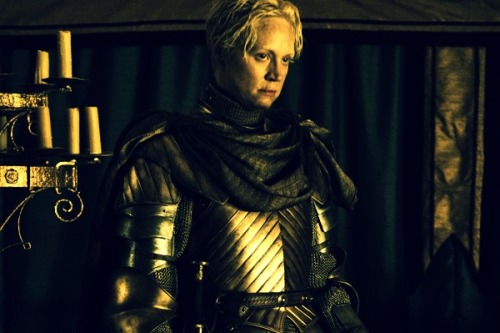
Brienne of Tarth, from dear-westeros.tumblr.com

Gwendoline Christie as Brienne of Tarth

Now then, here’s the burning question: Brienne of Tarth, where the hell is she??? She may come closest to being the moral center of this part of the story, and they don’t even see fit to introduce her? Think about it: through the first four books, she is instrumental in turning one bad character (Jaime Lannister) sort of good, and in showcasing how one good character (Catelyn Stark) has turned bad, sort of. She’s also one of the most interesting characters overall–in a universe full of people who have lost all control over their own destinies, she is one of the few who dares to try to be who she really is. It almost never works out for her, of course, but the scorn and ridicule that nearly all of Westeros puts on her just makes her that much more heroic. She deserves to be prominently featured.


Continue reading

Share

I forgot a few very obvious “Hunger Games” influences, may the Great Geek God forgive me

I am embarrassed to admit a few omissions from yesterday’s post about influences in The Hunger Games. In order to shore up my geek creds, let’s just go ahead and list them here and pretend this never happened, okay?

The SPOILER ALERT from the previous post remains in effect.

  • Running Man Theatrical Poster [Fair use claimed]“The Running Man” (movie): The 1987 Arnold Schwarzenegger movie offers a disturbingly-prescient view of today’s reality TV lineup, with the only difference, really, being that no one actively tries to kill anyone on actual reality shows today (that we know of). Arnold, as a convicted (but innocent) criminal, doesn’t have much choice but to participate in “The Running Man,” in which he must escape various celebrity “stalkers,” portrayed by real-life sports celebrities like Jesse Ventura (wrestling is sort of a sport) and Jim Brown. If he wins, he gets all manner of fabulous prizes (or does he???) Much like The Hunger Games, the game takes place in a large arena with various resources scattered about. It has a smarmy host who seems kindly but is actually a monster (Richard Dawson, soon to be channeled by Stanley Tucci). The biggest difference is likely to be in the fact that “The Running Man” is very, very ’80s.
  • “The Running Man” (novella): Where the 1987 Arnold movie errs on the side of cheesiness, the 1982 Stephen King (writing as Richard Bachman) novella is dark. Dark to the point of being downright cynical. The Ben Richards character doesn’t enter the game because someone coerces him, but because he needs money and really has no other options. Instead of a game arena, the game is played out in the real world in a dystopian future U.S., and in addition to “hunters” tracking him, anyone else can bring him in or kill him. He wins money for every hour he stays alive, and if he can survive for 30 days, he wins the grand prize of $1 billion. Much like The Hunger Games, the “Games Network” is ubiquitous in society, and there is even a mention, after televisions become required in all households, of instituting a requirement that they always be on. In a strange foreshadowing of today’s YouTube culture, Richards must make a video recording of himself every day and mail it to the Games Network. This keeps the audience updated on his doings and, of course, allows the powers that be to track him. In a final bit of foreshadowing, easily the most troubling of all, Richards brings the Games Network down, literally, by crashing an airplane into the Games Building. The novella ends with “…and it rained fire twenty blocks away.”
  • “The Long Walk:” This is another Stephen King book written as Richard Bachman and first published in 1979. It is set in a dystopian alternate United States controlled by a military dictatorship of some sort. Young men volunteer to participate in the annual “Long Walk.” The prize for the last man standing is, essentially, everything. Winners supposedly receive whatever they want, which must be tempting in what is described as a desperately poor and subjugated society. Losers “buy a ticket,” a term whose meaning is not made clear at first (I’m getting to that). The “Walk” starts at the Maine/Canada border and proceeds south for as long as it takes. Walkers must maintain a pace of four miles per hour, monitored by trained soldiers accompanying them on half-tracks. If their pace drops below that, they receive a warning. If they walk for an hour with no subsequent warning, the warning is removed. They get three warnings, and on the fourth warning they “buy their ticket.” The meaning of this becomes clear several hours into the walk when someone on his third warning gets a Charley horse and drops back. Despite his pleas, his ticket is called, and a soldier approaches him, pulls out his carbine, and shoots the man in the head. This being Stephen King, the carbine fires with sufficient power to eviscerate the man’s skull. Of course, all of this is televised. The remainder of the book is a psychological study of (a) the effect of nonstop walking under penalty of messy death, and (b) the factors that would possibly compel people to volunteer for this event.
  • “The Lottery:” A 1948 short story by Shirley Jackson, this may be the most disturbing of all, because it offers no hints at all that it is going somewhere creepy. Early on in the story, it might as well just be a standard small-town America story. Everyone is preparing for a big event, “the lottery,” held every year. The heads of the town’s families draw slips of paper from a box, and the family that draws the slip with the black spot is “chosen.” The members of that family draw slips of paper again, and the person who gets the one with the black spot wins, so to speak. The rest of the town then stones that person to death. It is fair to say that, based on the tone of the rest of the story, the reader does not see this coming.

I’m heading to the “Hunger Games” movie in a few hours. I’ll let you know how it is.

Photo credit: Running Man Theatrical Poster [Fair use claimed] via Wikipedia.

Share

A watered-down “Battle Royale” with hints of the “Handmaid’s Tale,” all wrapped up in “Twilight”

(WARNING: Might contain spoilers) It’s not really fair to compare The Hunger Games to Twilight, especially since I’ve never actually read Twilight (and, FSM willing, I never will.) I watched the first “Twilight” movie with a vaguely annoyed expression over a three- or four-day period, since I couldn’t sit through more than about thirty minutes at a time. I only mention it because of a gnawing fear that the forthcoming “Hunger Games” movie will drop the threadbare scraps of its dystopian themes of oppression and alienation and throw itself at a tween-swoon-inducing love triangle that only barely rears its sparkly head towards the end of the book.

Actually, I know that’s going to happen, because this review says so.

I actually quite enjoyed the book (I haven’t read the second or third books yet), even if I’m not the main target demographic. It was pretty derivative of quite a few things, but I like the way it took some disparate scifi elements and put them together in an innovative, if not altogether immersive, universe.

Here are a few things I liked about the book, in terms of its homage material:

  • “Battle Royale:” I’m referring to the profoundly-disturbing Japanese movie, not the Manga series. If The Hunger Games is not at least partly inspired by this, then it is a truly remarkable coincidence. The Hunger Games takes the children-fighting-to-the-death premise and improves on it by making the rationale for the event actually make sense. In “Battle Royale,” if I recall correctly, society has decided that children (defined as anyone under 20 years of age) constitute a grave threat to the safety and stability of society. As a disincentive to misbehaving, every year a ninth-grade class is selected to participate in the Battle Royale, in which they are deposited on an island and given a set period of time to fight to the death. It’s more disturbing than Hunger Games in the sense that these are classmates, who have known each other their whole lives, suddenly compelled to kill each other. Each child is fitted with an explosive collar to give them an extra incentive–if they refuse to fight, then the game master (whatever they’re called) will kill them anyway. The problem is that the premise makes no dang sense. The children are chosen at random, meaning that there is no value as a deterrent to crime or other misbehavior, because even model children could find themselves picked for the Battle. At least the Hunger Games are acknowledged to be random, as a demonstration of the Capitol’s complete dominance over society.
  • “The Handmaid’s Tale:” This is actually another one where I’ve only seen the movie (1990, starring Natasha Richardson, Robert Duvall, and Aidan Quinn), and I’m pretty sure it leaves a lot of the book’s elements out. It posits a near-future dystopian America, the Republic of Gilead, with an uber-conservative religious leadership. Women who have managed to retain their fertility are literally treated like cattle. The main parallel I can see is in the portrayal of an all-powerful state that dominates all features of life, although it occurs to me that just about everyone, from hardcore liberals to hard core libertarians, could see some relatable material here
  • A Storm of Swords: This would be Book 3 of George R.R. Martin’s “A Song of Ice and Fire” series (the one that starts with A Game of Thrones). Specifically, the effete, peacock-y people in the Capitol remind me of the people in the cities of Slavers’ Bay in Storm of Swords. Daenerys Targaryen and her entourage go there early in the book and are generally horrified by what they find. The three cities, Astapor, Yunkai, and Meereen, were once part of a great empire, but they are now in a strange state of denial about their own decline. The warriors and merchants dress ostentatiously, fashioning their hair into horns and other strange shapes and dyeing it bright colors. The warriors in particular do not make for a very effective fighting force because of their ornamentation, and they prefer to rely on their slave armies. As fans of the book know, things do not go well for the slavers. The capital of Panem rests on a fragile foundation, depending on the Districts to maintain their lives of luxury while needing to keep the Districts brutally suppressed.

Of course, there are a few things I don’t like so far:

  • Backstory: The Hunger Games does not appear to have any. At all. All we know is that something very bad happened, possibly a nuclear war and/or severe climate change, and that the oceans have risen. After some amount of time, the Capitol united all the remaining areas of North America. The Districts, which had apparently already been established, rebelled against the Capitol, but lost in a major way. The Capitol destroyed District 13 entirely, and started the Hunger Games as a reminder to the Districts that it was in charge. That’s literally all we know. It makes sense that Katniss wouldn’t know any more than that, since it would be in the Capitol’s interest to keep the District populace in the dark. The audience does not need to be that much in the dark. Try Googling a map of Panem–it’s remarkable how many different interpretations you’ll find. One person thought District 13 was in the DC area, while someone else thought it was in Quebec (apparently the Quebec theory makes the most sense, but I forget why.) At least one fan has put a remarkable amount of work into developing a map and history of Panem.
  • Economics: Matt Yglesias has a review of economic theories that make a society like Panem plausible at Slate. I did not finish reading his article because it has Book 2 & 3 spoilers, so I’ll just summarize my thoughts on the matter. The Capitol uses some very scifi technology. “Hovercraft” that either use cloaking devices or can do some sort of teleportation. Ointments that can heal second-degree burns in a matter of hours. Genetically-engineered animals with rudimentary intelligence. And so on. The Districts supply all of the raw materials used by the Capitol, it would seem, and they seem to enjoy few of these technological advances. District 12 could be part of the 1930’s or the 95th century, but it seems odd that they wouldn’t have any of the technology enjoyed elsewhere, or that they could meet the needs of the Capitol without such technology. Which leads me to my next point…
  • Geography of the Capitol: District 12 is in Appalachia. The Capitol is somewhere in the Rockies. If climate change has caused ocean levels to rise and flood low-lying areas of North America, then those areas would probably have a warmer climate than they do today. Which would be good, because it is difficult to imagine building an imperial capital city in the middle of the mountains, around 8,000 feet above sea level. Just about any city that has ruled over a large area with any degree of control (think Rome, Constantinople, Baghdad, Tenochtitlan, and so forth) had ready access to some amount of natural resources. The middle of the Rocky Mountains does not offer that, at least not in today’s ecosystem. So how did they get to be the biggest kid on the block? Perhaps their geographic isolation worked to their advantage in a nuclear war, with mountains shielding them from the worst of the fallout. Or maybe they rode out a climatic or geological upheaval by being so far away from sea level, and were then able to roam the continent, picking up the scraps. All we know for sure from the first book is that the mountains protected the Capitol from the rebellious districts. The problem is that geography is a two-way street. If it’s hard to get into an area, it might also be hard to get out.
  • Geography of the Districts: District 12 produces coal for the Capitol. District 11 handles agriculture. District 1 makes luxury goods. There is a problem with monocultures like this. Does District 11 produce good for all of Panem, or just the Capitol? Panem would need a highly sophisticated distribution system if it had to get food and other supplies from one District to all the others with little to no contact between the Districts. The mind boggles at the logistics.
  • The word “Capitol:” the book keeps referring to the capital city of Panem as the “Capitol.” One small, grammar-nerd problem with that. “Capitol” refers exclusively to a building. Anything else, i.e. a city, is referred to with “capital.” That’s been bugging me for a while.

Anyway, I’m going to see the movie on Saturday. We’ll see how it goes.

In the meantime, I can finally start reading A Dance with Dragons.

Photo credit: aimmyarrowshigh at livejournal.

Share

Admit it, this does not contribute to the game itself in any way

Sports viewers, by and large, tend to be male. Statistical support or no, that is the conventional wisdom.

Male television viewers, by and large, tend to like certain things. These things are also part of conventional wisdom, statistical support or no: violence, beer, boobs. (This is not an exhaustive list, by the way.)

So how do marketers get more people (i.e. guys) to watch the Olympics?

Violence: there’s only so much you can do to make Olympic sports more violent, and the potential cost in international relations probably outweighs any benefit to ratings.

Beer: even the most hardcore boozehound would probably agree that the middle of a mountain biking run or a swim meet is not the best time to down a few.

Boobs: Hmmmmm…tell me more……

(h/t to Ragen) Let’s face it, there is no athletic advantage to wearing skimpy outfits, unless the knowledge that lots of people are staring at your bum improves your game. As Aussie blogger Lauredhel said in preparation for the 2008 Olympics:

No. It’s not about faster, higher, stronger. Women in sports are promoted as sexualised bodies for ogling; men are promoted as performers.

She offered a side-by-side comparison of male and female athletic outfits for the Australian teams, such as:

Here are a few side-by-side comparisons of what Aussie contenders are put into

In case you can’t see the image, on the left is a male beach volleyball player in a comfortably-baggy jersey and shorts that reach at least halfway down his thighs. On the right are two female players with remarkable abs. We know this because we can see all of them, and can offer a clinic description of the muscle tone in their thighs.

Not quite a year ago, the Badminton World Federation, trying to combat the problem of no one ever watching badminton, tried to mandate that female players wear skirts. They quickly ditched that rule in the face of massive criticism. They need to either find a different way to drum up interest in the sport, or just admit that few people enjoy watching a sport with a game piece called a shuttlecock.

Now, it would not add anything to my experience of watching the Olympics to put male athletes into similarly-revealing uniforms, nor would it add anything to the actual performance of the Games themselves.

But neither would it take away from my experience of watching the Olympics (or their performance) to put female athletes into uniforms that make a bit more athletic sense. Plus, it’s not about me. There is some evidence that all this sexifying is turning girls away from getting involved in sports at all, and that’s bad in and of itself.

If I want to see beautiful ripped women in skimpy clothes in various states of sweatiness, Rule 34 dictates that it is available to me at any time on the internet. If I want to see world-class displays of athletic prowess, that only happens a few times a decade.

Consider this an example of my point and/or eye candy. Here’s Croatian high jumper Blanka Vlašić in Greece in 2009. She probably could have performed just as well with a bit more clothes on and still done a sexy dance:

All of this said, I am sure I will still watch beach volleyball this summer.

Share

Pleasepleasepleasepleaseplease may “Prometheus” be good…

The official trailer for “Prometheus” came out last week, and I must admit that I am very excited.

The initial teaser trailer, released on December 22, 2011, was like brain foreplay for fans of the original “Alien”:

The “official” trailer came out last week to the collective squee of millions:

Finally, the “international” trailer pretty much rubs the awesome in our faces:

I have to allow for the possibility that this movie will not be good, or that it even might suck. Ridley Scott might have given us the original “Alien” and “Gladiator,” but he also gave us “Robin Hood” and “Hannibal.” I’m enough of an “Alien” fan, though, that I even went public with my excitement about Aliens vs. Predator: Requiem, a film that took two incredible science fiction icons and turned them into a slightly higher-budget Jason Voorhees.

“Prometheus” has a remarkably solid cast, probably the most solid of any film in the franchise since the original. I’m not a fan of Michael Fassbender (he gets on my nerves for some reason), but I can’t deny the guy can act. I’m glad to see Noomi Rapace get a chance to reach a wider audience, especially now that most Americans picture a different actress when they think of Lisbeth Salander. I will watch anything with Idris Elba in it, just sayin’.

Of course, I am assuming that “Prometheus” actually is a prequel to the “Alien” movies. The director and producers have been extremely coy about that issue. Anyone who has seen the original “Alien” will recognize the derelict ship and the Space Jockey’s chair in the new trailers. Then again, that last Aliens vs. Predator movie seemed to want to set up the Predators as the race that piloted the derelict, although it could have been an homage. I suspect “Prometheus” will pull a reboot and ignore the AvP movies entirely (and justifiably). The project began with the idea of a prequel telling the story of the Space Jockey’s race, and that appears to be where this film is headed.

I can delve more into the “Alien” films, but for now just enjoy the anticipation of “Prometheus.”

Also, “enjoy” might not be the right word for this, but marvel that someone actually took the time to compile all the “kill scenes” from the first four films:

Spoiler alert: although I disagree with the math, they find the total score to be Aliens 53, Sigourney Weaver 17.

Share

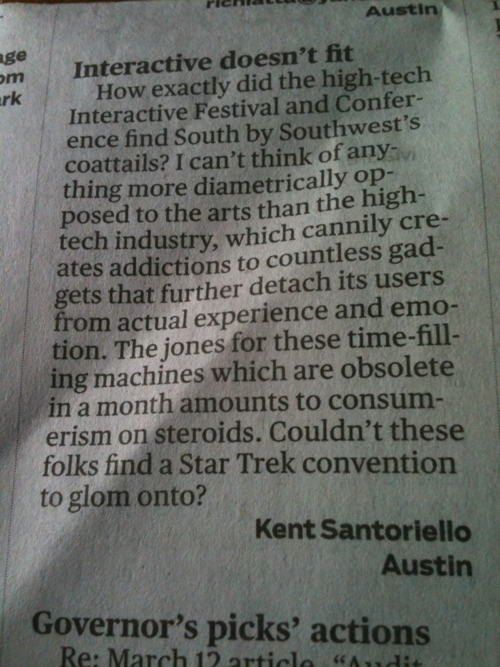
“Consumerism on steroids”

Via Addie Broyles at the Austin American Statesman, here’s an interesting take on South by Southwest Interactive:

Baffling letter to the editor

For your Sunday reading, a baffling letter to the editor in @statesman about SXSW interactive fest: “I can’t think of anything more diametrically opposed to the arts than the high-tech industry, which cannily creates addictions to countless gadgets that further detach its users from actual experience and emotion.”

(h/t Don Cruse)

I will be the first to admit that South by Southwest Interactive is a smorgasbord of first-world problems and self-important navel-gazing, but I would hardly say that it bears no relevance to “the arts” per se. Some huge percentage of all internet technology is now devoted to transmitting music and movies around, and much of the conference seems devoted to finding newer and shinier ways to do that.

People do make good connections and do quite a bit of business at SXSWi. Much of the purpose of the conference, after all, is to connect people in ways that will make them money. Having never been to a Star Trek convention, I have no idea if any business networking goes on or if any actual products get rolled out there. Maybe haters are just gonna hate.

Even if the vast bulk of what goes on at SXSWi is generally useless fluff, the same can be said for nearly every gathering of people in history. After all, it’s only five days. The Constitutional Convention needed four weeks, to use a wholly-inappropriate analogy.

Cue Sturgeon’s Law, paraphrased as “ninety percent of everything is crap.”

Share

SXSW Diary, Final Entry

It’s over. The hipsters will return to their respective coasts, and the music scene will recede to its usual level of cultural dominance. Many Austin businesses have more money in their coffers, and many Austinites probably have raging hangovers right about now. Starting tomorrow, if you want to see ironic handlebar mustaches, you’re going to have to look harder.

This has been a great opportunity for me, not only in that I got to meet amazing people and learn quite a bit, but forcing myself to write about it every day has helped jump start my creativity again.

That said, I’m tired of writing about music. I will simply recap my last day of South by Southwest 2012 by telling you who I wanted to see buy didn’t, and who I saw.

We wanted to see Nada Surf at Waterloo Records, but didn’t quite make it. “High/Low” was a recurring soundtrack to my senior year of college in 1996-97, and I’ve never seen them live. It was a time in my life when lyrics like this seemed quite deep:

Take a look at what’s been done
The killing wound is the thousandth cut
A dead turtle on the beach puts my happiness out of reach

Everyone probably remembers “Popular,” but the entire album is solid. You should check it out.

I had hoped to see Shiny Toy Guns at Auditorium Shores, but again, fatigue and an overwhelming sense of just wanting to chill out kept us home. I had learned that all of their songs I know were sung by their previous lead singer, Sisely Treasure, who left the band last year. I bet it was still a great show, I just would not have been as familiar with the material. (I tried to find a good concert video of “When Did This Storm Begin,” but the sound was terrible on everything I could find on YouTube.

We did make it to the Cult at 8:00 at Auditorium Shores. As you may know, they were big in the late ’80s, particularly with their song “She Sells Sanctuary.” That song has always stood out to me as being one of the most iconic rock songs to almost completely lack any specific hooks (unless you count Ian Astbury wailing “Hey yeah heh heh-eh-eh” over and over again.)

I won’t belabor the point that I suck as a music writer, so I’ll just say it was a great show. As my imaginary Shakespearean friend might say: Off with our socks did they fucking rock.

I even took a cell phone video of “She Sells Sanctuary” that turned out pretty well (see attached).

I thus conclude this chronicle of SXSW 2012. See many of you next year.

Share

SXSW Diary, Day Eight

My assessments of the music at South by Southwest this year have been unremittingly critical, and I figured out why. For various reasons, we have been looking for specific events with bands we know well. This is great, but the spirit of SXSW has always been discovery: wandering around downtown, or any number of other parts of Austin, to just see who’s playing. I have on occasion made some great discoveries. This year, though, we are keeping it relatively simple. I hereby commit, in front of whomever might be reading this, that next year I will take in some unknown bands and then say at least a few nice things about them.

Back to tonight: After an attempt to hear the Cult play the Waterloo Records parking lot (you really can’t hear them from across Lamar while a band is playing on the Whole Foods patio, although it creates a fascinatingly jarring stereo effect), we made our way back to Auditorium Shores for Counting Crows.

Let me first say that “August & Everything After” was my theme music for part of the mid-90’s, and Adam Duritz is one of my heroes among singers. I had high hopes for the show, and those hopes were fully realized when they played “Rain King.” Unfortunately, that was the last pre-encore song of a roughly 90-minute set. There are two terms I’m trying to remember, but Google isn’t helping:

  1. When singers who have been performing for a long time start to forget their own lyrics during concerts; and
  2. When bands with long careers end up having to mostly play songs from two or more decades ago at their concerts.

I saw R.E.M. play a show in Houston in 1995, and while they put on a phenomenal show, they clearly could not remember the lyrics to several of their most famous songs. No one really knows all the words to “It’s the End of the World as We Know It,” except hopefully the people who wrote it. When Billy Joel played in Houston around the same time, it was clear no one cared what he had released recently. We just wanted “Piano Man.”

Tonight, it felt as though we waited politely through about an hour of new material for them to play “Mr. Jones.” The musicians were incredible, but Adam Duritz was not displaying the energy that always made them such a great band. He mentioned that he had been partying all week (and that’s partly what SXSW is for), so perhaps he was just dragging a bit. Still, I sensed that they are tired of playing their old stuff. Okay, enough negativity. Here’s the song that had me so excited:

Share

SXSW Diary, Day Seven

[Cue the grumpy old man rant…]

Today was a less-than-satisfying attempt to venture into the music side of South by Southwest. The plan, hatched several days ago, was to catch the Shins’ free show at Auditorium Shores at 8:00, then head to the gutted remains of Spaghetti Warehouse at 10:00 to see Girl Talk.

A note on Girl Talk and the overall trend of making people jump through hoops in order to get to see shows. Maybe offering vague hints of a show’s location (or even very existence) is an effective way to generate buzz and get some people to wander downtown Austin and/or the internet doing whatever it takes to get to the show, but that ain’t me. Maybe I’m just grumpy and old, but I prefer to look up a show’s date and time, purchase a ticket if necessary, and go to an entrance of some sort in order to enter a venue and watch a show. That’s how most of the world works, but SXSW sometimes does it different.

But I’ll get back to that.

The worst view of the Shins has the best sound

This was the best picture I could get of the Shins from the spot where we could actually hear them, alas.

As for the Shins, they’re a pretty good band. I get them confused with the Strokes for two reasons: (1) their names are both “The ***” names beginning with “S” and (2) I am out of touch with music. The main observation I can make about the show is that the stage, set up against the backdrop of Lady Bird Lake and downtown Austin, reminded me of the Austin City Limits studio stage, except that this backdrop was real. We wandered the park in search of a good spot to both see and hear the show, eventually concluding that there was no available spot where we could do both. The best sound, in my opinion, was actually on the walkway of the 1st Street bridge, where we couldn’t see anything.

Anyway, the Girl Talk show was part of a Nike/VEVO event promoting a new doodad that Nike rolled out this week. Getting on the RSVP list involved tweeting something to VEVO and getting a password to a website. They never got back to me with the password, but then someone tweeted the password and it showed up on Facebook. The line to get into the former Spaghetti Warehouse was long–not as long as some lines I’ve seen, but pretty damn long. A volunteer told us that the venue only holds 500 people, that there were 100 VIP’s that would get in no matter what, and that over 7,000 people had RSVP’d. Another volunteer told us that if we did not receive an e-mail in response to our RSVP with the subject line “Awesomeness,” then we were not on the list.

Guess who didn’t get such an e-mail?

Where's Fulffy? by mr-tee on redbubbleSeriously, it would have been easier to get into a Where’s Fluffy? show, and they’re not even a real band.

At any rate, I didn’t really want to support Nike anyway, because of reasons.

That left us wandering downtown Austin with no wristbands and no particular idea of what else was going on, and then my phone battery died because I left the camera feature running for too long. Nothing seemed to be going on outdoors, so we went home.

I remember Thursday night of last year’s SXSW being much more active, in terms of people being out and music going on in accessible places. Last year, the Thursday of SXSW week was St. Patrick’s Day, which I’m sure had much to do with the activity. This year, it just seemed like nearly everything was behind one barrier to access or another, except for Auditorium Shores. Again, though, maybe I’m just getting older and grumpier.

Photo credit: Yeah, I took that first picture, but I don’t really want to admit it; Where’s Fulffy? by mr-tee on redbubble.

Share

SXSW Diary, Day Four

We are now more than halfway through the excitement! Part of me is sad to think it will be over soon. The entire rest of me is exhausted, and slightly annoyed at that other part for continuing to make it do stuff.

The day was foggyThe day started out cold and foggy. It abruptly turned warm and sunny mid-morning, but this was not an inspiring way to start the day.

Not that my dietary habits are of any particular interest, but I had an awesome breakfast at Kerbey Lane, followed by some aimless wandering. I have been on vacation in my own town for the past few days, but today I must return to my actual house because of some real-world obligations, alas.

Copyright trolls

The first session I attended was “The Undoing of Copyright Trolls” (#UndoTrolls on Twitter), by Robert A. Spanner of the Trial & Technology Law Group. Since this was the only explicitly legal session I’ve been to so far, I’m going to put it on my law blog.

Game of Thrones geek-out

Perhaps the most anticipated (by me) event of the whole conference was the Game of Thrones meetup in Palm Park around 11:00 a.m. For those of you who do not know what Game of Thrones is, I have to ask, like I asked the people who’d never heard of “Firefly,” what are you doing here???

Moving on, Game of Thrones is the first book of the epic fantasy series A Song of Ice and Fire by George R.R. Martin. It is also a television series on HBO, starting its second season (roughly corresponding to the second book) on April 1.

The meetup was just a chance for fans of the books/show to hang out, talk about the books or show, avoid spoilers, and so on. It was great, after several days of feeling intimidated by my lack of technical know-how and slightly overwhelmed by the sheer volume of my own aspirations as a writer, to meet some like-minded people in an area that is more geeky than nerdy. I speak geek far better than I speak nerd. I happen to have strong opinions on the fundamental difference between “geeks” and “nerds.” That’s for another post, though.

So anyway, I met some awesome folks, found inspiration, learned a few new Westeros conspiracy theories, and fun was had by all.

Robert Rodriguez at SXSWChillin’

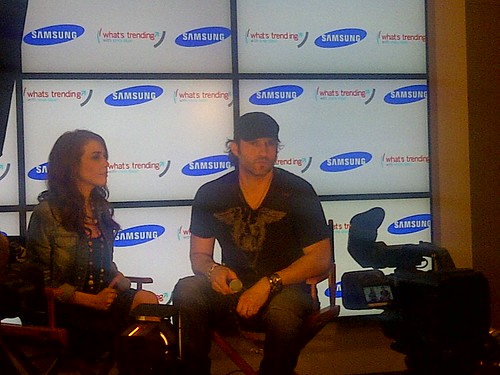
After hanging out with same Game of Thrones fan friends for an hour or so, I decided to wander again. I’m honestly a bit burned out on panels and sessions. I would rather hang out and meet interesting people. After grabbing a sandwich and charging my phone, I decided to head back to the Samsung Bloggers’ Lounge. I actually found a seat and once again met interesting writer types.

Since the whole raison d’être of this conference is to meet people, that seemed like the best use of my time. Another enticing feature of SXSW is chance celebrity sightings and surprise apearances. As I sat in the lounge writing and chatting, the person next to me excitedly noted that Robert Rodriguez was sitting on the stage. Turns out he was there for a live interview with “What’s Trending,” a web series or something. I have now achieved my obligation to see a famous person.

Actually, I’m pretty sure I saw Rob Riggle walking around Saturday, although his badge had someone else’s name on it. When I stood in line to get my badge on Friday, I stood next to someone I call not-Ben-Affleck. This is because I determined that he was not, in fact, Ben Affleck.

There was also a musician named Daria Musk who apparently built a following on Google+ and plays “hangout concerts.” She played on the stage for a little while and broadcast it (is that the word?) on Google+. I’m not entirely sold on the concept yet. It might have been the song title “+1 Me.”

On an unrelated note, I missed a panel the other day that sounded interesting, “Sex Nets: Pickup Artists vs. Feminists.” There were not as many fireworks as one might expect with those two groups thrown together, but I was more interested in hearing what people had to say. Panel participant Amanda Marcotte has a write-up of how the panel went. Worth a look.

Photo credit: ‘The day was foggy,’ ‘Robert Rodriguez at SXSW’ by wondermutt, on Flickr.

Share