It’s good to know some people have their priorities in order. I don’t know you, Alan Hanson, but I salute you.
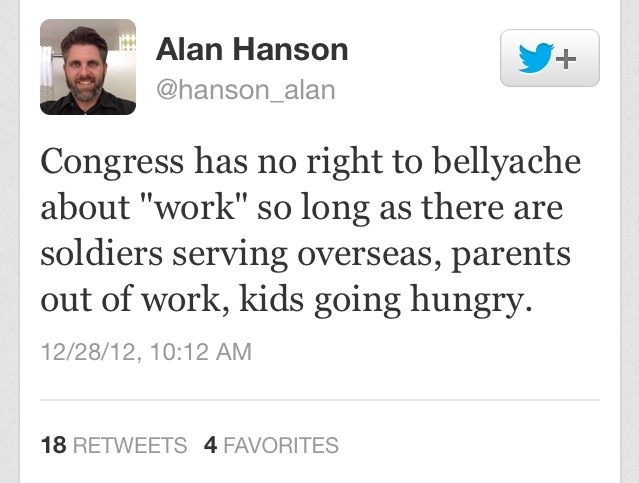


It’s good to know some people have their priorities in order. I don’t know you, Alan Hanson, but I salute you.

What would Adam Smith do???
Austin might soon ditch a three-decade-old policy of requiring downtown buildings and tenant businesses to have a minimum number of parking spaces tied either to square footage or the number of condos and apartments in a building.
Supporters of the move say the minimum requirement has caused a parking surplus downtown, encouraging people to use their cars rather than bikes, buses and rail. Take away that requirement, they say, and eventually garage parking will become a more scarce (and expensive) resource, encouraging people to use alternative transportation. [Emphasis added]
I must have missed this glut of downtown parking somehow. Admittedly, I do not spend as much of the evening hours downtown as I used to, say, ten years ago. In fact, I’m not certain of the last time I went downtown at night with the intention of doing anything other than improv or a movie.
The real question is about this “alternative transportation.” What “alternative transportation”??? Yes, we have buses, and yes, we have a nascent commuter rail system, but Austin is part of the grand western American tradition of drive-your-damn-self-everywhere.
Perhaps this is the Invisible Hand at work. If we remove the ability of consumers to park downtown, then the Invisible Hand will create a shiny, efficient transportation system to get people to and fro. I hope the mayor has an Adam Smith Signal, because we need to light that thing up!
Photo credit: © Copyright kim traynor and licensed for reuse under this Creative Commons Licence.
 Some people believe the earth is only six to nine thousand years old, while others prefer to remain (to use a phrase ironically) agnostic on the subject. Specifically, Georgia Republican Paul Broun expressed his “opinion” that the earth is only 9,000 years old. Florida Republican Marco Rubio, however, stated that the question of the earth’s age “has nothing to do with the gross domestic product or economic growth of the United States,” but that he thinks that “there are multiple theories out there on how the universe was created and I think this is a country where people should have the opportunity to teach them all.”
Can we really just live and let live on what may or may not have happened sometime between 6,000 and 4.5 billion years ago? You know, agree to disagree? Also, is this question irrelevant to our present-day economic concerns?
No, to both questions. And here is why.
One reason is scientific, and the other is political. First, the science: If the earth is only 9,000 years old, then all of observed science is wrong in ways that put everyone’s lives at imminent risk, and that also strip me of any certainty that this blog post will ever make it from my iPad to the server, and then to your computer.
Alex Knapp, writing at Forbes, explains why science is important to our modern economy:
…the age of the universe has a lot to do with how our economy is going to grow. That’s because large parts of the economy absolutely depend on scientists being right about either the age of the Universe or the laws of the Universe that allow scientists to determine its age.
For example, fiber optics:
Virtually all modern technology relies on optics in some way, shape or form. And in the science of optics, the fact that the speed of light is constant in a vacuum is taken for granted. But the speed of light must not be constant if the universe is only 9,000 years old. It must be capable of being much, much faster. That means that the fundamental physics underlying the Internet, DVDs, laser surgery, and many many more critical parts of the economy are based on bad science. The consequences of that could be drastic, given our dependence on optics for our economic growth.
In other words, if we don’t know the speed of light, then our entire fiber optics-based communications infrastructure is incorrectly calibrated. Our nuclear industry is in even bigger trouble, though:
Here’s an even more disturbing thought – scientists currently believe that the Earth is about 4.54 billion years old because radioactive substances decay at generally stable rates. Accordingly, by observing how much of a radioactive substance has decayed, scientists are able to determine how old that substance is. However, if the Earth is only 9,000 years old, then radioactive decay rates are unstable and subject to rapid acceleration under completely unknown circumstances. This poses an enormous danger to the country’s nuclear power plants, which could undergo an unanticipated meltdown at any time due to currently unpredictable circumstances. Likewise, accelerated decay could lead to the detonation of our nuclear weapons, and cause injuries and death to people undergoing radioactive treatments in hospitals. Any of these circumstances would obviously have a large economic impact.
If the Earth is really 9,000 years old, as Paul Broun believes and Rubio is willing to remain ignorant about, it becomes imperative to shut down our nuclear plants and dismantle our nuclear stockpiles now until such time as scientists are able to ascertain what circumstances exist that could cause deadly acceleration of radioactive decay and determine how to prevent it from happening.
This is not to say that the earth is 4.5 billion years old because our economy needs it to be so. This is to say that our economy, and all of the technological marvels it has produced, would not exist if the earth were significantly younger (or older), based on the observations scientists have painstakingly compiled over the course of centuries, confirmed experimentally, and harnessed for our benefit. That is, unless you think your cell phone runs on Jesus.
If Paul Broun does not immediately call for the dismantling of our entire nuclear arsenal, then he is either a fool or a liar. That brings me to the political reason this is important.
Any politician who honestly believes in something like a 6,000 to 9,000 year-old earth has disqualified themselves from taking an active role in developing science policy. They can go off and debate angels dancing on the heads of 6,000-year-old pins all they want, but unless they are willing to go to bat for the full impact of what they believe, i.e. the risk of imminent nuclear meltdown worldwide, they need to take a seat.
Any politician who doesn’t believe this, but plays along to get votes, is among the worst sort of craven liar out there, and that should disqualify them, too. I’ll give Ron Chusid (who provided the Knapp quote) the final word on that:
Politicians who are ignorant of basic science are not capable of making rational decisions on public policy in the 21st century. It is possible that Rubio might be more knowledgeable about science but feels it is necessary to deny scientific facts to maintain the support of the anti-science right wing. If this is the case, such cowardice is also not desirable from those in government.
Photo credit: ‘Earth Structure’ [ Bookmark on Delicious Digg this post Recommend on Facebook Share on Linkedin share via Reddit Share with Stumblers Tumblr it Tweet about it Subscribe to the comments on this post Print for later Bookmark in Browser Tell a friend
The Daily Show had a report the other night on “Sudden Wealth Syndrome” (SWS), a newly-minted disorder afflicting the wealthiest of the wealthy, or about “1% of the 1%,” as Jason Jones puts it:
I am a big fan of the saying attributed to T.H. Thompson and John Watson:
Be kinder than necessary,
for everyone you meet is fighting
some kind of battle.
Everyone has emotional problems. Anyone can suffer from depression, anxiety, and any number of other mental illnesses. There should be no stigma attached to it, and there should be help and support for those afflicted by it. By that, I mean everyone afflicted by it.
My first reaction is this: It is going to be very hard to get a typical paycheck-to-paycheck 47-percenter to care about the emotional malaise of a beleaguered billionaire. If a millionaire or billionaire is having difficulties coping emotionally, how the *%$#&*!@$# hard do you think it is for someone who has to work 2-3 jobs just to keep the kids fed and clothed?
That is not the best response, though. This is not a competition to see who is more beleaguered, beat-down, or grizzled. Each individual sees the world from a unique perspective, and anyone can, as I said, be struck by depression, etc. The thought that other people have it worse does very little to lift any one person’s spirits (and when you think about it, that is a very good thing.) Here is a redacted anecdote, and then I will tell you what I think the correct reaction to SWS would be. Continue reading
 I award this week’s BAMF of the Day title to Thomas Daigle of Milford, Massachusetts. Out of a desire to make his final mortgage payment on his home, where he has lived for thirty-five years, “memorable,” he made his final $620 payment in pennies. Specifically, 62,000 pennies, weighing eight hundred pounds.
Daigle always wanted to make his last payment “memorable,” he told the Milford Daily News. He and his wife Sandra moved into their current home in 1977, and from then on, he began saving just a few pennies a day. After a few years, the coins’ original container — a grape crate — began to budge, so Daigle purchased two military rocket launcher ammo boxes to hold his bounty.
I feel like I should repeat that last clause, for the sake of history.
Daigle purchased two military rocket launcher ammo boxes to hold his bounty.
Thomas Daigle: serving up sarcasm in rocket launcher ammo boxes. Do not mess with this man.
Photo credit: ‘U.S. pennies’ by Roman Oleinik (Own work) [CC-BY-SA-3.0 or GFDL], via Wikimedia Commons.
!['Hyena vs ass' by Schillings, Karl Georg, 1865-1921; Johnston, Harry Hamilton, Sir, 1858-1927 [Public domain], via Wikimedia Commons](http://crypticphilosopher.com/wp-content/uploads/2012/06/Hyena_vs_ass-300x223.png "'Hyena vs ass' by Schillings, Karl Georg, 1865-1921; Johnston, Harry Hamilton, Sir, 1858-1927 [Public domain], via Wikimedia Commons") 1. Ron Paul gets social security:
1. Ron Paul gets social security:
Rep. Ron Paul (R-Texas) may rail against Social Security insolvency in the public eye, but that hasn’t stopped him from accepting the government checks.
The libertarian-leaning Republican and former presidential candidate admitted Wednesday that he accepts Social Security checks just minutes after he called for younger generations to wean themselves off the program, in an interview on MSNBC’s “Morning Joe.”
Ayn Rand also suckled at the big evil government’s teat, so it’s only fair. Anyway, it’s for the younger generations to make the sacrifices, right?
2. The EPA might ban baptisms, according to Mike Huckabee: Continue reading
!['John, Magna Carta' By unknown, held by The Granger Collection, New York (Britannia.com) [Public domain], via Wikimedia Commons](http://commons.wikimedia.org/wiki/File:John,_Magna_Carta.jpg "'John, Magna Carta' By unknown, held by The Granger Collection, New York (Britannia.com) [Public domain], via Wikimedia Commons") As we all know, sort-of Facebook co-founder Eduardo Saverin, who now owns a bit over $3 billion in Facebook stock, renounced his U.S. citizenship from his new digs in Singapore. Whether he did this to avoid paying U.S. taxes on his windfall is a matter of dispute. I suppose it is possible that the timing was coincidental.
As we all know, sort-of Facebook co-founder Eduardo Saverin, who now owns a bit over $3 billion in Facebook stock, renounced his U.S. citizenship from his new digs in Singapore. Whether he did this to avoid paying U.S. taxes on his windfall is a matter of dispute. I suppose it is possible that the timing was coincidental.
Not everyone is buying it, though. Two senators have introduced a bill, cleverly (if awkwardly) titled the Ex-PATRIOT Act, that would build on existing immigration law that makes people who renounce their citizenship to avoid taxes inadmissible to re-enter the country. The bill would create a presumption of intent to avoid taxes if a person with a net worth above a certain amount renounces citizenship.
There may or may not be constitutional problems with that, and while I’m not thrilled with the bill itself, I’m far less thrilled with Saverin’s defenders. Americans generally enjoy the freedom to travel where they will (thank you, U.S. Supreme Court). The thing is, if you renounce your citizenship, you are no longer an American, by your own choice.
That’s what makes Bill Bonner’s piece at the Christian Science Monitor, in which he extols the basic human right to travel, so unintentionally hilarious. He thinks that we should leave Mr. Saverin alone, and he cites various important historical statements of rights to support the thesis that Mr. Saverin should be able to go where he likes. Regardless of the provisions of the Ex-PATRIOT Act, this is absurd.
He quotes the Magna Carta of 1215:
It shall be lawful to any person, for the future, to go out of our kingdom, and to return, safely and securely, by land or by water, saving his allegiance to us, unless it be in time of war, for some short space, for the common good of the kingdom: excepting prisoners and outlaws, according to the laws of the land…
Emphasis added, for reasons that I will make clear soon if you can’t figure it out for yourself. Continue reading
!['Singapore Merlion BCT' by Bjørn Christian Tørrissen [CC-BY-SA-3.0 (www.creativecommons.org/licenses/by-sa/3.0) or GFDL (www.gnu.org/copyleft/fdl.html)], via Wikimedia Commons](http://commons.wikimedia.org/wiki/File%3ASingapore_Merlion_BCT.jpg "'Singapore Merlion BCT' by Bjørn Christian Tørrissen [CC-BY-SA-3.0 (www.creativecommons.org/licenses/by-sa/3.0) or GFDL (www.gnu.org/copyleft/fdl.html)], via Wikimedia Commons") America has quite a few brilliant but lucky entrepreneurs who work within the American system to make a lot of money, then whine about having to pay to help sustain that system.
America has quite a few brilliant but lucky entrepreneurs who work within the American system to make a lot of money, then whine about having to pay to help sustain that system.
Eduardo Saverin came to the U.S. from Brazil because his parents didn’t want him to be kidnapped:
Saverin, who stands to make billions from his 4 percent share in Facebook, hastily moved here at the age of 13 when his name turned up on a list of potential kidnap victims targeted by criminal gangs in Brazil. His father was a wealthy businessman, with a high profile in their home country, and so his family relocated to Miami to protect the youngster. Eduardo thrived in his new country, eventually attending Harvard University, where he had a stroke of life-changing luck when he was assigned future Facebook CEO Mark Zuckerberg as a roommate.
After years of reaping the benefits of a society that does reasonably well at preventing kidnapping, he became a billionaire. Then he moved to Singapore. Then, standing to make billions on Facebook’s IPO, he renounced his U.S. citizenship. Continue reading
 The latest gimmick to come out of SXSW has troubled quite a few people while also offering a valuable service. A marketing company called BBH has provided several homeless people with mobile wifi hubs–I think that’s the right term, but I’m not much of a techie–so people can quickly access the internet in downtown Austin, where the sheer mass of people makes accessing the 3G network problematic.
The plan has caused pretty substantial controversy, with reporting in the New York Times and even on BBC News.
I’m of two minds on the matter. For one thing, the name of the program, “Homeless Hotspots,” seems exploitative. Actually, the whole program seems exploitative in one way or another. At the same time, it is offering an opportunity that did not otherwise exist. I think the real debate should be in how the program is managed and how revenues are distributed–payments go directly to the company via PayPal.
Alternet offered a reasonable criticism of the program:
Mark [West] told us that they found him through a homeless shelter in Austin, where he has a case manager helping him look for employment. He doesn’t have an option while he’s out providing internet to check and see how much money he’s earned, but he had cards to hand out to passersby as well with his name on them (he was writing his name on the cards with a Sharpie) so that they could find and donate to him directly.
“The weather and the holidays were kind of sketchy,” he said, “I’m very confident that I’ll have something before summer. I took this opportunity to work now.”
“It’s your company,” he stressed, “What you bring in is what you bring in. They bought the devices, they’re allowing us to use the devices to bring in our own revenue.” But as my colleague Matt Bors noted, when you actually own your own business, no one takes away your supplies after four days. You don’t work for a suggested donation. You work for a salary, for an hourly rate, when you work for a company.
BBH compared the work to the street newspapers that homeless people in many cities use to raise money, but the key difference there is that in those cases, the newspapers are written by the homeless, and contain content that has political views. In this case, Mark cannot use the service he is providing, nor are the users of his service getting his story or his political views.
Of course, this is assuming that the point of the program is to spotlight the problem of homelessness, as opposed to offering a gimmicky service. The major difference between wifi service and newspapers, in my opinion, is that newspapers exist almost solely to convey viewpoints and opinions. The “Homeless Hotspots” program is primarily about allowing people in downtown Austin to get on the internet. Whether they are somehow exploiting or mistreating the homeless people involved in the program, I suspect, is the real controversy. I’m just not convinced that this is a particularly strong argument. Putting homeless people on a sort of technological display seems preferable to a different extreme, as noted by John Cole:
How is paying someone to distribute wifi access any different than paying someone to work in your food stand at SXSW for a week? I don’t see anything unseemly or wrong about it at all- they are providing a service and making some money, and I fail to see how it is different from a vendor selling t-shirts or bottled water.
And the fact that they are using homeless people seems to be better than what normally happens any time a big conference comes to a big city, which is basically they are cleared off the streets and penned up out of sight and out of mind. Again, maybe I’m wrong, but I just don’t get what is so awful about this.
My jury is still out on this. Discuss.
Photo credit: ‘secret wifi hotspot’ by woodleywonderworks, on Flickr.
Everything you need to know about the subprime mortgage crisis, with poorly-drawn stick figures (h/t Volokh).
Those poor Norwegian villagers…