Off the Beaten Path, America!

file000854387728Mark Manson, an American living abroad, has an amazing post up on his blog entitled “10 Things Most Americans Don’t Know About America.” In the form of “tough love,” he offers some observations of how we Americans tend to view ourselves versus how the rest of the world views us. Generalizations? Hell yes there are generalizations, but that’s not the point. America is something of an echo chamber, with a majority of people purportedly unable to locate Iraq on a map, and it does us all a world of good to get some damn perspective on the rest of the world–especially since we think we’re running the place.

Read the whole thing. I’ll wait.

Now then, I want to focus on part of #10, “We Mistake Comfort For Happiness,” that defined me far better than I’d like. I have always considered myself well-traveled, having been to something like twenty-one countries. Most of those were either guided tours or study abroad programs. Some were backpacking trips where I saw lots of museums and hostels, but very little real life. I got to visit families in their homes in Belize and Russia, but even then it seemed like we were guests of honor, not experiencing everyday life. I spent a month in Spain for a study abroad program, where I lived in a dorm and spent almost all my time with the other Americans and a handful of Italians. Which brings me to why I felt a written GPOY moment.

The American public is becoming docile and complacent…When we travel, we look for giant hotels that will insulate us and pamper us rather than for legitimate cultural experiences that may challenge our perspectives or help us grow as individuals.

At the end of May 2012, we went to one of those all-inclusive resorts in Cancun, Mexico. It was sort of all-inclusive, anyway. I won the trip in a raffle last year and did not entirely know what I was getting myself into (there was a timeshare presentation component that we worked very hard to avoid). Long story short, though, we barely ever ventured away from the hotel. The same goes for our trip this past month, which, to be fair, was our honeymoon, during which time all we wanted to do was sit on a beach/by a pool and not do anything. After five days in the Turks & Caicos, I can’t really tell you anything about the place except what I learned on the internet.

Of course, going off the beaten path sometimes has the unfortunate side effect of exposing people who aren’t expecting dumbass Americans to dumbass Americans. I can’t speak for how those people actually experience that, but I for one don’t like being a dumbass. I lost count of the number of times I tried valiantly (I think, anyway) to communicate with people I encountered in Germany in actual German. I thought I did well, considering that all the German I ever learned was in one year of college classes that I almost never attended without a hangover. I guess that’s the point of this rant. Not everyone can travel the world, but we can all learn about the rest of the world, and at least make an effort to talk to them in their own language, even if we’re hung over.

Photo credit: arker from morguefile.com.

Share

All Your Nudes Are Belong to Us: Likeness Rights in the Age of Photoshop

3762597413_d820da2d19During an inadvertent foray onto TMZ’s website, I came across this bit of fun a few months ago:

DO NOT Photoshop Megan Fox’s naked face on another chick’s naked body … and then publish it online … because she will sue the crap out of you — at least that’s the threat she sent to one website this week.

Megan’s legal team fired off the cease and desist letter to a parody website called Celebrity Jihad — after the site published a shockingly good Photoshopped pic last week, depicting Megan’s face on a naked chick’s body.

I’d be curious to hear a fair use argument for the doctored photo, but copyright law does not seem to enter into the discussion here. It’s hard to know what legal arguments were raised, because all the coverage comes from mouth-breathing websites like TMZ and Perez Hilton. Anyway, the website that posted the pictures was not nearly terribly clever in its reply:

A rep for Celebrity Jihad tells TMZ … “While we appreciate Megan Fox’s concern for her image, we find it hard to believe that a woman who spent two Transformers movies bent over with her breasts pressed together could have her reputation damaged by a blatantly satirical website.”

See, Megan Fox slutted it up in two Michael Bay movies, so how could she complain about some hack website sticking her face on someone else’s naked body, amirite??? (That’s my interpretation of their argument, anyway.)

(If you want to see the picture, you’ll have to Google it yourself. I already feel bad enough for linking to TMZ, although I tagged it “nofollow.”) Continue reading

Share

See If You Live in a Bubble, According to One Guy’s Quiz

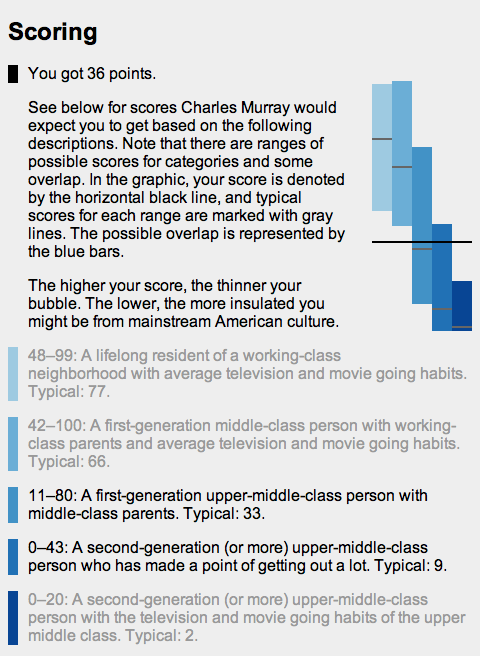
Screen Shot 2013-05-22 at 4.28.14 PMDo you live in a bubble?

I should probably explain what that means, except I don’t think I can. Here’s what some folks at PBS said:

White America is coming apart at the seams.

That’s the thesis Charles Murray, a libertarian political scientist at the American Enterprise Institute, puts forth in his new book, “Coming Apart.” In a piece soon to appear on the NewsHour, Murray argues that the super wealthy, super educated and super snobby live in so-called super-ZIPs: cloistered together, with little to no exposure to American culture at large.

Murray came up with a 25-question quiz to determine the size of your bubble. I’ve heard of Murray, but don’t know much about him. Since I tend to agree with libertarians on roughly 50% of issues (the issues involving keeping government out of the business of individual humans, as opposed to corporations that only exists because of government blah blah blah. I digress), I try to give the benefit of the doubt to those with whom I’m not familiar. Murray and I align at least somewhat on issues like marriage equality and some aspects of reproductive rights, but I’m sure there’s divergence elsewhere. His “bubble quiz” told me a lot more about what Charles Murray thinks of city folk than about any bubbles I may inhabit. (HINT: Eating at chain restaurants, identifying military rank insignia, and personally knowing at least one evangelical Christian will significantly reduce your bubblage.)

At any rate, I got a 36 out of 99, which overlaps two different bubbles. A 99, by the way, would mean the broadest exposure to American culture, while a 0 would be a Howard Hughes-esque bubble. Of the two bubbles in which my score fits, the one that seems closer to me is “A second-generation (or more) upper-middle-class person who has made a point of getting out a lot.” It was actually all the upper-middle-class evangelical Baptists I knew growing up that gave me most of my supposedly non-bubble experiences, but whatever. Take the quiz yourself and see how a 70 year-old libertarian who works for a think tank judges your life!

Share

Morality Clauses in the Modern Era

When I was practicing family law, I sometimes included “morality clauses” in the divorce decrees that I drafted. This is a clause prohibiting either parent, during their periods of possession of the child/ren, from allowing an unmarried adult who is not a family member, and with whom that parent has a romantic or dating relationship, from staying overnight.

I was never proud of including such a clause, and I hated calling it a “morality” clause. I saw situations where it was most likely necessary to protect the child/ren, though, usually where one parent had, after separation from the other parent, become a, ahem, player. The idea was to shield the child/ren from that parent’s dating life until that parent was ready to get hitched again, and the other parent usually had to accept a similar restriction. While I thought it was overkill in most cases, it seemed necessary in a few.

Here’s the thing, though: it applies to unmarried adults who are dating a parent. The morality clause is moot if the parent marries the person, so the restriction is not permanent……..provided the parent can legally marry the person they are dating.

See where this is going?

What happens if the parent is in a same-sex relationship? The courts of Texas are always ready to answer questions like that in the most restrictive and invasive way possible:

Carolyn Compton is in a three year-old relationship with a woman. According to Compton’s partner Page Price, Compton’s ex-husband rarely sees their two children and was also once charged with stalking Compton, a felony, although he eventually plead to a misdemeanor charge of criminal trespassing.

And yet, thanks to a Texas judge, Compton could lose custody of her children because she has the audacity to live with the woman she loves.

According to Price, Judge John Roach, a Republican who presides over a state trial court in McKinney, Texas, placed a so-called “morality clause” in Compton’s divorce papers. This clause forbids Compton having a person that she is not related to “by blood or marriage” at her home past 9pm when her children are present. Since Texas will not allow Compton to marry her partner, this means that she effectively cannot live with her partner so long as she retains custody over her children. Invoking the “morality clause,” Judge Roach gave Price 30 days to move out of Compton’s home.

Ah, Texas. Where it’s better for a parent to be a convicted criminal than to be gay.

Price posted about the judge’s ruling on Facebook last week, writing that the judge placed the clause in the divorce papers because he didn’t like Compton’s “lifestyle.”

“Our children are all happy and well adjusted. By his enforcement, being that we cannot marry in this state, I have been ordered to move out of my home,” Price wrote.

To be fair, much of the state has emerged from whatever mass bigotry led to the 2005 constitutional amendment banning same-sex marriage, but it hasn’t reached wide segments of the judiciary yet. State law allows district judges to make custody orders consistent with the “best interest of the child,” which is often whatever the district judge says it is, and which appellate judges view as findings of fact that they rarely question.

Few, if any, reported cases have addressed the enforceability of morality clauses. A Texas appellate court took a moment recently to dismiss a dad’s claim that a morality clause restricting him, but not his ex-wife, violated the Equal Protection Clause. Roberts v. Roberts, No. 04-11-00554-CV, opinion (Tex. App.—San Antonio, May 1, 2013).

As far as I know, the purpose of morality clauses is to protect kids from confusion if a parent starts dating after a divorce by trying to shield them from all but the most serious relationships. That this is still called “morality” reflects an origin in an earlier era. A blogger at the site Mr. Custody Coach offers a good take on the nature and effect of morality clauses today:

On the surface, the thought is about protecting the children from a revolving door of romantic partners from being introduced to the children, only to have them disappear from their lives in short order. It goes without saying that this would be detrimental to the children’s psyche, though how much and to what extent is hard to measure. However, there are far too many loopholes in even the tightest of morality clauses. Further, they simply can’t stop the children from being introduced to new significant others in a parent’s life.

There are some recent trends in child parenting agreements/orders that really should be avoided. In fact, morality clauses should be avoided, in our opinion, due to the reality that they are quite difficult to enforce and don’t afford children the “protection” that is intended.

First, the use of a parent’s sexual behavior to restrict visitation or withhold custody, even when there is no evidence that such behavior has any effect on the child. Children have close friends. Adults have close friends. It stands to reason that these friends may come in go in any of our lives. It seems counter-intuitive that a new adult “close friend” should be restricted from introduction or noticed as a part of a parent’s life. In fact, it may introduce suspicion to the children about the new person in their parent’s life without any real understanding of why it’s necessary, which can be detrimental in its own right.

Secondly, the use of restraining orders nowadays is used to introduce the family court’s opinion regarding the child’s best interests when in reality – it’s a tool to circumvent the parent’s judgments about what’s best for their child.

In each situation, the court is able to impose its view of moral behavior with the force of law. With all of the other intrusions that divorce and custody litigation affords the family court – this one is another that is an alarming trend. Further, it has been our experience that those initiating such clauses are doing so simply to control the life of their ex-partner and are even the person who violates the clauses that they are trying to impose on the other party

It is undoubtedly important to deal carefully with introducing a child to a new significant other, but the assumption of the standard morality clause is that the S/O could become a spouse. For Compton and her partner, this restriction could apply for the rest of their lives. A mostly-absentee dad seems to have gotten an assist from a regressive judge, and now the children may have to live in a single-parent household.

I hope the opponents of marriage equality are proud of themselves.

If we’re really going to talk about “morality” in a post-divorce scenario, as seen through the eyes of a conservative Republican state judge, I feel like I ought to break out the big guns:

I tell you that anyone who divorces his wife, except for sexual immorality, and marries another woman commits adultery.

Matthew 19:9 (NIV)

Just once, I’d like to see a sanctimonious parent in a post-divorce custody proceeding have that thrown in their face.

Of course, there are those who want to ban divorce entirely, forcing children to live with two miserable parents trapped in an unhappy marriage for the children’s own good because Jesus, so maybe I should keep the in-context Bible-quoting to a minimum.


Share

The Only Thing I Have to Say About Abercrombie & Fitch, feat. Dr. Seuss (UPDATED)

1822626

I could have written this post without showing headless, topless beautiful people, but where’s the fun in that? (Via hollywood.com)

I still own a few articles of clothing that I obtained at the Abercrombie & Fitch store in the Houston Galleria around 1997 or 1998. Shortly after that time period, I realized that the store no longer had anything to offer me. Around 1997, Abercrombie & Fitch was best described as a slightly fancier Eddie Bauer, a style that might still suit me to this day. One day, probably in 1999, I went into the Houston store and found myself knee- to waist-deep in douche. Not literally, of course, but the store seemed to have abruptly changed from a place that offered durable clothes that appealed to me (as evidenced by the fact that some of the clothes I got there have held on for 16+ years) to a place where beautiful people go to feel superior.

We have known for a long time that the current CEO of the company is a douchenozzle, and that he has designed a store for his fellow douchenozzles:

As far as [Mike] Jeffries is concerned, America’s unattractive, overweight or otherwise undesirable teens can shop elsewhere. “In every school there are the cool and popular kids, and then there are the not-so-cool kids,” he says. “Candidly, we go after the cool kids. We go after the attractive all-American kid with a great attitude and a lot of friends. A lot of people don’t belong [in our clothes], and they can’t belong. Are we exclusionary? Absolutely. Those companies that are in trouble are trying to target everybody: young, old, fat, skinny. But then you become totally vanilla. You don’t alienate anybody, but you don’t excite anybody, either.”

Recently, the company has been under fire for not even bothering to sell women’s XL sizes, which has brought Jeffries’ pontifications on coolness and beauty back to the fore. It has also given many of us an opportunity. More on that later.

In a heartfelt and moving piece at Huffington Post, Sara Taney Humphries writes to Jeffries: Continue reading

Share

The Bad-Ass in Cleveland

I’m out of town for a bit, and haven’t seen much in the way of news, but I just learned about the rescue of the three kidnapped women in Cleveland, and I must say that Charles Ramsey, the neighbor who reportedly discovered the three women, sounds like an epic-level bad-ass. Not only did he save the day, but he is refusing any reward money:

The man who is being hailed as a hero for rescuing the lives of three women kidnapped for a decade says that he would like any reward money to be turned over to the victims.

Charles Ramsey became an instant Internet sensation on Monday when he helped free Amanda Berry, Georgina DeJesus and Michele Knight from the house next to his where they had been trapped for around 10 years.

***

[CNN’s Anderson] Cooper noted that the FBI had offered a reward for at least two of the victims.

“I tell you what you do, give it to them,” Ramsey said. “Because if folks been following this case since last night, you been following me since last night, you know I got a job anyway.”

“Just went picked it up, paycheck,” he added, producing an envelope from his pocket. “What that address say?”

“Where are them girls living? Right next door to this paycheck. So yes, take that reward and give it to — that little girl came out the house and she was crying.”

We could probably use more people like that in the world.

Share

They Don’t Know that They Are the Villains

Jason_Collins_2012_3

Admittedly, he does look pretty fabulous in this picture

“I’m a 34-year-old NBA center. I’m black. And I’m gay.” –Jason Collins

I had never heard of Jason Collins before this week. After David Robinson retired from the Spurs, I pretty much stopped paying attention to professional basketball entirely, to the extent I ever gave it much attention. In the few days that I have had to learn about Jason Collins, though, I can say that I have tremendous respect for him. He does not have high stats, and he does not fit the concept of an NBA superstar by any stretch of the imagination. For twelve years, though, he has kept showing up. The Michael Jordans of the world (like I said, I haven’t followed the NBA for a while) could not become superstars if they didn’t have the support of players like Jason Collins. (I’m sure people who know more about basketball could dispute the specifics of this point, but that’s not what I want to talk about.)

The reason I heard about Jason Collins this week is that he is the first active male professional athlete to come out as gay. He is hardly the first professional athlete, as Martina Navratilova has more than three decades on him in this area, but it’s still kind of a big thing. Male professional sports are still rooted in traditional male gender norms, which is part of why I never much cared for them. The idea of an actively-playing athlete in the NBA still seems far-fetched, but here we are. I have no doubt there are others, as well as the NFL, Baseball, and the NHL, but whoever they are, they’re keeping it to themselves (and that’s totally their right, to be sure.) Collins wrote an eloquent, if occasionally egotistical, piece in the forthcoming issue of Sports Illustrated explaining his decision to come out.

The most you can do is stand up for what you believe in. I’m much happier since coming out to my friends and family. Being genuine and honest makes me happy. Continue reading

Share

The Original Caucasians

800px-Kezenoy-lake

Lake Kezenoyam, in Chechnya

The Boston Marathon bombings, or whatever historical name we decide to apply to the event, showed Americans at their best and their not-quite-worst. Despite the heroism and selflessness displayed by people at the event, other people, all of whom did not experience the incident directly, rushed in to cast a wide net of blame, mostly directed at Muslims. The most interesting take on this, to me, was David Sirota’s April 16 piece in Salon, “Let’s hope the Boston Marathon bomber is a white American.” The context of his piece, to me, was not so much an actual wish to implicate white, right-leaning Americans in the bombing, but rather an observation of how we deal differently with crimes committed by white people and non-white people:

[I]n the context of terrorist attacks,…white non-Islamic terrorists are typically portrayed not as representative of whole groups or ideologies, but as “lone wolf” threats to be dealt with as isolated law enforcement matters. Meanwhile, non-white or developing-world terrorism suspects are often reflexively portrayed as representative of larger conspiracies, ideologies and religions that must be dealt with as systemic threats — the kind potentially requiring everything from law enforcement action to military operations to civil liberties legislation to foreign policy shifts.

In other words, if the bomber(s) turned out to be white people, the aftermath would likely consist mostly of criminal investigations and prosecutions, rather than a nationwide panic reaction like the one that birthed the PATRIOT Act and the war in Iraq. Of course, some people are determined to read the worst possible interpretation into such a statement, and Sirota unfortunately used words that others could shape into “ghoulish race-baiting.” I do not see much point in trying to engage with those who use terms like “race-baiting,” because I doubt anything I say would have an effect (especially considering Sirota’s clarifications and further thoughts on the matter here, here, and here.).

The revelation that the bombing suspects (remember, there has been no conviction, so they remain alleged bombers) are originally from Chechnya has thrown a wrench into everyone’s reflexive discussion of race and ethnicity as it pertains to terrorism and national security. Yes, they’re Muslims, but they’re also literally Caucasian. This has led to some interesting (I use that term broadly) discussion of what exactly it means to be “white” and whether or not we can continue to profile Muslims as a group in any sort of efficient manner. It might not have stopped the invective of some on the right towards immigrants in general and the basic rights of criminal suspects, but it has at least brought a strange sort of nuance to the discussion among some. At the very least, it gives Americans an opportunity to learn something about an unfamiliar part of the world.

This raised two questions for me: (1) is being a Caucasian from the Caucasus at all the same as being Caucasian in the sense of being white? and (2) does it make even a smidgen of difference when it comes to questions of national security or anti-terrorism?

The answers, for those who want to stop reading at the end of this sentence are: (1) no, but it’s interesting and worthy of further exploration; and (2) no, but given the amount of right-wing terrorism associated with white nationalism in this country, along with anti-Muslim rhetoric, people on the right have no business acting offended all of a sudden. Continue reading

Share

So We Don’t Have Background Checks. Big Whoop.

450px-Open_Carry_of_a_9mm_Browning_Hi_Power_in_Eagle,_ColoradoI’ve been thinking about the vote in the Senate yesterday, and how a handful of red state Democrats supposedly betrayed the rest of the country, and so forth. The first thoughts that popped into my head were (1) just because a majority of Americans want something does not, by itself, make it a good idea or the right thing to do, and (2) legislation often works best as a formalizing process of a society-wide shift in attitudes. These two somewhat-contradictory ideas apply to gun regulation in the sense that, while most people seem to want background checks and other relatively modest regulations, and while the NRA can’t seem to address these issues without hyperbole and mendacity, the fact is that background check legislation, and similar laws, will be doomed to failure as long as the self-described “law-abiding” gun crowd seems predisposed to fight tooth and nail against them. I have seen no arguments against modest gun regulation that weren’t reduceable to “Regulation, registry, Nazis, oh my!” and quite frankly, I’m tired of trying to argue with people who refuse to address the issue at hand and tend to speak of everything in apocalyptic terms. As long as we tolerate people who have more respect for their guns than for their fellow citizens, none of this is ever going to get better.

The odd thing about all of this is that I’m actually pretty pro-gun rights, but I can’t stand shoddy arguments and uncompromising, extreme rhetoric. So here’s my point: Continue reading

Share

The Boston Marathon Bombings Brought Up a Lot of Thoughts, Mostly About Right-Wing Whininess

800px-Boston_marathon_mile_25_beacon_street_050418So far, after the horrors of what happened in Boston yesterday, hope and love are winning out over fear and hate, but only by the tiniest of ever-slimming margins. I so desperately want to strike a positive note today, to focus on the stories of selfless heroism, generosity, and compassion that are still coming out of this event. As Patton Oswalt brilliantly said yesterday, “when you spot violence, or bigotry, or intolerance or fear or just garden-variety misogyny, hatred or ignorance, just look it in the eye and think, ‘The good outnumber you, and we always will.'” Julie Gillis wrote that “we know there is something better than hating and hurting, something that is just as much our birthright as our breath. Love.”

We still don’t know who is responsible for the attack, whether it is a coordinated strike by a group of pathetic sociopaths or the act of a lone pathetic sociopath. This is where the negative comes in. We seem to be wired as a species, or at least as a culture, to focus on the negative or the prurient.

News of overwhelming donations of time, supplies, and blood cannot possibly compete with frenzied, breathless accusations against anyone’s favored bad guy, especially right now, when those accusations are utterly unburdened by the weight of any evidence whatsoever. And so we have the utterly predictable chorus of rants from the usual suspects about who might be responsible. Fox News claims Muslims, without a shred of evidence. Alex Jones claims a government conspiracy, or maybe the Illuminati, or maybe the radio transmitters implanted in his skull by video games. Westboro Baptist Church continues to do everything in their power to ensure that no one except protesters will attend their own funerals some day. Finally, there is the possibility that the Boston attack was the work of right-wing extremists, who most likely are white, and probably male. And that’s where the real hysteria starts. Continue reading

Share