Enjoy your week.



I am embarrassed to admit a few omissions from yesterday’s post about influences in The Hunger Games. In order to shore up my geek creds, let’s just go ahead and list them here and pretend this never happened, okay?
The SPOILER ALERT from the previous post remains in effect.
![Running Man Theatrical Poster [Fair use claimed]](http://en.wikipedia.org/wiki/File:Running_Man_Theatrical_Poster.jpg "Running Man Theatrical Poster [Fair use claimed]") “The Running Man” (movie): The 1987 Arnold Schwarzenegger movie offers a disturbingly-prescient view of today’s reality TV lineup, with the only difference, really, being that no one actively tries to kill anyone on actual reality shows today (that we know of). Arnold, as a convicted (but innocent) criminal, doesn’t have much choice but to participate in “The Running Man,” in which he must escape various celebrity “stalkers,” portrayed by real-life sports celebrities like Jesse Ventura (wrestling is sort of a sport) and Jim Brown. If he wins, he gets all manner of fabulous prizes (or does he???) Much like The Hunger Games, the game takes place in a large arena with various resources scattered about. It has a smarmy host who seems kindly but is actually a monster (Richard Dawson, soon to be channeled by Stanley Tucci). The biggest difference is likely to be in the fact that “The Running Man” is very, very ’80s.
“The Running Man” (movie): The 1987 Arnold Schwarzenegger movie offers a disturbingly-prescient view of today’s reality TV lineup, with the only difference, really, being that no one actively tries to kill anyone on actual reality shows today (that we know of). Arnold, as a convicted (but innocent) criminal, doesn’t have much choice but to participate in “The Running Man,” in which he must escape various celebrity “stalkers,” portrayed by real-life sports celebrities like Jesse Ventura (wrestling is sort of a sport) and Jim Brown. If he wins, he gets all manner of fabulous prizes (or does he???) Much like The Hunger Games, the game takes place in a large arena with various resources scattered about. It has a smarmy host who seems kindly but is actually a monster (Richard Dawson, soon to be channeled by Stanley Tucci). The biggest difference is likely to be in the fact that “The Running Man” is very, very ’80s.I’m heading to the “Hunger Games” movie in a few hours. I’ll let you know how it is.
Photo credit: Running Man Theatrical Poster [Fair use claimed] via Wikipedia.
 (WARNING: Might contain spoilers) It’s not really fair to compare The Hunger Games to Twilight, especially since I’ve never actually read Twilight (and, FSM willing, I never will.) I watched the first “Twilight” movie with a vaguely annoyed expression over a three- or four-day period, since I couldn’t sit through more than about thirty minutes at a time. I only mention it because of a gnawing fear that the forthcoming “Hunger Games” movie will drop the threadbare scraps of its dystopian themes of oppression and alienation and throw itself at a tween-swoon-inducing love triangle that only barely rears its sparkly head towards the end of the book.
Actually, I know that’s going to happen, because this review says so.
I actually quite enjoyed the book (I haven’t read the second or third books yet), even if I’m not the main target demographic. It was pretty derivative of quite a few things, but I like the way it took some disparate scifi elements and put them together in an innovative, if not altogether immersive, universe.
Here are a few things I liked about the book, in terms of its homage material:
Of course, there are a few things I don’t like so far:
Anyway, I’m going to see the movie on Saturday. We’ll see how it goes.
In the meantime, I can finally start reading A Dance with Dragons.
Photo credit: aimmyarrowshigh at livejournal.
Sports viewers, by and large, tend to be male. Statistical support or no, that is the conventional wisdom.
Male television viewers, by and large, tend to like certain things. These things are also part of conventional wisdom, statistical support or no: violence, beer, boobs. (This is not an exhaustive list, by the way.)
So how do marketers get more people (i.e. guys) to watch the Olympics?
Violence: there’s only so much you can do to make Olympic sports more violent, and the potential cost in international relations probably outweighs any benefit to ratings.
Beer: even the most hardcore boozehound would probably agree that the middle of a mountain biking run or a swim meet is not the best time to down a few.
Boobs: Hmmmmm…tell me more……
(h/t to Ragen) Let’s face it, there is no athletic advantage to wearing skimpy outfits, unless the knowledge that lots of people are staring at your bum improves your game. As Aussie blogger Lauredhel said in preparation for the 2008 Olympics:
No. It’s not about faster, higher, stronger. Women in sports are promoted as sexualised bodies for ogling; men are promoted as performers.
She offered a side-by-side comparison of male and female athletic outfits for the Australian teams, such as:

In case you can’t see the image, on the left is a male beach volleyball player in a comfortably-baggy jersey and shorts that reach at least halfway down his thighs. On the right are two female players with remarkable abs. We know this because we can see all of them, and can offer a clinic description of the muscle tone in their thighs.
Not quite a year ago, the Badminton World Federation, trying to combat the problem of no one ever watching badminton, tried to mandate that female players wear skirts. They quickly ditched that rule in the face of massive criticism. They need to either find a different way to drum up interest in the sport, or just admit that few people enjoy watching a sport with a game piece called a shuttlecock.
Now, it would not add anything to my experience of watching the Olympics to put male athletes into similarly-revealing uniforms, nor would it add anything to the actual performance of the Games themselves.
But neither would it take away from my experience of watching the Olympics (or their performance) to put female athletes into uniforms that make a bit more athletic sense. Plus, it’s not about me. There is some evidence that all this sexifying is turning girls away from getting involved in sports at all, and that’s bad in and of itself.
If I want to see beautiful ripped women in skimpy clothes in various states of sweatiness, Rule 34 dictates that it is available to me at any time on the internet. If I want to see world-class displays of athletic prowess, that only happens a few times a decade.
Consider this an example of my point and/or eye candy. Here’s Croatian high jumper Blanka Vlašić in Greece in 2009. She probably could have performed just as well with a bit more clothes on and still done a sexy dance:
All of this said, I am sure I will still watch beach volleyball this summer.

Click to embiggen
Please stop making up dumb things to attribute to Fox News. They do not need anyone’s help to sound dumb, and crap like this only makes their devotees even more devoted.
STOP. DOING. THIS. SHIT.
This is not a real screen capture from Fox News. It is a Photoshop job.
The Snopes community has already covered this. Another site has what appears to be the original screen capture–I don’t know French, so I’m kind of assuming.

All this accomplishes is giving Fox News fans an out when someone on Fox really does say some bullshit. “Well, you liberals made up that other crap, so how do we know you didn’t make this up too?”
(Cross-posted from I Can’t Believe It’s A Law Blog!)
I got some new coffee mugs. They look like this:

You, too, could have some from Creature Cups, if you think you are brave enough to stare at this in your coffee each morning…
Of course, my friend Jenn made the literary connection that I missed in my reverie of having my very own octopus cup, but at least now I know what to call it:

All hail the wondrous Coffthulu! We tremble in his shadow.
About five years ago I took the World’s Smallest Political Quiz and the results indicated that I was a left-leaning libertarian:
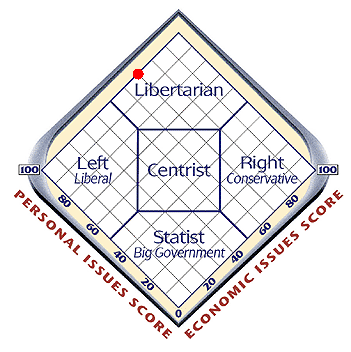
I took the test again, to see what five years have done, and, perhaps unsurprisingly, I’m all liberal and crap:

Here’s how it describes me:
Liberals usually embrace freedom of choice in personal matters, but tend to support significant government control of the economy. They generally support a government-funded “safety net” to help the disadvantaged, and advocate strict regulation of business. Liberals tend to favor environmental regulations, defend civil liberties and free expression, support government action to promote equality, and tolerate diverse lifestyles.
How did a kid from Alamo Heights grow up to be such a stinking hippie? I’m sure there are lots of reasons, but for now I just thought the shift in test results was interesting.
Of course, the test presumes to categorize you based on ten questions (five political and five economic), so its reliability is dubious. Meh.
 It’s more commonly known as the “blood pressure thingie.”
A sphygmomanometer or blood pressure meter (also referred to as a sphygmometer) is a device used to measure blood pressure, composed of an inflatable cuff to restrict blood flow, and a mercury or mechanical manometer to measure the pressure. It is always used in conjunction with a means to determine at what pressure blood flow is just starting, and at what pressure it is unimpeded. Manual sphygmomanometers are used in conjunction with a stethoscope.
The word comes from the Greeksphygmós (pulse), plus the scientific term manometer (pressure meter). The device was invented by Samuel Siegfried Karl Ritter von Basch in 1881.Scipione Riva-Rocci introduced a more easily used version in 1896. In 1901, Harvey Cushing modernized the device and popularized it within the medical community.
A sphygmomanometer consists of an inflatable cuff, a measuring unit (the mercury manometer, or aneroid gauge), and inflation bulb and valve, for manual instruments. [Citations omitted]
Here endeth the lesson. Just don’t ask me to pronounce it.
Photo credit: Sphygmomanometer&Cuff by ML5 at en.wikipedia [Public domain], from Wikimedia Commons
 I’m exaggerating, sort of. It seems the police had to intervene on Saturday in an altercation between some Ron Paul supporters (or Ronulans, as they are sometimes known) and local Republican leaders outside St. Louis:
Police and organizers shut down proceedings at one of Missouri’s largest caucuses today, as Ron Paul supporters feuded with local GOP leaders.
“It’s like the Hatfields and the McCoys around here,” St. Charles County’s former GOP chairman told ABC News, after police arrived on-scene with a helicopter and removed Paul backers.
In St. Charles, an exurb of St. Louis and one of the state’s largest GOP counties, Paul supporters sought to elect their own chairman and adopt their own rules when proceedings opened — both of which are part of standard caucus rules and procedure. But as they argued with the caucus chair, Paul supporters held video cameras — against caucus rules, according to a GOP official who was there — and things became contentious.
“It turned into a little food fight within the caucus, between the caucus chairman trying to control the caucus and certain elements, I guess with Ron Paul, trying to be heard,” said Tom Kipers, a former chairman of the St. Charles GOP, who attended the caucus at Francis Howell North High School.
An off-duty police officer, hired as security, eventually filed a trespassing complaint against the Paul supporters and notified on-duty police in the area municipality of St. Peters, who, along with police from other jurisdictions, arrested two Paul supporters and ended the caucuses early. A joint-jurisdictional police helicopter arrived on the scene. Kipers said about 10 officers arrived in total.
“Two people were arrested for trespassing after receiving numerous warnings to leave the school property,” the St. Peters police said in a press release. “Both subjects were transported to St. Peters Justice Center where they were booked for Trespassing and released on a summons.”
Seriously, how far are we from sticking the remaining candidates into Thunderdome and waiting until one man leaves?
Photo credit: Southern Chivalry – Argument versus Club [PD-US] at Wikimedia Commons.
 Several Austin City Council members want to let businesses lease parking spaces along Congress Avenue to use for sidewalk cafe space.
Austin City Council Members Chris Riley and Sheryl Cole, looking to invigorate the Congress Avenue street scene à la New York and San Francisco, say some businesses should be allowed to set up shop in city parking spaces.
Under a proposal from the pair, businesses along busy streets such as Congress Avenue would be able to lease spots from the city and use them for sidewalk cafes or retail activity. The proposal would essentially expand the city’s practice of allowing businesses to lease sidewalk space for cafes. Riley said the goal is to create more vibrant, interesting places for pedestrians and bicyclists.
I see a future in which downtown Austin is a bicycle and pedestrian utopia, and anyone wishing to frolic through its glory will have to park on the far side of Lady Bird Lake. If that day comes, you had better believe I am investing in my own pedicab.
Photo credit: 02.DCPedicab.400F.NW.WDC.12May2011 by ElvertBarnes, on Flickr.